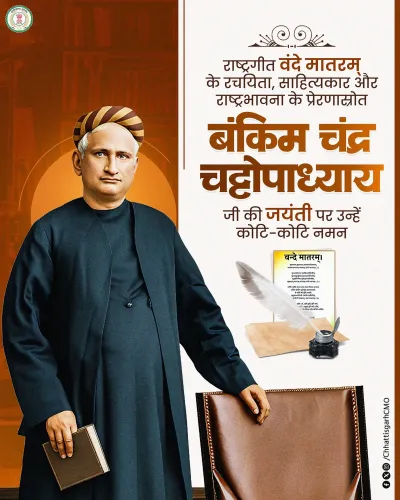
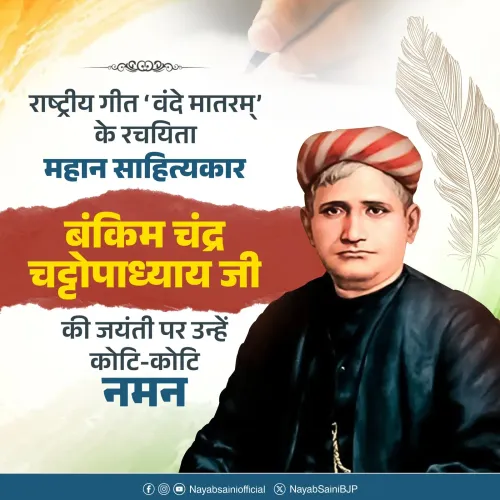
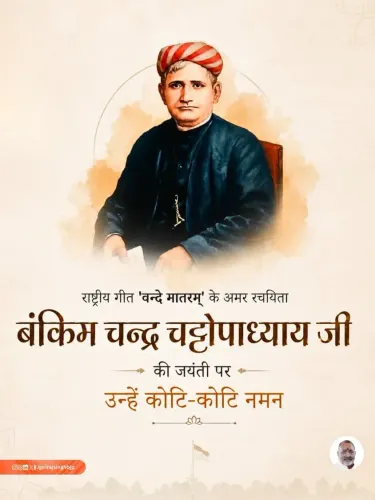
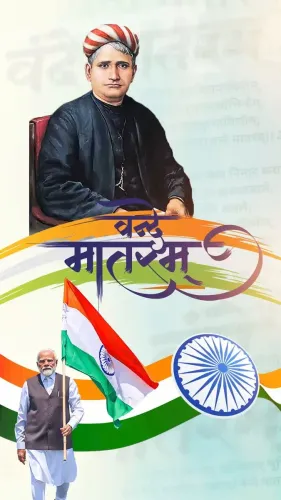
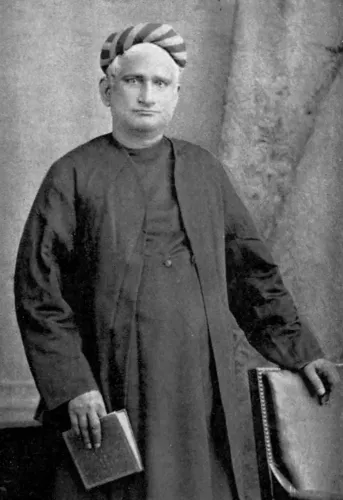
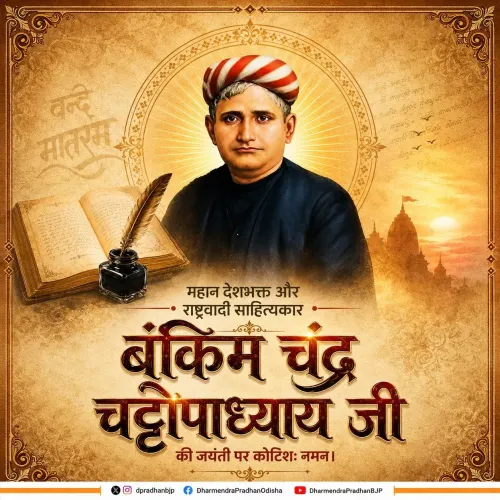
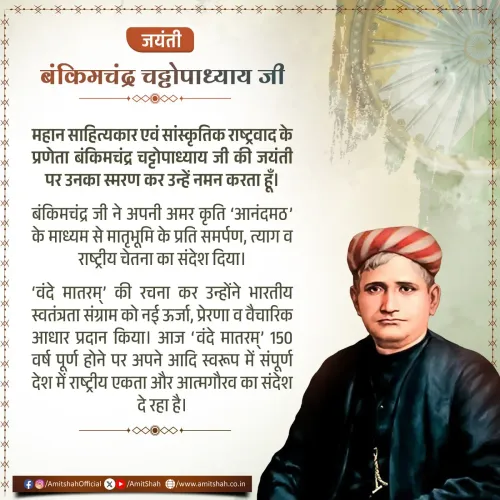
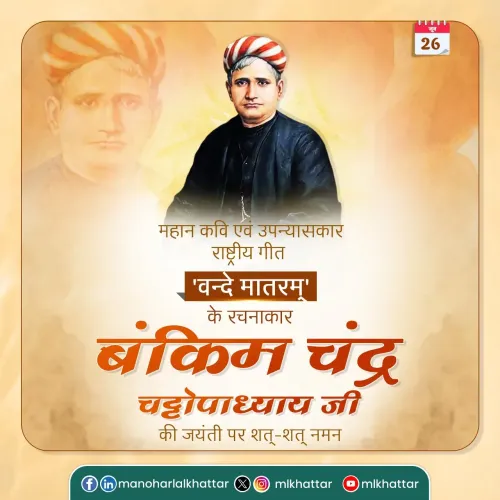
Shivraj Singh Chouhan Pays Tribute to Bankim Chandra on Birth Anniversary
Synopsis
Union Agriculture Minister Shivraj Singh Chouhan marked the birth anniversary of Bankim Chandra Chattopadhyay on 26 June 2026, paying tribute to the Bengali poet and novelist who composed 'Vande Mataram' — India's national song — and whose works are credited with kindling nationalist consciousness during the independence era.
Key Takeaways
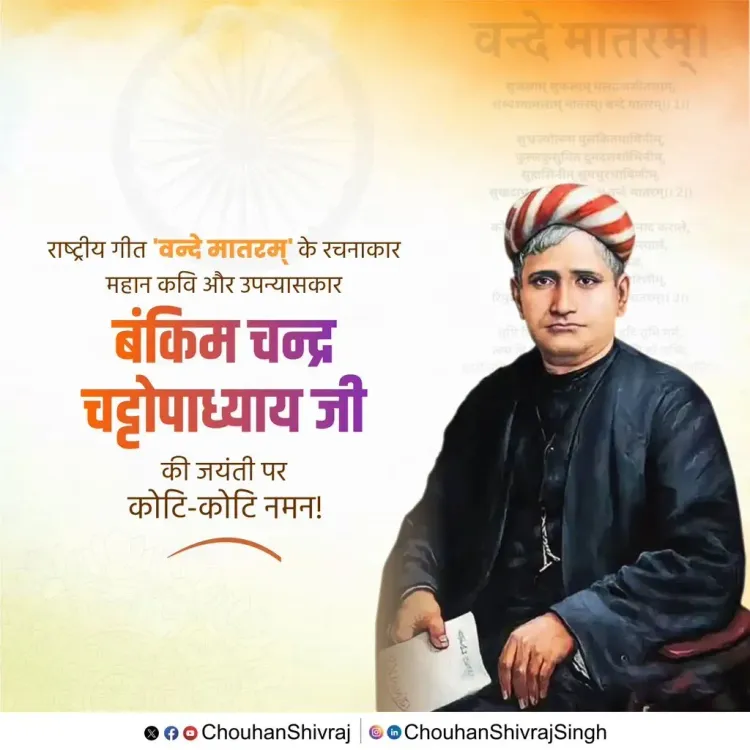
Shivraj Singh Chouhan , Union Agriculture Minister, posted a Hindi tribute to Bankim Chandra Chattopadhyay on 26 June 2026 , his birth anniversary.
Bankim Chandra Chattopadhyay ( 1838–1894 ) composed 'Vande Mataram' in his 1882 novel Anandamath , which became a defining anthem of India's independence movement.
The Constituent Assembly of India adopted 'Vande Mataram' as the national song on 24 January 1950 , alongside 'Jana Gana Mana' as the national anthem.
Chouhan described Bankim's writings as having 'awakened the spirit of nationhood' and instilled 'unwavering love for the motherland' among Indians.
The tribute reflects a recurring pattern of BJP leaders using social media to honour 19th-century literary figures associated with modern Indian nationalism.
Union Agriculture Minister Shivraj Singh Chouhan on Friday, 26 June 2026, paid homage to celebrated Bengali poet and novelist Bankim Chandra Chattopadhyay on his birth anniversary, hailing him as the immortal creator of India's national song 'Vande Mataram'.
Context
Posting in Hindi on X, Chouhan offered what he described as 'koti-koti naman' (countless salutations) to Bankim Chandra Chattopadhyay, calling him a great poet and novelist whose works awakened a sense of nationhood among Indians. He wrote that Bankim ji's compositions 'ignited the independent consciousness of patriotism in every person and filled them with the pride of national awareness,' and that they 'continue to inspire even today.' The post closed with the words 'Vande Mataram!' — the opening line of the national song Bankim himself composed.
Policy Backdrop
Bankim Chandra Chattopadhyay (1838–1894) was a pioneering Bengali-language novelist and the first deputy magistrate of British India to graduate from Presidency College, Calcutta. He composed 'Vande Mataram' as part of his landmark 1882 novel Anandamath, in which the song served as an anthem for a fictional band of ascetic freedom fighters resisting colonial rule. The song rapidly transcended its literary origins to become one of the most powerful rallying cries of India's independence movement. On 24 January 1950, the Constituent Assembly of India formally adopted 'Vande Mataram' as the national song, even as 'Jana Gana Mana' was designated the national anthem — a distinction that placed both compositions at the heart of the republic's founding cultural identity.
Stakeholders and Impact
The tribute fits a well-established pattern in which senior BJP leaders use social media to mark the birth anniversaries of 19th-century literary and cultural figures associated with the making of modern Indian nationalism. For millions of Indians, 'Vande Mataram' carries deep emotional resonance — it is sung at Independence Day and Republic Day programmes, in schools, and at public gatherings across the country. By invoking Bankim Chandra's legacy, Chouhan aligns the ruling party's cultural messaging with a broadly shared national sentiment that cuts across regional and linguistic lines.
What's Next
Commemorative tributes to Bankim Chandra Chattopadhyay are expected to recur annually on 26 June from leaders across political parties, and his legacy is likely to feature prominently at official Independence Day programmes in August, where 'Vande Mataram' is traditionally performed. The broader cultural-nationalist discourse that such tributes reinforce is expected to remain a consistent thread in government communication as India approaches significant national anniversaries.
Point of View
Senior BJP leaders consistently seek to draw an unbroken line between the independence-era nationalist imagination and the party's present-day governance narrative. The pattern is significant: such commemorations are rarely confined to the culture ministry but are issued by ministers across portfolios, signalling a whole-of-government approach to cultural messaging. Over time, these tributes collectively construct a public memory in which the BJP is seen as the natural political heir to India's pre-independence intellectual and literary awakening.
NationPress
26 Jun 2026
Frequently Asked Questions
Who was Bankim Chandra Chattopadhyay?
Bankim Chandra Chattopadhyay ( 1838–1894 ) was a pioneering Bengali novelist and poet, best known as the composer of 'Vande Mataram,' which he published in his 1882 novel Anandamath . The song became a rallying cry during India's independence movement and was later adopted as India's national song.
What is the difference between India's national anthem and national song?
India's national anthem is 'Jana Gana Mana,' composed by Rabindranath Tagore , while the national song is 'Vande Mataram,' composed by Bankim Chandra Chattopadhyay . Both were adopted by the Constituent Assembly of India on 24 January 1950 , with equal honour accorded to each.
When is Bankim Chandra Chattopadhyay's birth anniversary?
Bankim Chandra Chattopadhyay was born on 26 June 1838 , and his birth anniversary is observed on 26 June each year. Leaders across political parties typically pay tribute to him on this date.
What did Shivraj Singh Chouhan say about Bankim Chandra?
Shivraj Singh Chouhan said that Bankim Chandra's writings 'awakened the spirit of nationhood' and 'instilled unwavering love for the motherland' among Indians, adding that his compositions 'continue to inspire even today.' He closed his post with the words 'Vande Mataram!'
What is Anandamath and why is it significant?
Anandamath is an 1882 Bengali novel by Bankim Chandra Chattopadhyay set against the backdrop of the Sannyasi Rebellion of the late 18th century. It is significant because it contains the song 'Vande Mataram,' which became one of the most powerful anthems of India's freedom struggle.