Space Infrastructure for National Security: IAF Astronaut Shukla's Major Call
Synopsis
IAF Group Captain Shubhanshu Shukla has called for robust space infrastructure to secure India's national defence, citing satellite communication as the backbone of operations like Operation Sindoor. He also warned that Gaganyaan's human spaceflight mission is far more complex than satellite launches, with timelines dependent on upcoming test mission outcomes.
Key Takeaways
Group Captain Shubhanshu Shukla on April 25 called for building robust sovereign space infrastructure for India's national security .
Shukla confirmed that indigenous satellite communication was the operational backbone behind India's surgical strikes, including Operation Sindoor .
The SBS-3 strategic satellite programme was cited as a key initiative moving India toward space self-sufficiency in defence.
Shukla declined to give a specific timeline for the Gaganyaan crewed mission , stating confidence can only be established after a successful test mission.
Group Captain Prasanth Balakrishnan Nair confirmed astronauts recently completed prototype training in Leh and are conducting design reviews of the Gaganyaan capsule at ISRO .
Shukla emphasized that human spaceflight is significantly more complex than satellite missions due to the life-preservation technologies required.
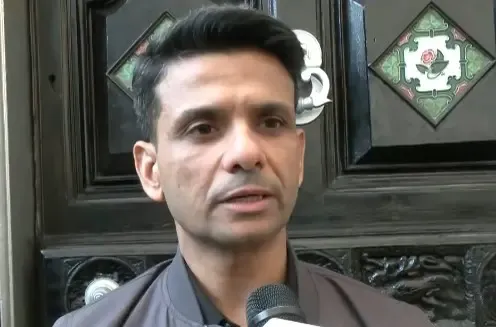
New Delhi, April 25 (NationPress) — Indian Air Force (IAF) Group Captain and astronaut Shubhanshu Shukla on Friday, April 25, made a strong case for building dedicated space infrastructure for national security, asserting that India's satellite-based communication backbone must be significantly strengthened. Speaking in the context of recent military operations, he also highlighted that human space missions like ISRO's Gaganyaan are far more complex than conventional satellite missions and require considerably more time to execute safely.
Shukla's Call for Sovereign Space Infrastructure
Group Captain Shukla acknowledged that indigenous satellite-based communication has played a pivotal role in enabling India to successfully execute precision military operations, including surgical strikes like Operation Sindoor. He described this satellite network as the "backbone" of India's strategic defence posture.
"Yes, it is the backbone which we have to make stronger. We need to create a space infrastructure for national security. Our backbone should be strong," Shukla said in an interview.
He further pointed to ongoing government initiatives, specifically referencing the SBS-3 satellite programme, which he said is already working in this direction. "I think very soon, our sovereign infrastructure for these things will be very strong and self-sufficient from the perspective of national security," he added, underlining India's push toward strategic autonomy in space.
Why Space Infrastructure Matters for India's Defence
India's growing reliance on space-based assets for military operations is not new, but Shukla's remarks come at a particularly significant moment. Operation Sindoor — India's cross-border precision strike operation — demonstrated in real time how satellite communication, surveillance, and navigation form the invisible backbone of modern warfare.
Notably, India's Defence Space Agency (DSA), established in 2019, was created precisely to integrate space capabilities into military operations. However, experts and defence analysts have long argued that India remains partially dependent on foreign satellite infrastructure for certain critical functions, making indigenous capacity-building a matter of urgent national priority.
The reference to SBS-3 — a strategic communication satellite — signals that ISRO and India's defence establishment are actively closing this gap. This aligns with India's Space Policy 2023, which explicitly identified national security as a core driver of India's space programme investments.
Gaganyaan Mission: Complexity and Timelines
Group Captain Shukla, who is among the astronauts selected for ISRO's Gaganyaan human spaceflight programme, elaborated on why the mission has taken longer than initially projected. He drew a clear distinction between satellite missions and crewed spaceflight.
"A human space mission is much more complex. Many technologies need to be developed for this because in this case a human life needs to be preserved when he or she is sent into space. That is why it takes time," he explained.
He also addressed the uncertainty inherent in developmental space programmes. "Especially in the developmental programme, there is a period of great uncertainty for any astronaut about when the mission will take place, what will be its duration or definition," he said. He noted that missions often begin with one concept and evolve significantly — a natural part of the development process.
Crucially, Shukla declined to commit to any specific launch timeline, stating: "Only after the test mission will we get the confidence level to know when exactly we will be able to carry out this mission."
Fellow Astronaut Nair on Gaganyaan Preparations
Group Captain Prasanth Balakrishnan Nair, another astronaut shortlisted for the Gaganyaan mission, offered an update on the training and preparatory activities underway. He expressed confidence in India's readiness, saying, "In India, we are always prepared."
Nair revealed that the astronaut cohort recently completed prototype training in Leh, simulating high-altitude conditions relevant to mission scenarios. Upcoming training modules include psychological and medical training with the Aerospace Medicine Department.
Additionally, Nair confirmed that at ISRO, the team is actively conducting design reviews of the Gaganyaan crew capsule, a critical step before any crewed mission can be greenlit.
Broader Implications: India's Space Race and Strategic Autonomy
India's ambitions in space are accelerating on multiple fronts simultaneously. ISRO is not only developing the Gaganyaan crewed mission but is also expanding its commercial launch capabilities, lunar exploration under Chandrayaan, and now deepening its military space infrastructure. The convergence of these programmes reflects a strategic vision where space is no longer just a scientific frontier but a domain of national power.
Globally, this mirrors a broader trend: the United States Space Force, China's PLA Strategic Support Force, and several European nations have all dramatically increased defence space spending post-2020. India's moves, while comparatively measured, are directionally aligned with this global shift.
With the Gaganyaan uncrewed test flight expected to precede any crewed mission, and with India's defence space infrastructure expanding rapidly, the coming 12-24 months are likely to be defining for India's position as a serious space power — both scientifically and strategically.
Point of View
Not casual commentary. The reference to Operation Sindoor in the context of satellite dependence exposes a vulnerability India has been slow to publicly acknowledge: that its military precision relies on space assets that are not yet fully sovereign. While India's Space Policy 2023 and programmes like SBS-3 indicate institutional awareness, the gap between intent and operational capability remains real. Shukla's call is less a wish and more a warning — and policymakers should treat it as such.
NationPress
19 Sept 2026
Frequently Asked Questions
What did Shubhanshu Shukla say about space infrastructure and national security?
IAF Group Captain Shubhanshu Shukla stated that India must build strong sovereign space infrastructure for national security, describing satellite communication as the backbone of India's defence operations. He cited the SBS-3 programme as a step in the right direction toward self-sufficiency.
What is the current status of India's Gaganyaan mission?
The Gaganyaan mission is in active development, with astronauts undergoing prototype training in Leh and design reviews of the crew capsule ongoing at ISRO. No specific crewed launch timeline has been confirmed, as a test mission must first be completed to establish confidence levels.
Who are the astronauts selected for the Gaganyaan mission?
Group Captain Shubhanshu Shukla and Group Captain Prasanth Balakrishnan Nair are among the astronauts selected for ISRO's Gaganyaan human spaceflight programme. Both are Indian Air Force officers undergoing multidisciplinary training including medical, psychological, and technical modules.
How did satellite communication support Operation Sindoor?
According to Group Captain Shukla, indigenous satellite-based communication served as the backbone enabling India to successfully execute precision strikes during operations like Operation Sindoor. He emphasized the need to strengthen this infrastructure further for future national security requirements.
Why is the Gaganyaan mission taking longer than expected?
Group Captain Shukla explained that human spaceflight is fundamentally more complex than satellite missions because preserving human life in space requires developing multiple advanced technologies. Mission concepts also evolve significantly during the developmental phase, which naturally extends timelines.