What Did Karnataka CM Siddaramaiah Say About Religion and Ethics at Sivagiri?
Synopsis
Karnataka CM Siddaramaiah passionately articulates the vision of Sree Narayana Guru for a united India. At the Sivagiri festival, he emphasizes the vital connection between ethics and religion, urging society to combat caste oppression and foster social justice.
Key Takeaways
Sree Narayana Guru's vision emphasizes unity amidst diversity.
Religion without ethics can lead to oppression.
The Sivagiri Mutt acts as a moral university.
Education is a crucial element for social liberation.
Addressing caste oppression is vital for social justice.
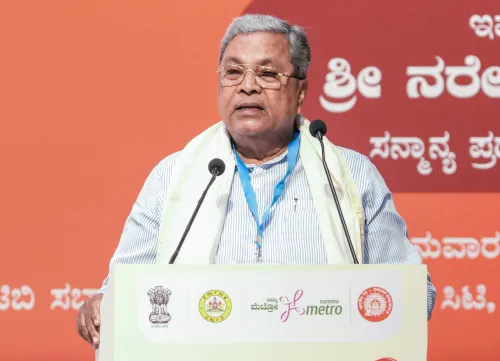
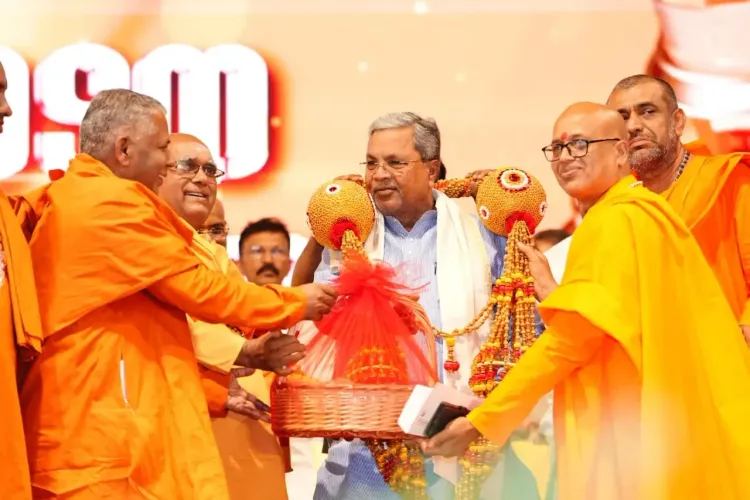
Thiruvananthapuram/Bengaluru, Dec 31 (NationPress) The Chief Minister of Karnataka, Siddaramaiah, emphasized that the aspiration of creating an India where individuals coexist harmoniously in diversity was the vision of Sree Narayana Guru. He cautioned against the perils of communalism and casteism within society.
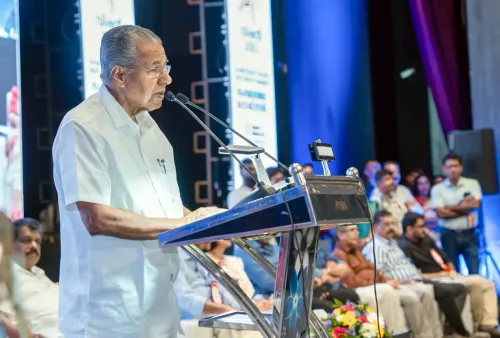
While addressing the 93rd Sivagiri Theerthadanam festival in Thiruvananthapuram, Kerala, the Chief Minister remarked that Narayana Guru's mission was to cultivate a compassionate India, uniting people regardless of their differences.
He highlighted that Sivagiri signifies that spirituality cannot be separated from equality, reason, and human dignity, asserting that religion devoid of ethics transforms into a means of domination.
“Narayana Guru was not just a saint; he embodied a movement for equality and morality. As such, the Sivagiri pilgrimage should evolve into a movement that abolishes caste oppression and guides society towards social justice,” Siddaramaiah stated.
“This represents the India that Narayana Guru envisioned, and it embodies what Sivagiri stands for. Together, we must fortify such an India,” he added.
He remarked that the Sivagiri Mutt is more than a pilgrimage site; it serves as a moral university that symbolizes the conscience of India. “It is a privilege for me to stand before you at this sacred location. This journey is not merely geographical but moral and intellectual,” he expressed.
According to CM Siddaramaiah, in an era where politics is straying from morality and religion is often wielded as a tool for power instead of ethics, Sivagiri must act as a moral movement and a source of inspiration. “The Sivagiri Mutt operates like a ‘living Constitution’,” he noted.
He remarked that the Sivagiri Theerthadanam epitomizes India’s foundational anti-communal ethos. “In a society beset by artificially instigated hatred, Sivagiri champions dialogue over dominance, equality over hierarchy, and morality over mere symbolism,” he asserted.
Referencing the theme “The role of Sivagiri Theerthadanam in modern nation-building”, CM Siddaramaiah stated that this endeavor is not merely symbolic but a pressing need and a direct reaction to current crises. “The driving force behind this is Sree Narayana Guru, recognized not only as a saint but also as one of India’s most significant social philosophers,” he highlighted.
Siddaramaiah explained that Narayana Guru sought to uproot the very foundations of injustice instead of reforming within an unjust framework. “In an era when Kerala was ensnared in caste discrimination, superstition, and inequality, he boldly proclaimed: ‘One caste for humankind, one religion, one God’,” he emphasized.
“This declaration was not just poetic; it posed a direct challenge to the Manusmriti-based hierarchical system that perpetuated caste discrimination, religious monopoly, and social exclusion,” he elaborated.
He explained that Narayana Guru’s philosophy included the concept of ‘Vishwamanava’ (universal humanism), which was later articulated by Kannada national poet Kuvempu. “It envisioned a society free from caste, fear, and inhumanity,” he remarked.
By encouraging backward communities to establish their own temples, Narayana Guru replaced idols with mirrors in temples, symbolizing that divinity resides within every human being, and that true worship consists of self-realization, equality, and non-harm towards others.
Through the creation of schools, temples, and social organizations, Narayana Guru established platforms that reinstated self-respect, knowledge, and leadership among the oppressed, Siddaramaiah stated.
“He understood that caste persists not just through rituals but through the systematic denial of knowledge. For him, ignorance was a politically constructed condition designed to uphold hierarchical social structures,” he mentioned.
The Guru’s fundamental belief in “liberation through education and empowerment through organization” was not just a slogan but a blueprint for social transformation, the Chief Minister asserted.
“Long before modern nations discussed ‘human capital’, Narayana Guru advocated for education as the most potent weapon to eradicate deliberate inequality,” he stated.
Siddaramaiah noted that Narayana Guru established ITIs, organized industrial exhibitions, and encouraged backward communities to transform into producers rather than dependents.
“He promoted industrial training, skill development, and modern agricultural workshops to ensure dignified employment,” he said.
This movement, he stated, directly contributed to the emergence of industrial and entrepreneurial communities throughout the coastal regions of Kerala, Tamil Nadu, and Karnataka.
“Narayana Guru viewed employment and industry not as cultural or spiritual threats, but as tools for social liberation,” Siddaramaiah remarked.
He further noted that the Guru’s focus on productive labor directly contradicted regressive economic thinking.
Point of View
I believe that Siddaramaiah's remarks highlight the urgent need for a moral renaissance in our society. In a time rife with division, the teachings of Sree Narayana Guru remind us of the importance of equality and ethical governance, aligning with the nation's quest for social justice.
NationPress
9 Oct 2026
Frequently Asked Questions
What is the significance of the Sivagiri Theerthadanam festival?
The Sivagiri Theerthadanam festival commemorates the teachings of Sree Narayana Guru, emphasizing unity, equality, and social justice.
Who was Sree Narayana Guru?
Sree Narayana Guru was a prominent social reformer and philosopher in India, advocating for caste equality and moral values.
What did CM Siddaramaiah propose regarding religion?
CM Siddaramaiah proposed that religion must be rooted in ethics and serve as a force for social justice rather than domination.
How does the Sivagiri Mutt contribute to society?
The Sivagiri Mutt serves as a moral university, promoting education and empowerment for all communities, particularly the oppressed.
What is the role of education according to Narayana Guru?
Narayana Guru believed that education is essential for liberation and empowerment, serving as a powerful tool against inequality.