CM Tamang attends 1st Governor's Archery Gold Cup in Sikkim
Synopsis
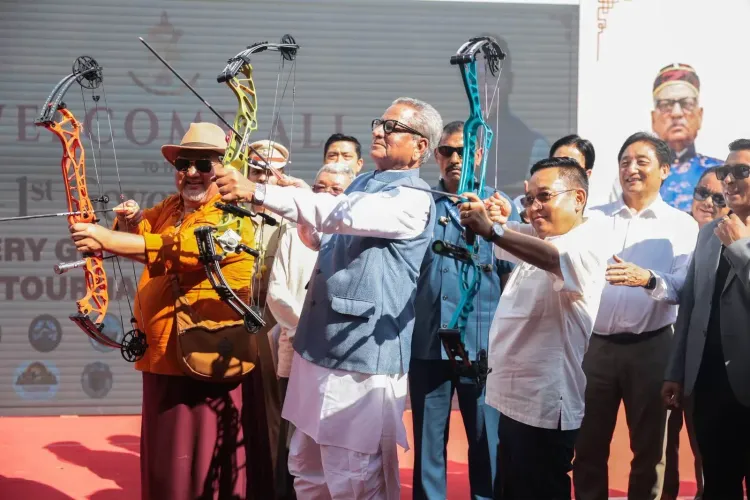
Sikkim Chief Minister Prem Singh Tamang attended the inaugural Governor's Archery Gold Cup at Tathangchen on 29 September 2026, alongside Governor Om Prakash Mathur. Team Green Tara won the top prize. Tamang called archery a treasured cultural heritage and urged continued support for Sikkim's indigenous sporting traditions.
Key Takeaways
Green Tara won the inaugural Governor's Archery Gold Cup held at Tathangchen, Gangtok on 29 September 2026 .
Sikkim CM Prem Singh Tamang and Governor Om Prakash Mathur both attended, lending the event high institutional visibility.
Tamang described archery as 'a treasured part of our traditional heritage' embodying discipline, patience, precision and strength of character.
The event is positioned as a platform for Sikkim's youth to connect with indigenous sporting roots while developing competitive excellence.
The Gold Cup fits a wider northeast Indian pattern of state-backed promotion of indigenous games alongside mainstream sports development.
Future editions and potential integration of traditional sports into school or youth programmes remain the key indicators of the initiative's long-term impact.
At Tathangchen, Gangtok, on the afternoon of Tuesday, 29 September 2026, Sikkim Chief Minister Prem Singh Tamang joined Governor Om Prakash Mathur for the inaugural Governor's Archery Gold Cup — a tournament that framed a traditional sport as living cultural memory, not just athletic competition.
Green Tara wins the inaugural Gold Cup
The day's honours went to Green Tara, who claimed the top prize in the first edition of the Governor's Archery Gold Cup. Chief Minister Tamang extended 'heartiest congratulations to the winning team, Green Tara,' while also praising every participating side for their 'spirited performances and sportsmanship.' The presence of Governor Om Prakash Mathur gave the event a formal institutional weight, signalling that the state's highest constitutional authority is invested in the revival of indigenous sporting traditions.
Why Sikkim views archery as more than a sport
Tamang was direct about the stakes: 'Archery is more than a sport — it is a treasured part of our traditional heritage, reflecting discipline, patience, precision, concentration and strength of character.' That framing matters. Across the northeastern states, indigenous games have long competed for attention and funding against mainstream cricket and football. Sikkim's decision to anchor a Governor-level trophy to archery is a deliberate counter-weight — an official signal that the state's cultural identity is as worth investing in as its medal tally at national games.
Archery carries deep roots in the communities of Sikkim, historically tied to both livelihood and ritual. A state-backed Gold Cup transforms that heritage into a competitive platform, giving young athletes a formal ladder to climb without abandoning the traditions their families have passed down for generations.
Sikkim's broader push for indigenous sports
The Governor's Archery Gold Cup fits a recognisable pattern across northeast India, where state governments have periodically used sports events to reinforce cultural identity alongside conventional athletic development. Tamang framed the tournament explicitly as a bridge: 'Such platforms provide our youth an opportunity to connect with our roots, develop sporting excellence and carry forward traditions that have been passed down through generations.' The dual mandate — cultural preservation and sporting excellence — is the architecture of the initiative.
Whether the Gold Cup becomes an annual fixture, and whether it feeds into school or youth-development programmes, will determine if this first edition is a one-off ceremony or the foundation of something structural. The Chief Minister's call to 'empower our young athletes and ensure that Sikkim's rich sporting heritage thrives for generations to come' suggests the ambition runs further than a single afternoon at Tathangchen.
For a small Himalayan state that punches above its weight culturally, the bow and arrow pointed at a target in Tathangchen carries a message that travels well beyond the archery range.
Point of View
Chief Minister Tamang elevates archery from a community tradition to an officially endorsed competitive discipline, which matters for funding, media attention and youth uptake. The dual framing of cultural preservation and sporting excellence is politically astute: it speaks to traditionalists and modernisers simultaneously. The real test will be whether the Cup becomes a recurring institution with youth pipelines attached, or remains a well-intentioned ceremonial gesture.
NationPress
29 Sept 2026
Frequently Asked Questions
What is the Governor's Archery Gold Cup in Sikkim?
The Governor's Archery Gold Cup is an archery tournament launched in Sikkim to promote the state's indigenous sporting heritage. The first edition was held at Tathangchen, Gangtok, on 29 September 2026, in the presence of Governor Om Prakash Mathur and Chief Minister Prem Singh Tamang.
Who won the 1st Governor's Archery Gold Cup?
Team Green Tara won the inaugural Governor's Archery Gold Cup held at Tathangchen, Sikkim, on 29 September 2026.
Where is Tathangchen located?
Tathangchen is an area in Gangtok, the capital of Sikkim, and served as the venue for the 1st Governor's Archery Gold Cup.
Why is archery important to Sikkim's culture?
Archery holds deep traditional significance in Sikkim, historically connected to community identity, discipline and heritage. Chief Minister Prem Singh Tamang has described it as 'a treasured part of our traditional heritage' that reflects discipline, patience, precision and strength of character.
What is Sikkim doing to promote indigenous sports?
Sikkim has launched the Governor's Archery Gold Cup as a formal competitive platform to preserve and promote indigenous sporting traditions, with Chief Minister Tamang calling for continued efforts to empower young athletes and integrate traditional sports into the state's sporting culture.