Sitharaman: GST Rate Cuts Expanded Tax Base Beyond Estimates
Synopsis
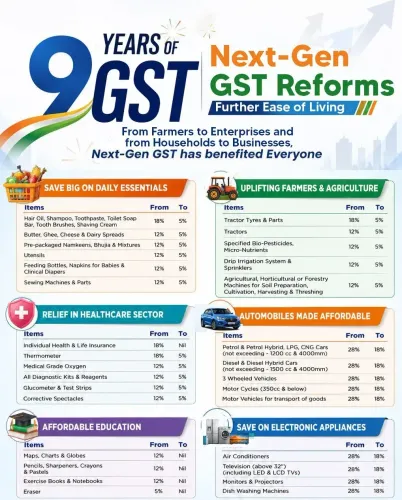
On the ninth anniversary of GST, Finance Minister Nirmala Sitharaman said the September 2025 rate rationalisation expanded India's tax base beyond expectations, with higher taxable supplies more than making up for revenue lost to lower rates — validating the government's reform strategy.
Key Takeaways
Nirmala Sitharaman marked #9YearsOfGST on 1 July 2026 by citing a larger-than-expected tax base expansion following the September 2025 rate rationalisation.
Higher taxable supplies generated by the rate cuts more than offset the revenue foregone, according to the Finance Minister's post.
GST was launched on 1 July 2017 , replacing a fragmented web of central and state indirect taxes with a unified framework.
The GST Council — comprising central and state finance ministers — has conducted multiple rounds of rate rationalisation since 2017 to simplify compliance and broaden the tax base.
The outcome aligns with a recurring pattern in which lower rates reduce evasion incentives, drawing more businesses into the formal, taxable economy.
The next GST Council meeting and monthly collection data will be watched to confirm whether the base-expansion trend is sustained.
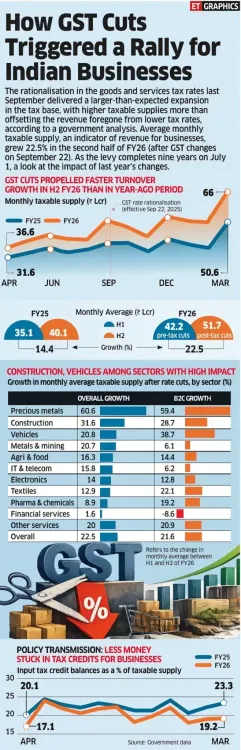
Union Finance Minister Nirmala Sitharaman on Wednesday, 1 July 2026 marked #9YearsOfGST by highlighting that the goods and services tax rate rationalisation carried out in September 2025 produced a larger-than-expected expansion in the tax base, with higher taxable supplies more than offsetting the revenue foregone from lower rates.
Context
Posting on the ninth anniversary of the Goods and Services Tax rollout — which came into force on 1 July 2017 — Sitharaman shared that the rate rationalisation round of September 2025 had delivered a counter-intuitive fiscal outcome: cutting rates had not shrunk the tax kitty but instead pulled more transactions into the formal, taxable economy. 'The rationalisation in the goods and services tax rates last September delivered a larger-than-expected expansion in the tax base, with higher taxable supplies more than offsetting the revenue foregone from lower tax rates,' she wrote.
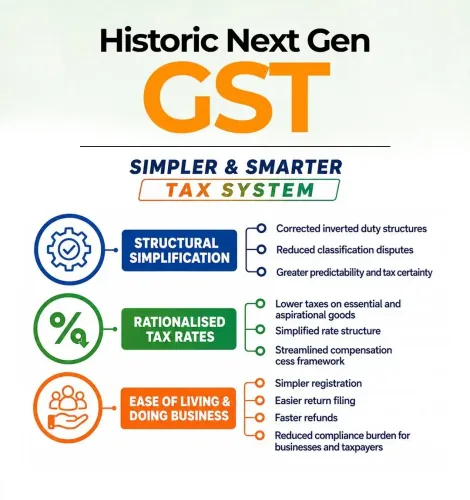
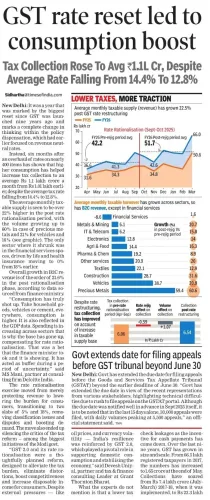
The post was accompanied by an infographic and a link to a detailed data piece illustrating how GST cuts have historically triggered a rally for Indian businesses. The timing — the exact anniversary date — underscores the government's intent to frame the occasion as a vindication of its reform strategy.
Policy Backdrop
GST was introduced on 1 July 2017, subsuming a complex web of central and state indirect taxes — including central excise duty, service tax, and value-added tax — into a single, destination-based framework. The GST Council, a constitutional body comprising the Union Finance Minister and state counterparts, has periodically revised rates since launch, with notable rationalisation rounds in November 2017 and 2019.
The recurring logic behind these cuts has been that lower rates reduce the incentive for tax evasion and under-reporting, drawing more businesses into the compliance net. When the resulting expansion in taxable turnover is large enough, total collections can rise even as individual rates fall — a dynamic the Finance Minister's post now claims was borne out by the September 2025 round.
Over nine years, GST has evolved from a politically contentious reform — states had to be convinced to surrender their taxation autonomy — into the backbone of India's indirect tax architecture, with monthly collection data now watched as a key indicator of economic activity.
Stakeholders and Impact
Indian businesses, particularly small and medium enterprises that previously operated in the informal economy, are the primary beneficiaries when compliance costs fall and rate structures simplify. A wider taxable base also means state governments receive a larger share of GST revenue through the devolution formula, easing fiscal pressures at the sub-national level.
For consumers, lower rates on goods and services translate directly into reduced prices, supporting household purchasing power. The government's claim that taxable supplies expanded more than enough to compensate for rate cuts suggests the reform is functioning as a self-reinforcing cycle: lower rates encourage formal transactions, which in turn sustain or grow total revenue.
What's Next
Attention will now turn to the next GST Council meeting, where further rate adjustments or compliance-simplification measures could be on the agenda. Monthly GST collection data for the coming quarters will be the key empirical test of whether the base-expansion trend flagged by Sitharaman is sustained.
With the #9YearsOfGST milestone providing a political platform to showcase the reform's track record, the government is likely to press for deeper structural changes — including possible rationalisation of the remaining rate slabs — as it moves toward what officials have described as a more streamlined, two-or-three-rate structure in the medium term.
Point of View
The government is building an empirical case that lower rates and a wider base are complementary, not contradictory. This fits a broader fiscal strategy of deepening formalisation rather than raising rates to meet revenue targets. The political subtext on the ninth anniversary is equally clear: GST, once a lightning rod for opposition criticism, is now being presented as a self-validating reform success.
NationPress
1 Jul 2026
Frequently Asked Questions
What is #9YearsOfGST and why is it trending?
#9YearsOfGST marks the ninth anniversary of India's Goods and Services Tax, which was launched on 1 July 2017 . It is trending because Finance Minister Nirmala Sitharaman used the occasion on 1 July 2026 to highlight that the September 2025 rate rationalisation expanded the tax base beyond expectations.
What did the September 2025 GST rate rationalisation involve?
The September 2025 GST rate rationalisation was a round of rate reductions approved by the GST Council . According to Finance Minister Sitharaman, the cuts led to a larger-than-expected expansion in taxable supplies, more than compensating for the revenue foregone from lower rates.
How does GST rate rationalisation expand the tax base?
When GST rates are lowered, the incentive for businesses to under-report transactions or operate informally is reduced. More transactions enter the formal economy, widening the taxable base so that total collections can rise even as individual rates fall.
What is the GST Council and who is part of it?
The GST Council is a constitutional body that decides GST rates, exemptions and procedural rules. It is chaired by the Union Finance Minister — currently Nirmala Sitharaman — and includes finance ministers from all states and union territories.
What should we watch next regarding GST policy in India?
The next GST Council meeting is the key event to watch, as it may announce further rate changes or compliance measures. Monthly GST collection figures for the coming quarters will also reveal whether the tax-base expansion trend highlighted by Sitharaman is holding.