Sitharaman Marks 9 Years of GST, Cites Rate Rationalisation Gains
Synopsis
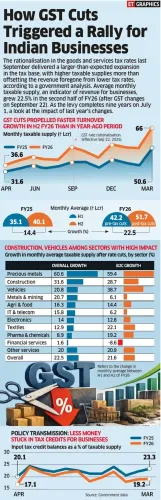
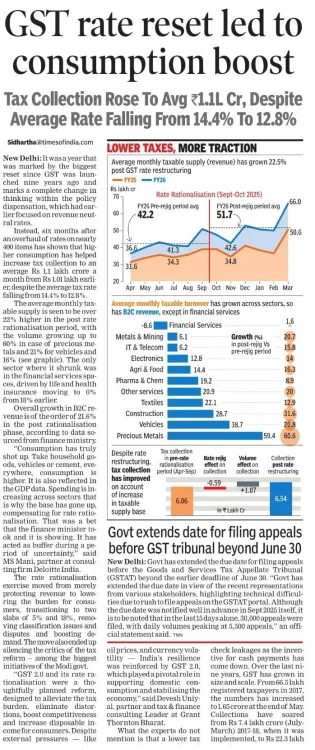
On the ninth anniversary of GST, Finance Minister Nirmala Sitharaman said rate rationalisation shifted the reform from revenue protection to consumer relief, citing a move toward two slabs of 5% and 18%, fewer classification disputes, and a demand boost — calling it one of the Modi government's biggest initiatives.
Key Takeaways
Nirmala Sitharaman marked 9 years of GST on 1 July 2026 with a post crediting rate rationalisation as a turning point for the reform.
The minister stated the exercise transitioned the tax structure toward two slabs of 5% and 18% , reducing classification disputes.
GST was launched on 1 July 2017 under the 122nd Constitutional Amendment , replacing central and state levies including excise duty, service tax, and VAT.
Sitharaman described GST as 'among the biggest initiatives of the Modi govt ' and said rationalisation 'silenced critics' of the reform.
The GST Council , comprising Union and state finance ministers, has been the constitutional forum driving successive rate revisions since 2017.
Future GST Council meetings and Union Budget data will be key indicators of whether the claimed consumption boost and slab simplification hold.
Union Finance Minister Nirmala Sitharaman on Wednesday, 1 July 2026 marked the ninth anniversary of the Goods and Services Tax (GST), crediting the rate rationalisation exercise with shifting the reform's focus from revenue protection to consumer relief and demand stimulation, while also silencing critics of the landmark indirect tax overhaul.
Context
GST was rolled out on 1 July 2017 following the 122nd Constitutional Amendment, subsuming a web of central and state levies — including excise duty, service tax, and value-added tax — into a single nationwide framework. The reform, pursued under Prime Minister Narendra Modi's government, was described at the time as the most sweeping indirect tax transformation since Independence. Sitharaman has steered GST policy as Finance Minister since 2019, presiding over multiple rounds of rate revision through the GST Council.
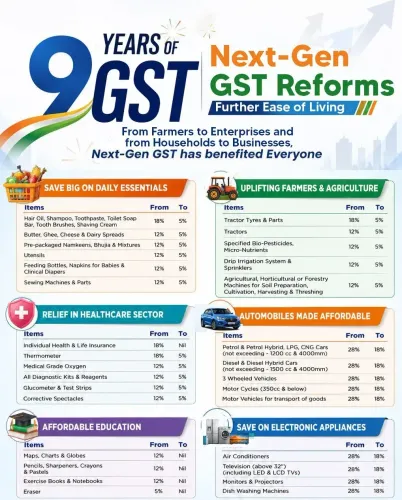
Posting on the occasion of #9YearsOfGST, Sitharaman wrote that the rate rationalisation exercise 'moved from merely protecting revenue to lowering the burden for consumers, transitioning to two slabs of 5% and 18%, removing classification issues and disputes and boosting demand.' She added that the move 'ended up silencing the critics of the tax reform — among the biggest initiatives of the Modi govt.'
Policy Backdrop
At its 2017 launch, GST operated across multiple rate slabs — broadly 0%, 5%, 12%, 18%, and 28% — with a cess layer on select demerit goods. Over successive GST Council meetings, rates on a wide range of items, including household goods and construction materials, were revised downward. The rationalisation exercise referenced by Sitharaman represents the government's stated ambition to compress the slab structure, reduce classification disputes that had generated litigation, and make the compliance architecture simpler for businesses and consumers alike.
The GST Council, a constitutional body comprising Union and state finance ministers, has been the principal forum for rate decisions. Successive budget cycles have emphasised both compliance improvement and revenue buoyancy as twin goals of the reform's maturation.
Stakeholders and Impact
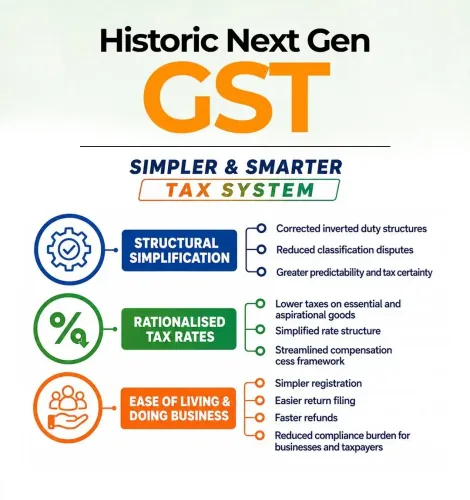
The minister's framing centres on three beneficiary groups: consumers, who she says face a lower tax burden; businesses, which gain from fewer classification ambiguities and disputes; and the broader economy, where demand stimulation is cited as an outcome. Reducing the number of active slabs to two — 5% and 18% — would, if fully achieved, substantially simplify the rate structure that traders and tax professionals have long flagged as a source of compliance friction.
Critics of GST in its early years pointed to teething troubles including invoice mismatches, input-tax credit delays, and the complexity of multiple rates. Sitharaman's post directly addresses this criticism, positioning the rationalisation as a rebuttal to those concerns and a vindication of the reform's trajectory under the Modi government.
What's Next
The next GST Council meeting will be closely watched for further movement on the slab rationalisation agenda, including any decisions on the compensation cess that applies to luxury and demerit goods. Annual GST revenue and compliance data, typically highlighted in Union Budget documents, will serve as the key empirical measure of whether the consumption boost Sitharaman describes translates into sustained revenue buoyancy. With the reform now entering its tenth year, the government's ability to lock in a simplified two-slab structure will define the next chapter of India's indirect tax story.
Point of View
Framing GST's evolution as a story of maturation rather than just implementation — using rate rationalisation as evidence that the reform has moved beyond its turbulent early years. By invoking the 'silencing of critics,' she is directly contesting the opposition narrative that GST was poorly designed and burdensome for small businesses. The two-slab framing, if realised fully, would mark a significant structural simplification and give the BJP a tangible governance achievement heading into future electoral cycles. The post also signals that the government views GST's ninth year as a consolidation phase, with further rationalisation likely to be a Budget-season talking point.
NationPress
30 Sept 2026
Frequently Asked Questions
What is the 9th anniversary of GST about?
1 July 2026 marks nine years since GST was launched on 1 July 2017 , replacing multiple central and state indirect taxes with a unified nationwide framework. Finance Minister Nirmala Sitharaman used the occasion to highlight rate rationalisation as a key achievement of the reform.
What did Nirmala Sitharaman say about GST rate rationalisation?
Sitharaman said the rate rationalisation exercise shifted from 'merely protecting revenue to lowering the burden for consumers,' moving toward two slabs of 5% and 18% , removing classification disputes, and boosting demand.
What are the two GST slabs mentioned by Sitharaman?
Sitharaman referenced a transition toward 5% and 18% as the two primary GST slabs, a rationalisation aimed at simplifying the earlier multi-slab structure and reducing litigation over item classification.
When was GST launched in India?
GST was launched on 1 July 2017 following the 122nd Constitutional Amendment , subsuming taxes such as excise duty, service tax, and VAT into a single indirect tax framework under the Modi government.
What is the GST Council and what role does it play?
The GST Council is a constitutional body comprising the Union Finance Minister and state finance ministers. It recommends GST rates, exemptions, and procedural changes, and has been the primary forum for the rate revisions Sitharaman described as rationalisation.