Sitharaman marks 9 years of GST, calls it citizen-centric reform
Synopsis
Union Finance Minister Nirmala Sitharaman marked the ninth anniversary of GST on 1 July 2026, crediting the unified indirect tax with making India's system simpler, more transparent and citizen-centric while easing burdens on essential sectors and businesses.
Key Takeaways
GST completes nine years on 1 July 2026 , having been launched on 1 July 2017 under the 101st Constitutional Amendment Act, 2016 .
Finance Minister Nirmala Sitharaman called GST 'simpler, more transparent and citizen-centric,' crediting it with easing burdens on essential sectors.
GST subsumed multiple central and state levies — including central excise, service tax and VAT — into a single destination-based indirect tax with input tax credit.
The GST Council , chaired by the Union Finance Minister, has carried out successive rate rationalisations and compliance simplifications since 2017.
MSMEs, businesses and consumers are among the key stakeholders who have been directly impacted by the regime's evolution.
Inclusion of petroleum products and real estate in GST remains a key unresolved question likely to feature in future Council deliberations.
Union Finance Minister Nirmala Sitharaman on Wednesday, 1 July 2026 marked the ninth anniversary of the Goods and Services Tax (GST), crediting the landmark indirect tax reform with easing the burden on essential sectors and improving both the ease of living and the ease of doing business in India.
Context
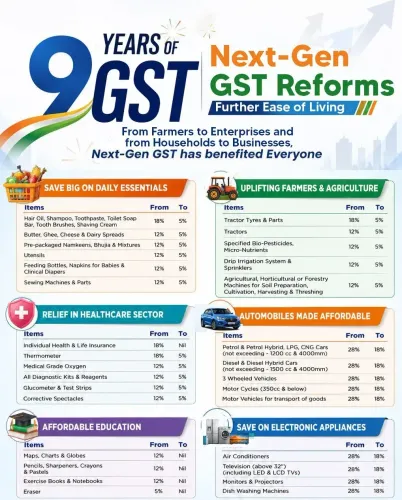
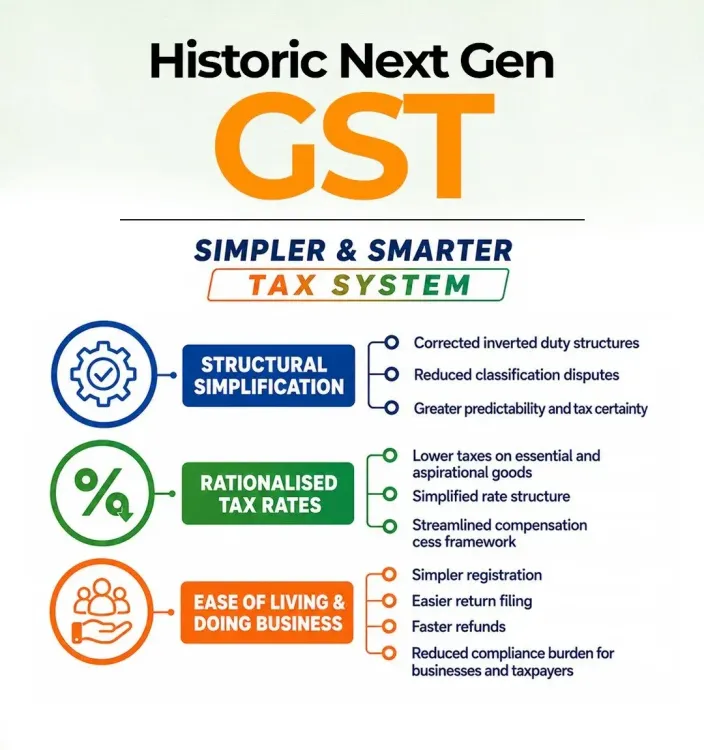
Sitharaman's post on X stated that 'GST reforms have strengthened India's growth journey through a simpler, more transparent and citizen-centric indirect tax system, easing the burden on essential sectors while enhancing the ease of living and ease of doing business.' The message was accompanied by an image and carried the hashtag #9YearsOfGST.
GST was launched on 1 July 2017, completing nine years on this date. As the Union Finance Minister and a senior BJP leader, Sitharaman chairs the GST Council, the constitutional body of central and state finance ministers that steers the regime's evolution.
Policy Backdrop
The 101st Constitutional Amendment Act, 2016 created the concurrent taxation framework that made GST possible. When it rolled out on 1 July 2017, it subsumed a web of central and state levies — central excise duty, service tax, value-added tax, central sales tax and several others — into a single destination-based tax with an input tax credit mechanism designed to eliminate the cascading effect of earlier taxes.
The architecture of GST has roots in policy discussions dating to the early 2000s, spanning multiple central governments. Since its launch, the GST Council has held successive rounds of rate rationalisation and compliance simplification, aiming to widen the tax base, ease the burden on smaller businesses and improve India's standing in global ease-of-doing-business assessments.
The Finance Minister's reference to 'essential sectors' aligns with the Council's periodic decisions to reduce or exempt GST on items such as food grains, medicines and certain services, moves intended to shield lower-income households from the tax's incidence.
Stakeholders and Impact
Businesses and MSMEs have been among the most directly affected stakeholders. Compliance simplifications — including the introduction of the QRMP (Quarterly Return Monthly Payment) scheme for smaller taxpayers — have been aimed at reducing the filing burden on micro, small and medium enterprises that make up a large share of India's formal economy.
Consumers have seen the impact through rate changes on everyday goods and services, while state governments have had to navigate the transition from their own tax regimes to a shared federal framework under the Council's oversight. The compensation mechanism for states, which ran for five years post-launch, was a significant fiscal element of that federal compact.
The GST Council continues to serve as the principal forum for negotiating rate changes, exemptions and structural adjustments, with both the Centre and states holding voting weight under the constitutional arrangement.
What's Next
Attention will now turn to upcoming GST Council meetings, where further rate rationalisation — including the long-pending question of bringing petroleum products and real estate under the GST net — may be taken up. Any such moves would require amendments to the Central GST (CGST) and State GST (SGST) Acts, and would need Parliamentary and state legislative consideration.
The anniversary message signals that the government views GST as a settled and successful reform, even as the regime's next phase of evolution — particularly on broadening its base and deepening compliance — will define its long-term revenue and equity outcomes for India's federal fiscal architecture.
Point of View
A reform that predates the BJP's tenure in its conception but was executed under it, as a cornerstone of the party's economic governance record. By foregrounding 'citizen-centric' language, the Finance Ministry is attempting to shift the public narrative on GST from its early complexity and compliance friction to its matured, rationalised form. The message fits a broader BJP pattern of using policy anniversaries to consolidate credit for structural reforms ahead of electoral cycles. The conspicuous absence of any new policy announcement, however, suggests this is consolidation rather than acceleration — the harder questions of petroleum inclusion and further base-broadening remain unaddressed.
NationPress
1 Jul 2026
Frequently Asked Questions
When did GST complete 9 years in India?
GST completed nine years on 1 July 2026 , having been launched across India on 1 July 2017 .
What did Nirmala Sitharaman say about GST on its 9th anniversary?
Finance Minister Nirmala Sitharaman said GST reforms have 'strengthened India's growth journey through a simpler, more transparent and citizen-centric indirect tax system, easing the burden on essential sectors while enhancing the ease of living and ease of doing business.'
What taxes did GST replace in India?
GST subsumed several central and state levies including central excise duty, service tax, value-added tax (VAT) and central sales tax , among others, into a single unified indirect tax.
What is the GST Council and who chairs it?
The GST Council is a constitutional body comprising central and state finance ministers that recommends GST rates, exemptions and policy changes. It is chaired by the Union Finance Minister , currently Nirmala Sitharaman .
Will petroleum and real estate come under GST in India?
Inclusion of petroleum products and real estate under GST remains pending and is expected to be a subject of future GST Council deliberations, though no formal decision has been announced as of the ninth anniversary.