Sitharaman's 3 Aspirations for SRC at Platinum Jubilee
Synopsis
At SRC's Platinum Jubilee in Tiruchirappalli, Finance Minister Nirmala Sitharaman called on the college to become a research hub by 2051 — its centenary year — by forging collaborative partnerships with NIT Tiruchirappalli, ICAR, BHEL, and Bharathidasan University, tying the college's future to India's Viksit Bharat 2047 vision.
Key Takeaways
Seethalakshmi Ramaswami College celebrated its Platinum Jubilee in Tiruchirappalli, Tamil Nadu on October 26, 2026 .
Finance Minister Nirmala Sitharaman laid out aspirations for the college, with depth in original research as the first priority.
SRC's centenary falls in 2051 , four years after India's 100th Independence anniversary in 2047.
Sitharaman named four nearby research partners: NIT Tiruchirappalli , ICAR-National Research Centre for Banana , BHEL , and Bharathidasan University .
The call aligns with the National Education Policy 2020 's push for multidisciplinary research and industry linkages in higher education.
Today's students at SRC were framed as future leaders of a Viksit Bharat , placing personal accountability on the audience.
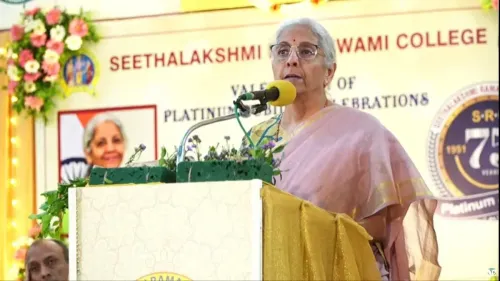
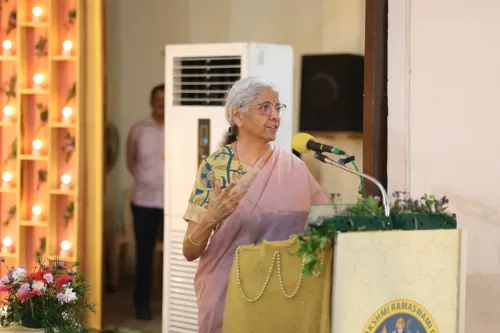
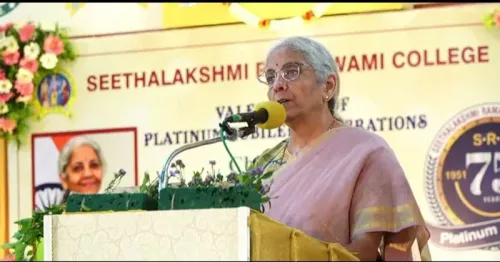
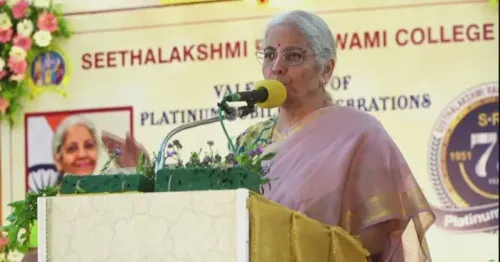
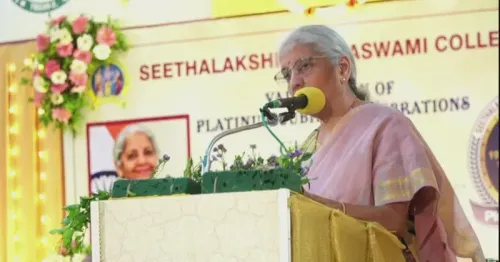
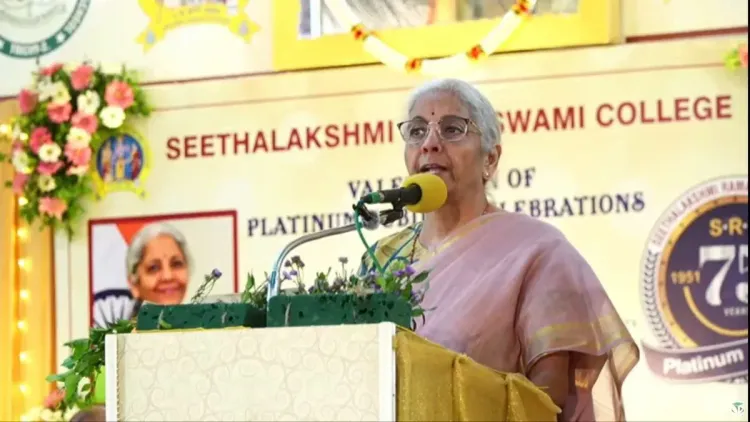
With 2051 on the horizon — the year Seethalakshmi Ramaswami College (SRC) turns 100 — Union Finance Minister Nirmala Sitharaman stood before its students on Monday, October 26, 2026, and did something rarer than a ceremonial address: she handed them a blueprint. Speaking at the college's Platinum Jubilee Celebrations in Tiruchirappalli, Tamil Nadu, Sitharaman framed SRC's centenary not as a distant milestone but as a personal assignment for every woman in that hall.
Her first and sharpest aspiration was depth — original, cited, applied research. 'SRC should become a centre of original research, whose work is cited by scholars and put to use by industry and farmers alike,' she told the gathering. It is a standard that cuts both ways: scholarship rigorous enough for academic citation, and practical enough to reach a banana farm or a factory floor. That dual test is the whole point.
Tiruchirappalli's research corridor, waiting to be activated
What makes the aspiration credible is geography. Sitharaman named four institutions within striking distance of the college — NIT Tiruchirappalli, one of India's premier technical universities; the ICAR-National Research Centre for Banana, a specialist agricultural research body; BHEL, the public-sector engineering giant with a major manufacturing unit in the city; and Bharathidasan University, the state university that anchors the region's academic ecosystem.
The argument is that SRC does not need to build from scratch. It needs to plug in. A women's liberal-arts college collaborating with an engineering institute, an agri-research centre, a heavy-industry giant, and a university — that is a research mesh few Tier-2 city institutions anywhere in the country have assembled. 'Strong partners are nearby,' Sitharaman said pointedly. 'SRC can pioneer collaborative research with these neighbours.'
The Viksit Bharat thread running through the address
The Minister's framing was deliberate. 2047 — the centenary of Indian Independence and the target year of the government's Viksit Bharat vision — arrives four years before SRC's own centenary. The students in that auditorium, she noted, will be among the women leading a developed India by then. It is a generational accountability argument: the college's institutional ambition and the nation's development arc are meant to arrive together.
This sits squarely within the logic of the National Education Policy 2020, which has pushed higher education institutions — including smaller colleges — toward multidisciplinary research, industry linkages, and innovation ecosystems. Sitharaman's call for SRC to become a research hub mirrors that policy's ambition to decentralise quality research beyond metropolitan centres and into cities like Tiruchirappalli.
A centenary goal that starts now
SRC was founded with vision and resolve, Sitharaman acknowledged — and the road to its hundredth year demands the same currency. The watch now shifts to whether formal agreements follow between SRC and the named institutions, and whether central or state funding channels open up to support college-level research infrastructure in Tiruchirappalli.
Twenty-five years is a long runway. But as Sitharaman framed it, the women sitting in those seats are not waiting for 2051 — they are already on the clock.
Point of View
The speech moves beyond aspiration into a quietly operational frame — the question now is whether formal MoUs and funding follow. The Viksit Bharat 2047 thread running through the remarks also signals that the BJP is increasingly using centenary timelines — both national and institutional — as a political grammar for development ambition. For higher-education watchers, the more consequential signal is the NEP 2020 subtext: smaller colleges are being publicly tasked with research roles that were once assumed to belong only to central universities and IITs.
NationPress
26 Oct 2026
Frequently Asked Questions
What is the Platinum Jubilee of Seethalakshmi Ramaswami College?
The Platinum Jubilee marks 75 years since the founding of Seethalakshmi Ramaswami College (SRC) , a women's college in Tiruchirappalli, Tamil Nadu . The celebration was held on October 26, 2026 , and was addressed by Finance Minister Nirmala Sitharaman .
What did Nirmala Sitharaman say at SRC Tiruchirappalli?
Sitharaman called on SRC to become a centre of original research whose findings are cited by scholars and used by industry and farmers. She named NIT Tiruchirappalli , ICAR-National Research Centre for Banana , BHEL , and Bharathidasan University as potential collaborative partners.
When does Seethalakshmi Ramaswami College complete 100 years?
SRC will complete 100 years in 2051 , four years after India marks its centenary of Independence in 2047 .
What is the connection between SRC and Viksit Bharat 2047?
Sitharaman framed the students of SRC as future leaders of a Viksit Bharat — a developed India — by 2047 . She linked the college's institutional growth to national development goals, asking SRC to be a research contributor to that vision.
Which institutions near SRC can it collaborate with for research?
Sitharaman identified NIT Tiruchirappalli , the ICAR-National Research Centre for Banana , BHEL 's Tiruchirappalli unit, and Bharathidasan University as strong nearby partners for collaborative research.