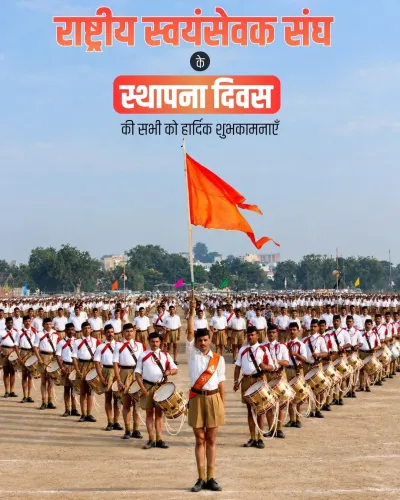
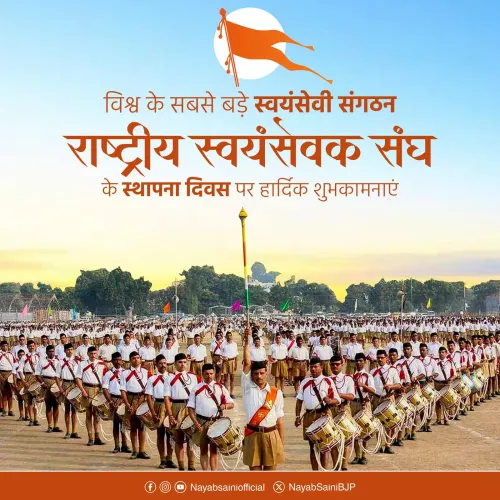
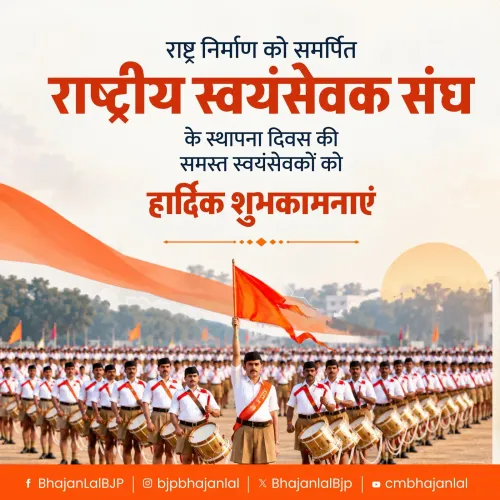
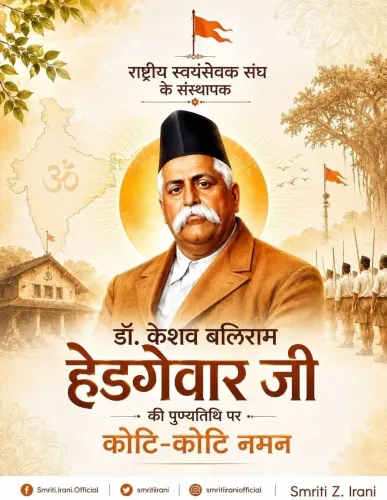
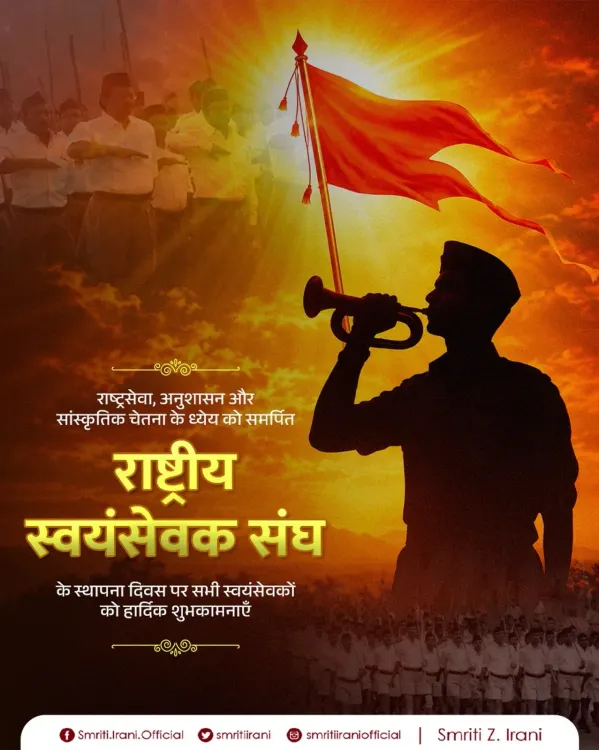
Smriti Irani greets RSS on Foundation Day, hails centenary journey
Synopsis
BJP leader Smriti Irani posted a Sanskrit-infused tribute on X for RSS Foundation Day 2026, praising the organisation's centenary journey, honouring founder Dr. Keshav Baliram Hedgewar, and calling the RSS a vast banyan tree of service and sacrifice.
Key Takeaways
Smriti Irani greeted RSS volunteers on Foundation Day, 20 October 2026 , via a post on X tagging @RSSorg .
She invoked a Sanskrit verse calling on the organisation to lead the nation to 'supreme glory.' Irani credited Dr.
Keshav Baliram Hedgewar , RSS founder, with planting an intellectual force to build an organised and empowered nation in 1925 .
She described the RSS as the world's largest voluntary organisation, now grown into a 'vast banyan tree' after nearly a century.
The tribute coincides with the RSS's centenary milestone, with the organisation approaching its 100th year since its founding on Vijayadashami 1925.
Senior BJP leaders routinely mark RSS Foundation Day publicly, reflecting the party's enduring ideological and organisational ties to the Sangh.
A century of volunteers, one enduring idea — BJP leader Smriti Irani marked the Foundation Day of the Rashtriya Swayamsevak Sangh (RSS) on Tuesday, 20 October 2026, with a Sanskrit-laced tribute that saluted the organisation's near-hundred-year march from a single nagpur shakha to what she called the world's largest voluntary organisation.
Posting on X and tagging @RSSorg, Irani offered warm wishes to all swayamsevaks, invoking the Sanskrit verse 'param vaibhavam netum etat svarashtram' — (lead this nation to supreme glory) — before grounding her message in a sweep of institutional history. She described the RSS as an 'intellectual force' (vicharashakti) planted by its founder to rid society of forgetfulness and build an organised, empowered nation.
From Hedgewar's vision to a 'vast banyan tree'
Dr. Keshav Baliram Hedgewar, a physician and social activist from Nagpur, established the RSS on Vijayadashami, 1925, with the explicit aim of consolidating Hindu society around a culture of discipline and service. Irani's post describes his foundational idea as having grown into a 'vast banyan tree' (vishaal vatvriksha) — a metaphor for an organisation whose roots and branches now span every district of India.
The RSS counts its volunteers not in thousands but in millions across its network of daily shakhas, and the organisation's reach into education, disaster relief, and tribal welfare has made it one of the most studied civil-society structures in the world. Irani's use of the banyan metaphor is deliberate: the banyan grows new roots from its own branches, a living symbol of continuity across generations.
The centenary milestone and the language of sacrifice
Irani's tribute lands at a moment of particular symbolism — the RSS is in the final lap of its centenary journey, approaching the 100-year mark since 1925. She describes this journey as being 'irrigated' (sinchhit) by the sacrifice, dedication, and devotion of swayamsevaks generation after generation, and frames the organisation as 'a continuous source of inspiration.'
Senior BJP leaders routinely issue public messages on RSS Foundation Day, a practice that reflects the party's deep historical and ideological roots in the Sangh Parivar. Vijayadashami — the Hindu festival that marks RSS's birthday — serves as an annual occasion for the organisation's chief, the Sarsanghchalak, to address the nation from Nagpur, with attendance from across the political and social spectrum.
For Irani, who has consistently positioned herself as a voice of cultural nationalism within the BJP, the greeting is both ritual and conviction — a reminder that the party's electoral machinery and the RSS's grassroots mobilisation remain intertwined threads in a single, decades-long project.
As the RSS steps into its centenary year, the question is not whether the organisation endures — it is what its next hundred years will look like in a fast-changing India.
Point of View
Generational sacrifice, the banyan metaphor — but it arrives at a symbolically loaded moment as the RSS approaches its centenary, amplifying the message beyond routine annual courtesy. The BJP's electoral project has always rested on a division of labour: the party provides the ballot infrastructure, the RSS provides the moral vocabulary and ground volunteers. Public greetings on Vijayadashami are one of the clearest annual reminders of that compact. For Irani, a leader who has built her brand around cultural nationalism, the post also reinforces her positioning within the party at a time when ideological credibility with the Sangh remains valuable political currency.
NationPress
20 Oct 2026
Frequently Asked Questions
When was the RSS founded and by whom?
The Rashtriya Swayamsevak Sangh was founded on Vijayadashami, 1925 , by Dr. Keshav Baliram Hedgewar , a physician and social activist from Nagpur, with the goal of uniting and strengthening Hindu society.
Why did Smriti Irani post about the RSS on 20 October 2026?
20 October 2026 marked the RSS Foundation Day (Vijayadashami), and Irani, a senior BJP leader, posted greetings on X to all swayamsevaks, a practice common among BJP leaders on this annual occasion.
What does the RSS centenary mean?
The RSS is approaching 100 years since its founding in 1925 , making the current period its centenary milestone — a significant moment the organisation and its supporters have been marking with special events and messages.
What is the connection between the BJP and the RSS?
The BJP and the RSS share deep historical and ideological roots — the RSS is widely regarded as the parent organisation of the broader Sangh Parivar, of which the BJP is a part. Senior BJP leaders regularly participate in RSS observances and publicly mark Foundation Day.
What Sanskrit verse did Smriti Irani quote in her RSS post?
Irani quoted 'param vaibhavam netum etat svarashtram' , which translates to 'lead this nation to supreme glory' — a line from a well-known RSS prayer, used here to frame the organisation's national purpose.