Smriti Irani Pays Tribute to Jana Sangh Founder Mookerjee
Synopsis
BJP leader Smriti Irani paid homage to Bharatiya Jana Sangh founder Dr. Shyama Prasad Mookerjee on his death anniversary on 23 June 2026, invoking his sacrifice for national unity and the ideal of an integrated India as an enduring inspiration for crores of Indians.
Key Takeaways
Smriti Irani posted a tribute to Dr.
Shyama Prasad Mookerjee on his death anniversary, 23 June 2026 .
Mookerjee founded the Bharatiya Jana Sangh in 1951 , the direct precursor to the BJP.
He died in detention in Srinagar in June 1953 while opposing the permit system for entry into Jammu and Kashmir.
The BJP government cited Mookerjee's legacy when it abrogated Article 370 in August 2019 .
Irani's post described his sacrifice as an inspiration for crores of Indians and praised his commitment to Akhand Bharat .
Annual commemorations on 23 June form a consistent part of the BJP's political narrative on national unity.
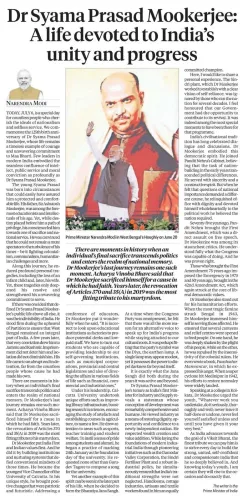
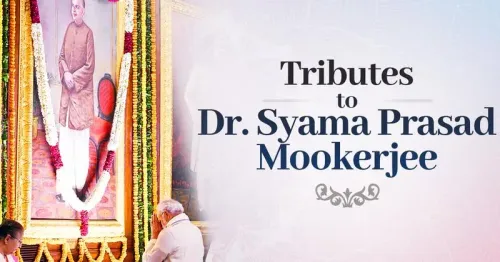
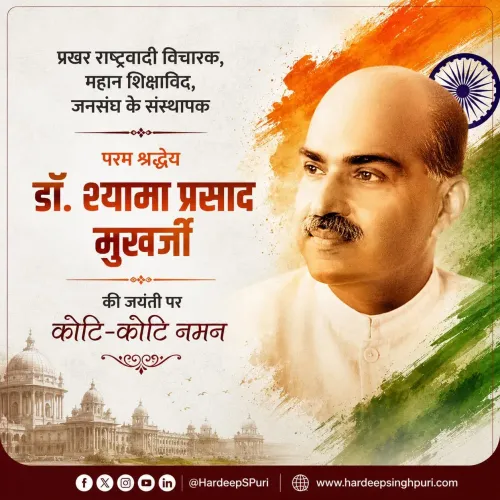
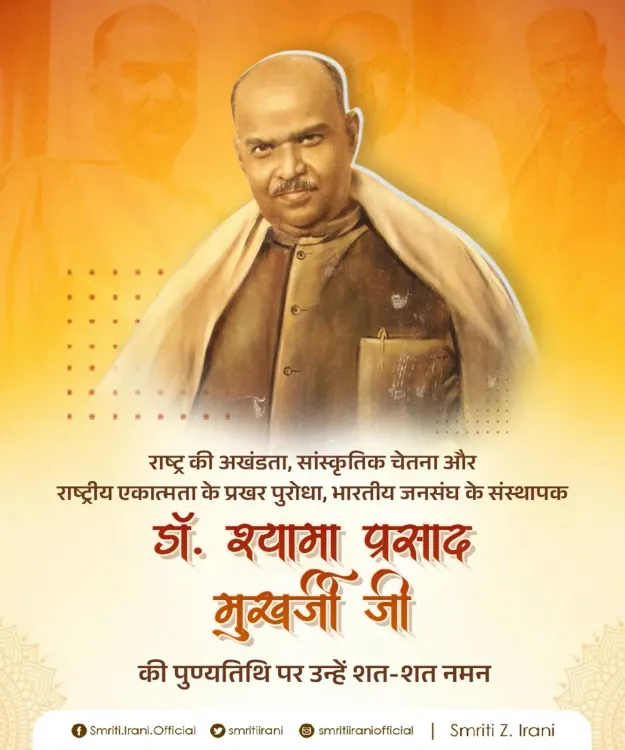
BJP leader and former Union Minister Smriti Irani on Tuesday, 23 June 2026, paid homage to Dr. Shyama Prasad Mookerjee, founder of the Bharatiya Jana Sangh, on his death anniversary, honouring him as a towering nationalist who dedicated his life to India's unity and integrity.
In her post, Irani wrote — 'राष्ट्र की एकता, अखंडता और स्वाभिमान की रक्षा के लिए अपना जीवन समर्पित कर दिया' — ('he dedicated his life to protecting the unity, integrity, and self-respect of the nation') — and described Mookerjee's sacrifice and his unwavering commitment to placing national interest above all else as a continuing source of inspiration for crores of Indians.
Context
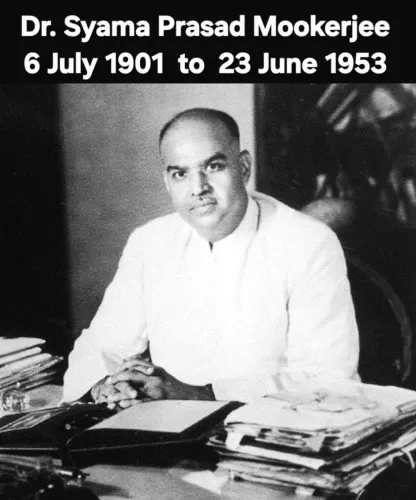
Dr. Shyama Prasad Mookerjee founded the Bharatiya Jana Sangh in 1951 as a political platform committed to national integration and the complete constitutional absorption of Jammu and Kashmir into the Indian Union. He died in detention in Srinagar in June 1953 while agitating against the requirement for a separate permit to enter the state — a cause that would define his political legacy for decades.
The Bharatiya Jana Sangh served as the direct ideological and organisational precursor to today's Bharatiya Janata Party. For the BJP, Mookerjee is not merely a historical figure but a founding father whose vision frames the party's contemporary identity on questions of national unity.
Policy Backdrop
Mookerjee's central demand — the full constitutional integration of Jammu and Kashmir — was cited by the BJP-led government as the animating principle behind the abrogation of Article 370 in August 2019, which stripped the region of its special status. The party has consistently presented that decision as the fulfilment of a promise made by its founding figure more than six decades earlier.
Annual commemorations on 23 June reinforce this narrative of ideological continuity, connecting present-day governance priorities to the commitments of the Jana Sangh era. References to 'Akhand Bharat' ('undivided, integrated India') — a phrase Irani invokes in her tribute — remain a recurring motif in BJP political communication.
Stakeholders and Impact
Tributes of this nature resonate most directly with the BJP's core support base, for whom Mookerjee represents a model of nationalist sacrifice. The commemoration also carries significance for the broader Sangh Parivar ecosystem, which regards 23 June as a day of solemn political remembrance.
For the wider public, the anniversary serves as a periodic reminder of the contested political history around Jammu and Kashmir's integration and the ideological lineage that shapes the ruling party's positions on sovereignty and territorial integrity.
What's Next
Tributes from other senior BJP leaders and party programmes centred on Mookerjee's legacy are expected to follow through the day. References to national integration themes may also surface in upcoming parliamentary sessions or party events as the BJP continues to frame its governance record within the ideological arc traced back to its Jana Sangh origins.
Point of View
These anniversaries will likely continue to serve as touchstones for its identity politics.
NationPress
22 Sept 2026
Frequently Asked Questions
Who was Dr. Shyama Prasad Mookerjee?
Dr. Shyama Prasad Mookerjee was the founder of the Bharatiya Jana Sangh , established in 1951 , and a prominent nationalist leader who advocated for the complete integration of Jammu and Kashmir into India. He died in detention in Srinagar in June 1953 .
Why is 23 June significant for the BJP?
23 June marks the death anniversary of Dr. Shyama Prasad Mookerjee , the founder of the Bharatiya Jana Sangh, the ideological predecessor to the BJP. Senior party leaders observe the day with tributes and commemorative events each year.
What did Smriti Irani post about Shyama Prasad Mookerjee?
Smriti Irani posted a tribute in Hindi on 23 June 2026 , describing Mookerjee as a great nationalist thinker who dedicated his life to protecting India's unity, integrity, and self-respect, and calling his sacrifice an inspiration for crores of Indians.
What is the connection between Shyama Prasad Mookerjee and Article 370?
Mookerjee opposed the special status given to Jammu and Kashmir under Article 370 and died agitating for the state's full constitutional integration. The BJP-led government cited his legacy when it abrogated Article 370 in August 2019 .
What is Akhand Bharat?
Akhand Bharat translates to 'undivided' or 'integrated India' and refers to the ideal of a fully unified Indian nation. It is a recurring concept in BJP political communication and was central to Dr. Shyama Prasad Mookerjee's vision for national integration.