Did many attempts to destroy Somnath Temple fail?
Synopsis
Prime Minister Narendra Modi commemorates the resilience of the Somnath Temple, emphasizing its enduring legacy despite numerous attacks by invaders. This historic site symbolizes India's strength, pride, and cultural heritage, marking both a millennium of survival and 75 years since its modern reconstruction. Join the celebration of a legacy that transcends destruction.
Key Takeaways
Somnath Temple has a rich history of resilience against invasions.
The temple signifies India's cultural pride and spiritual strength.
Modern reconstruction occurred in 1951 , marking 75 years of revival.
Historical figures like Mahmud of Ghazni attempted destruction but failed.
Somnath’s story is one of victory , not defeat.
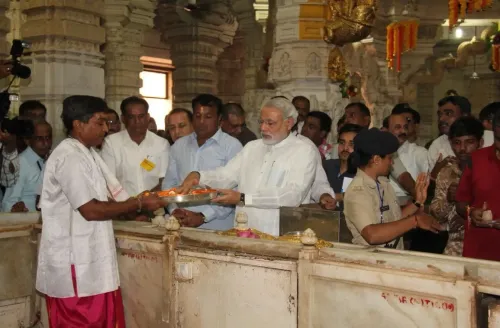
Somnath (Gujarat), Jan 11 (NationPress) Prime Minister Narendra Modi on Sunday reflected on the numerous assaults by foreign invaders against the Somnath Temple and emphasized that the narrative of this sacred site should not merely focus on its instances of destruction. Instead, it should be celebrated for the bravery, sacrifice, and determination that led to its restoration after each attack.
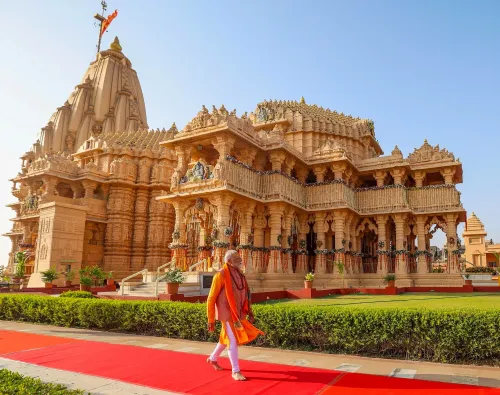
He highlighted that the history of the Somnath Temple signifies not just a millennium of resilience and dignity but also marks 75 years since its modern restoration in 1951.
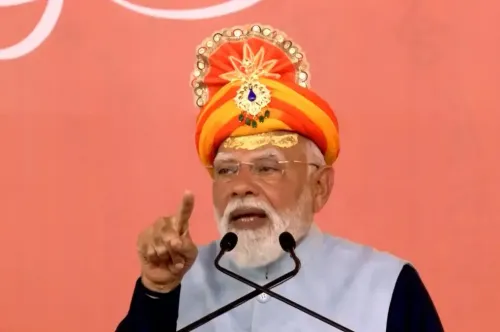
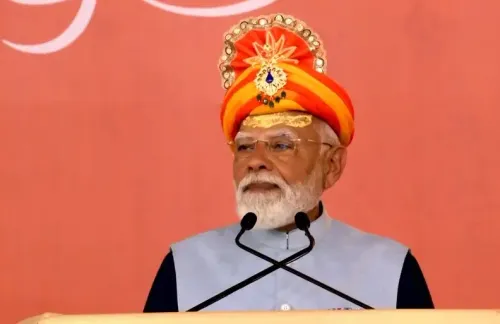
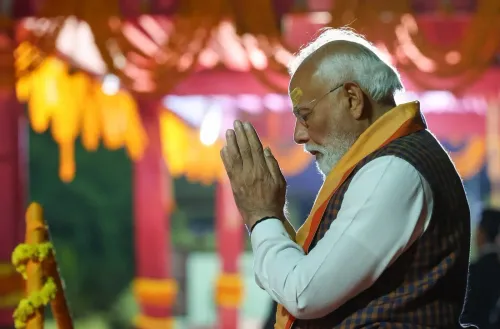
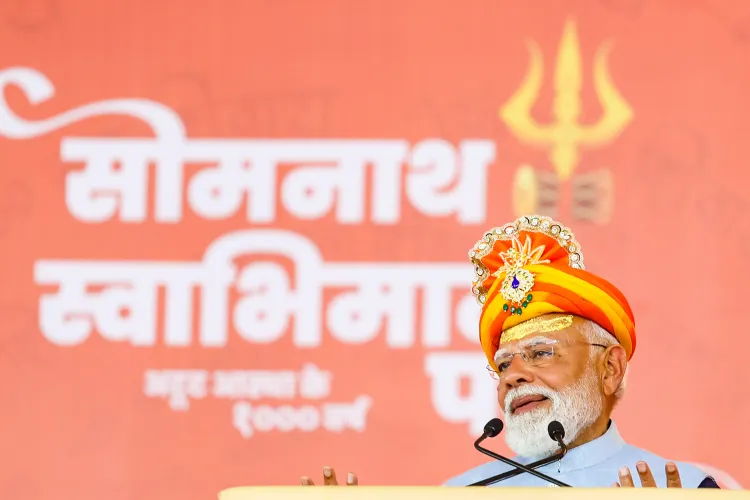
Speaking at a large gathering at Sadbhavna Maidan post his prayers at the revered temple, PM Modi delivered an impassioned address stating, "This festival is not solely about remembering the destruction from a millennia ago. It is a celebration of a thousand-year journey. It also embodies India's existence and pride."
By drawing parallels between India's history and the temple's legacy, he noted that both have faced similar adversities.
"Just as many attempts were made to annihilate Somnath, foreign invaders also sought to undermine our nation. Yet, neither Somnath nor India fell. This resilience stems from the profound connection between India and the essence of its faith," he remarked.
Reflecting on historical events, PM Modi recounted, "A thousand years prior, in 1026, Mahmud of Ghazni launched his first assault on the Somnath Temple, believing he had obliterated it. However, it was rebuilt within a few short years. In the 12th century, King Kumarapala enhanced the temple's grandeur. The 13th century saw Alauddin Khilji attack once more, but Rana Kumbha of Jalore defended it valiantly. Later, in the early 14th century, the rulers of Junagadh restored Somnath again."
"In the late 15th century, Sultan Ahmed Shah attempted to desecrate the temple, followed by his grandson Sultan Mahmud Begda, who sought to convert it into a mosque. Yet, due to the fervent efforts of Lord Mahadev's devotees, the temple was once again rebuilt. In the 17th and 18th centuries, Aurangzeb also endeavored to damage the temple and tried to repurpose it as a mosque, but Ahilyabai Holkar successfully reconstructed it yet again," he added.
The Prime Minister asserted that the narrative of Somnath should be linked not to loss, but to the strength and resolve of those who continuously rebuilt it.
"This illustrates that the history of Somnath is not one of destruction and defeat, but of triumph and restoration, showcasing the valor, sacrifice, and selflessness of our ancestors," he stated.
"Despite facing continual religious and other attacks, Somnath was revived in every era. Centuries of struggle, enduring resistance, and immense creativity have kept it alive. Such strength, faith, and resilience in our culture are remarkable examples in global history," he further mentioned.
Elucidating the deeper significance of the name Somnath, PM Modi expressed, "From Mahmud of Ghazni to subsequent invaders, all who attacked Somnath believed their swords could vanquish the Sanatani Somnath. Their motivations were steeped in religious fanaticism, yet they failed to comprehend that Somnath signifies 'Som' — immortality."
"Within it lies the eternal energy of Lord Shiva, a force of creation and protection, the very essence of divine power," he added, noting that another name for Lord Mahadev is 'Mrityunjaya', signifying the conqueror of death.
He affirmed that Lord Shiva pervades everything, stating, "We perceive Shankar in every single particle."
"What can anyone truly destroy? We, as a people, recognize Shiva in every living being. Thus, how could anyone ever undermine our devotion?" PM Modi questioned.
He noted that time has demonstrated that those who sought to obliterate Somnath have dwindled into history.
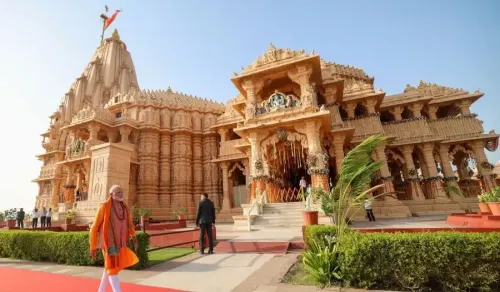
"Religious extremists who attempted to destroy Somnath are now relegated to the annals of history, while the Somnath Temple remains steadfast on the shores of a vast ocean, reaching the skies and upholding the tenets of dharma," he concluded.
Referring to the Somnath Swabhiman Parv, the Prime Minister stated that it serves not just as a remembrance of the past, but as a means to sustain a timeless journey for the future.
He urged India to seize this moment to further fortify its identity and existence, much like other nations proudly celebrate their ancient heritage before the global community.
Point of View
It is vital to recognize the profound significance of the Somnath Temple within India's cultural and historical narrative. Prime Minister Modi's reflections serve as a reminder of the resilience and strength that characterize our nation. This event not only honors our past but also inspires future generations to uphold and celebrate our rich heritage.
NationPress
19 Sept 2026
Frequently Asked Questions
What is the significance of Somnath Temple?
The Somnath Temple symbolizes resilience, showcasing India's ability to recover and thrive despite repeated invasions and attempts at destruction, embodying cultural pride and spiritual strength.
When was Somnath Temple reconstructed?
The modern reconstruction of Somnath Temple was completed in 1951, marking 75 years of its restoration.
Who attacked Somnath Temple historically?
Historical accounts indicate that Mahmud of Ghazni, Alauddin Khilji, and Aurangzeb were among the notable invaders who attacked the Somnath Temple.
What does the name Somnath mean?
The name Somnath translates to 'Lord of the Moon', with deeper connotations of immortality and divine energy, embodying the essence of Lord Shiva.
How does Somnath Temple represent Indian culture?
Somnath Temple represents Indian culture as a symbol of resilience, faith, and the enduring spirit of a civilization that has faced numerous challenges throughout history.