Sonowal hails BJP sweep in Legislative Council polls across 4 states
Synopsis
Union Minister Sarbananda Sonowal hails BJP's sweep in Legislative Council elections across Uttar Pradesh, Karnataka, Maharashtra and Bihar on October 28, 2026, calling the results a decisive rejection of Congress's 'politics of deception' and a mandate for development and good governance.
Key Takeaways
Sarbananda Sonowal posted on October 28, 2026 celebrating BJP victories in Legislative Council elections across four states: Uttar Pradesh, Karnataka, Maharashtra, and Bihar .
The polls were conducted through ballot papers , the traditional method for Legislative Council indirect elections involving sitting MLAs.
Sonowal directly targeted the Indian National Congress , accusing it of 'dirty propaganda and politics of deception.' The minister framed the results as popular endorsement of 'development, good governance, and a stronger New India.' Legislative Council outcomes mirror assembly compositions, as sitting MLAs are the electors — making BJP wins consistent with the party's existing strength in these states.
The results carry forward-looking significance, with multiple state assembly elections expected in the 2027-28 cycle .
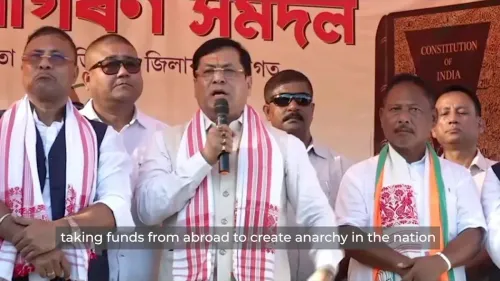
Four states, one verdict — and the BJP is claiming it loudly. Union Minister of Ports, Shipping and Waterways Sarbananda Sonowal on Wednesday, October 28, 2026 celebrated his party's performance in Legislative Council elections across Uttar Pradesh, Karnataka, Maharashtra, and Bihar, calling the results an 'overwhelming verdict' that has rejected what he termed Congress's 'dirty propaganda and politics of deception.'
Ballot-paper polls, big political claims
Legislative Council elections are indirect contests — sitting MLAs cast ballot papers, meaning the results almost always track a party's strength on the assembly floor. In all four states where results came in, the BJP and its allies currently hold or share power, making these outcomes broadly in line with the existing legislative arithmetic. But Sonowal's framing goes well beyond arithmetic: 'The more they try to undermine democracy, the stronger the people's faith in the BJP grows,' he wrote, projecting the institutional results as a popular mandate.
The minister extended congratulations to 'all victorious candidates and our dedicated Karyakartas,' invoking the party's grassroots cadre — a standard but pointed signal that organisational muscle, not just incumbency, drove the wins.
BJP's pattern of converting council wins into national narrative
This is familiar BJP playbook. Since its landmark assembly victories in Uttar Pradesh in 2017 and 2022, Maharashtra in 2014, and through the Bihar alliance of 2020, the party has systematically framed every downstream institutional result — from council elections to Rajya Sabha seats — as cascading public endorsement of its 'development and good governance' agenda. Sonowal's post fits that template precisely, pivoting from a procedural upper-house poll to a claim about 'a stronger New India.'
The Congress, the named target of the minister's sharpest lines, has not yet responded publicly to this specific post.
What the four-state sweep signals heading into 2027-28
Political watchers will note the timing: several state assemblies are due for elections in the 2027-28 cycle, and early institutional wins — even indirect ones — help a party demonstrate organisational coherence and keep its MLA base motivated. Legislative Council results also shape party strength in state upper houses, influencing the passage of legislation and, eventually, the composition of Rajya Sabha benches sent to New Delhi.
For Sonowal, a senior leader who built his political career in the northeast before joining the Union Cabinet, the post is also a signal of active alignment with the BJP's central electoral machine — reinforcing national party solidarity at a moment when the party is keen to project momentum well ahead of the next major electoral cycle.
Four states have delivered their council verdicts. Whether the party can convert that institutional momentum into assembly wins when voters — not just MLAs — hold the ballot papers, is the question the BJP will have to answer next.
Point of View
Well before direct popular votes arrive. The four-state spread — spanning India's most populous state, a financially significant western state, and two electorally pivotal states — maximises geographic optics. By invoking 'Karyakartas,' the messaging also serves an internal party-management function, keeping cadre morale high in the interregnum before the 2027-28 assembly cycle. The explicit singling out of Congress, rather than local rivals, signals that the BJP continues to frame every sub-national contest as part of a binary national battle.
NationPress
28 Oct 2026
Frequently Asked Questions
What are Legislative Council elections in India?
Legislative Council elections are indirect polls for members of state upper houses (Vidhan Parishads), conducted by sitting MLAs using ballot papers rather than by the general public. Results therefore typically reflect the party composition of the state assembly.
Which states held Legislative Council elections in October 2026?
According to Sarbananda Sonowal's post, Legislative Council elections were held across Uttar Pradesh, Karnataka, Maharashtra, and Bihar , with results described as an 'overwhelming verdict' in favour of the BJP.
Who is Sarbananda Sonowal?
Sarbananda Sonowal is the Union Minister of Ports, Shipping and Waterways, a senior BJP leader, and former Chief Minister of Assam. He is known for delivering BJP's first-ever majority government in Assam in 2016.
Why does the BJP emphasise Legislative Council victories?
The BJP consistently uses council election results as proof of sustained public trust in its governance agenda. Such wins also strengthen the party's position in state upper houses, influencing state legislation and Rajya Sabha nominations.
What is the significance of these results ahead of 2027-28 state assembly elections?
Legislative Council wins help a party demonstrate organisational strength and keep its MLA base motivated well ahead of direct popular votes. Several state assemblies are expected to face elections in the 2027-28 cycle , making early institutional momentum politically valuable.