India's Fuel Prices Steady Despite Surge in Global Oil Rates

Synopsis
In light of rising global crude oil prices, India's petrol and diesel prices are expected to remain unchanged, as the government asserts that state-run oil companies will absorb the costs. With improved energy stocks and diversified import routes, the situation appears stable amidst escalating Middle Eastern tensions.
Key Takeaways
Global crude oil prices have exceeded $110 per barrel.
India's petrol and diesel prices are expected to remain unchanged.
State-run oil marketing companies are expected to absorb the cost impacts.
India is diversifying its crude imports to enhance energy security.
Improved energy stock levels bolster the government's confidence in fuel management.
New Delhi, March 9 (NationPress) Despite global crude oil prices surpassing $110 per barrel amidst rising tensions in the Middle East, the prices of petrol and diesel in India are not expected to increase in the immediate future. The government anticipates that state-run oil marketing companies (OMCs) will absorb the increased costs for the time being, maintaining current fuel pump prices. Sources indicate that OMCs may need to accept reduced profits as international oil prices surge.
West Texas Intermediate climbed by 27% to reach $116 per barrel, while Brent crude rose by 28% to also hit $116, marking a significant milestone as both benchmarks exceeded the $100 threshold for the first time since 2022. This surge was triggered by escalating conflicts in the Middle East, particularly affecting supply routes through the Strait of Hormuz.
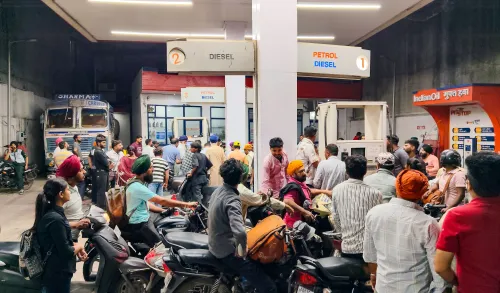
Despite the soaring global oil prices, domestic fuel prices have remained static across the nation. Typically, India aligns its retail fuel prices with global crude movements; however, the government has occasionally directed oil companies to absorb fluctuations during times of significant volatility.
On Saturday, government sources confirmed that there will be no increase in petrol and diesel prices, indicating that India's energy stock levels are improving, leading to a more stable situation.
The enhanced energy stock has bolstered the government's confidence in managing fuel supplies effectively. Additionally, India is diversifying its crude oil imports to lessen reliance on vulnerable routes.
According to sources, “India has ramped up its crude oil imports from alternative sources, with the share from non-Strait of Hormuz routes increasing from 60% to approximately 70%.”
“The first shipment has already commenced transit through the Strait of Hormuz, suggesting that supply flows are stabilizing,” they noted.
Qatar's energy minister, Saad al-Kaabi, cautioned that prolonged conflict in the Middle East could lead Gulf suppliers to declare force majeure, potentially halting deliveries and pushing oil prices to $150 per barrel and natural gas to $40 per MMBtu within weeks.
US President Donald Trump has justified the rise in oil prices, attributing it to the temporary costs associated with addressing Iran's nuclear threat.
Point of View
The stabilization of fuel prices amidst volatile global oil markets reflects the government's strategic approach to energy management. By diversifying import routes and maintaining energy stock levels, India aims to navigate the complexities posed by international tensions, prioritizing consumer stability.
NationPress
16 Sept 2026
Frequently Asked Questions
Will petrol and diesel prices in India rise soon?
No, the Indian government has indicated that prices will remain stable in the near term despite the rise in global crude oil prices.
What has caused the increase in global oil prices?
The surge in global oil prices is due to escalating tensions in the Middle East and supply disruptions in critical shipping routes.
How is India managing its oil supply?
India is diversifying its crude oil imports to reduce reliance on vulnerable routes and has improved its energy stock levels.
What percentage of India's crude oil imports come from non-Strait of Hormuz sources?
Approximately 70% of India's crude oil imports now come from sources outside the Strait of Hormuz.
What did US President Trump say about rising oil prices?
President Trump stated that the increase in oil prices is a temporary cost related to confronting Iran's nuclear threat.