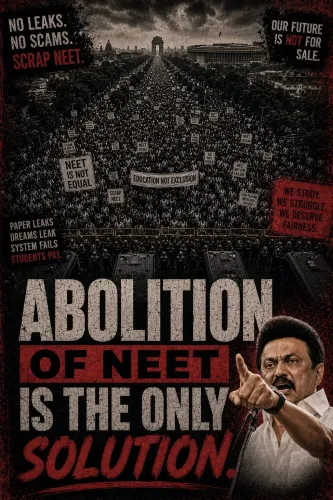
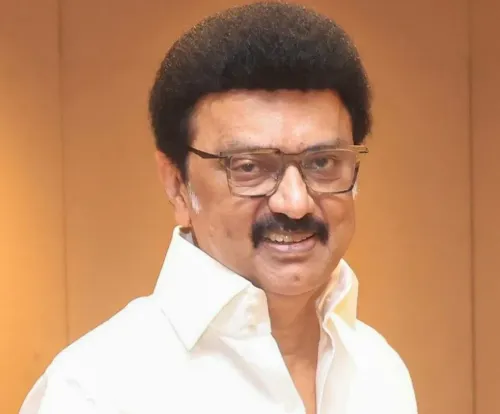
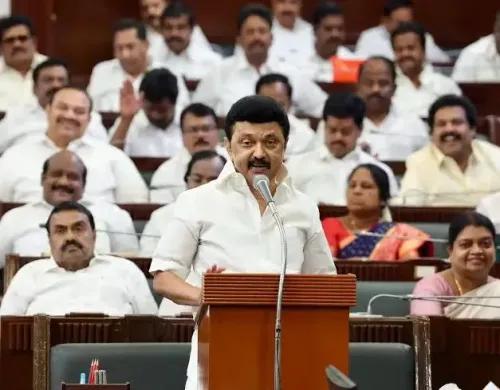
NEET has failed, abolish it now: DMK's Stalin backs paper leak protests
Synopsis
M.K. Stalin isn't just backing the NEET protests — he's reframing the entire debate. By calling NEET a structural failure rather than a procedural lapse, he is arguing that no amount of reform can fix it, only abolition can. That framing, if it gains traction nationally, could force the Centre into a far more difficult political corner than a mere paper-leak scandal would.
Key Takeaways
Stalin on 23 July called for the abolition of NEET , declaring it a structural failure.
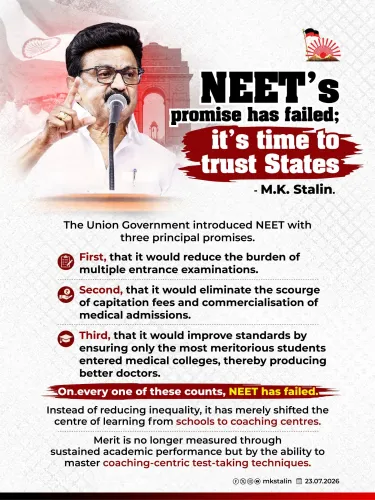
Stalin posted on X : 'It's time to trust the states.
It's time to abolish NEET.' He argued NEET shifted learning to private coaching centres and failed to curb commercialisation of medical education.
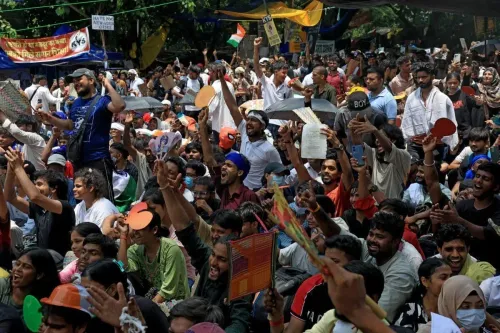
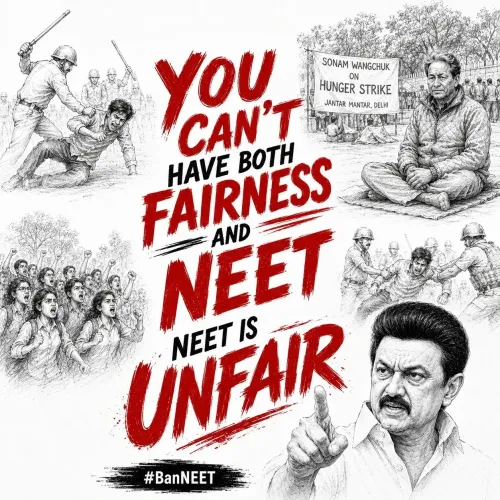
Stalin expressed solidarity with students protesting at Jantar Mantar, New Delhi , demanding NEET reforms and abolition.
The DMK has opposed NEET since its inception, citing harm to students from rural, government school and economically weaker backgrounds.
Stalin urged the Centre to replace NEET with an equitable admissions process and to trust states on education policy.
Dravida Munnetra Kazhagam (DMK) President and former Tamil Nadu Chief Minister M.K. Stalin on Thursday, 23 July sharpened his demand for the scrapping of the National Eligibility-cum-Entrance Test (NEET), declaring the medical entrance examination a structural failure and calling on the Centre to abolish it in response to nationwide student protests over alleged paper leaks.
Stalin's Core Argument
In a post on social media platform X, Stalin argued that NEET had delivered on none of its original promises — it had neither eased the academic burden on students, nor curbed the commercialisation of medical education, nor raised educational standards. Instead, he contended, it had merely displaced learning from schools to private coaching centres, heaping additional financial and psychological pressure on students and their families.
'The ongoing student protests must serve as a wake-up call for the Union Government. It's time to trust the states. It's time to abolish NEET,' Stalin wrote on X.
He was categorical that the problems with NEET were structural, not procedural — meaning that reforms or tighter oversight would not suffice. Only abolition, he argued, could restore fairness, accessibility and transparency to medical admissions.
Solidarity With Jantar Mantar Protesters
Stalin's remarks came a day after he expressed solidarity with students demonstrating at Jantar Mantar in New Delhi, where protesters have been demanding NEET reforms and its outright abolition following fresh allegations of irregularities in the conduct of the examination. He backed their call and urged that abolition — not procedural fixes — remain the central demand of the nationwide movement.
Notably, Stalin argued that Tamil Nadu had anticipated this outcome from the outset, warning years ago that NEET's design would create conditions conducive to large-scale irregularities and unequal access.
DMK's Long-Standing Opposition
The DMK has opposed NEET since its inception, arguing that the centralised test undermines social justice and disproportionately disadvantages students from rural areas, government schools and economically weaker sections. Stalin reiterated that Tamil Nadu — which played a pioneering role in advancing social justice through the First Constitutional Amendment — has consistently sought the complete abolition of the examination.
This is not the first time the DMK chief has escalated his rhetoric on NEET. The party has repeatedly passed resolutions, moved legislation in the Tamil Nadu Assembly and petitioned the Centre on the issue, making it one of the most persistent federal fault lines in Indian education policy.
What the Centre Must Do, According to Stalin
Stalin urged the Union government to place greater trust in states when framing education policy and to replace NEET with an admission process that ensures equitable access to medical education across socioeconomic backgrounds. He framed the student protests as a democratic signal that the current system had lost legitimacy.
With protests intensifying across the country and political pressure mounting, the Centre's response to the NEET controversy will be closely watched in the weeks ahead.
Point of View
He forecloses the Centre's easiest escape route — a cosmetic overhaul. The paper-leak controversy has handed the DMK a national audience for an argument it has been making for years, but mainstream coverage tends to treat this as regional politics rather than a federal governance question. The deeper issue — whether a single centralised test can equitably serve a country as educationally unequal as India — remains largely unexamined. If student protests sustain momentum beyond Tamil Nadu, the Centre may find it harder to dismiss abolition demands as southern regionalism.
NationPress
21 Oct 2026
Frequently Asked Questions
Why is M.K. Stalin demanding the abolition of NEET?
Stalin argues that NEET has failed on every metric it was introduced to achieve — it has not reduced student burden, curbed commercialisation or improved standards. He contends the problems are structural, not procedural, and that only abolition can ensure fair and equitable medical admissions.
What triggered Stalin's latest remarks on NEET?
His statement on 23 July came in the context of ongoing student protests at Jantar Mantar in New Delhi, where demonstrators have been demanding NEET reforms and abolition following fresh allegations of irregularities in the conduct of the examination.
How long has the DMK opposed NEET?
The DMK has opposed NEET since its inception, arguing it undermines social justice and disadvantages students from rural areas, government schools and economically weaker sections. Tamil Nadu has passed legislation and repeatedly petitioned the Centre on the issue.
What does Stalin want the Centre to do?
Stalin has urged the Union government to abolish NEET and replace it with an admission process that ensures equitable access to medical education. He has also called on the Centre to trust states in framing education policy.
Who is affected by the NEET controversy?
Aspiring medical students across India are affected, particularly those from rural backgrounds, government schools and lower-income families, who critics argue are structurally disadvantaged by a centralised test that favours students with access to expensive private coaching.