Stalin visits ailing Veeramani, hails Periyar Arivulagam in Coimbatore
Synopsis
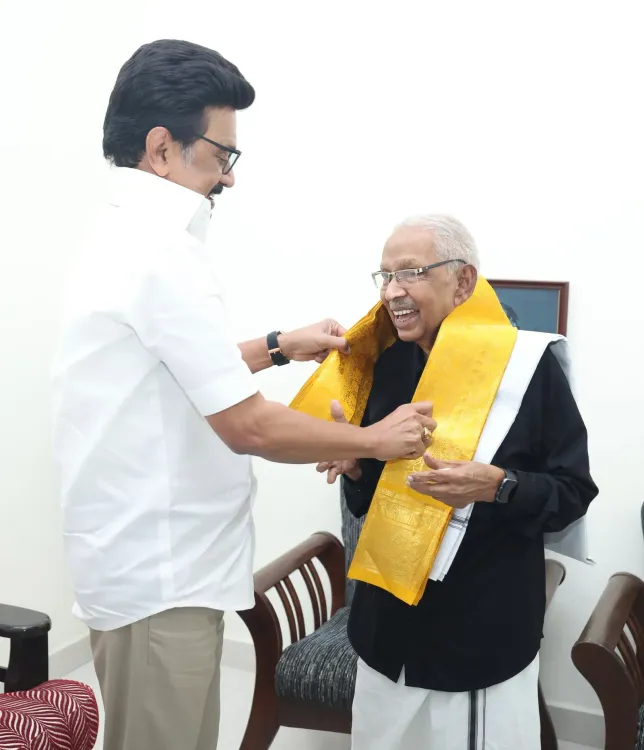
DMK president M. K. Stalin personally visited Dravidar Kazhagam chief K. Veeramani after learning he was unwell, urged him to rest, and shared Veeramani's blessing that the newly opened Periyar Arivulagam in Coimbatore will become a new identity for the city.
Key Takeaways
Veeramani in person after learning the Dravidar Kazhagam chief was unwell.
Stalin urged Veeramani to cut back on frequent long-distance travel and overwork.
Veeramani blessed Stalin and declared the newly inaugurated Periyar Arivulagam in Coimbatore will become a new identity for the city.
Veeramani compared the centre's significance to the unveiling of Periyar's portrait at Oxford , which he said put Periyarism on the global map.
The Dravidian Model government is credited with establishing the Periyar Arivulagam as part of its cultural programme.
Stalin closed with a pledge to continue spreading Periyarism to 'eradicate the social disease.'
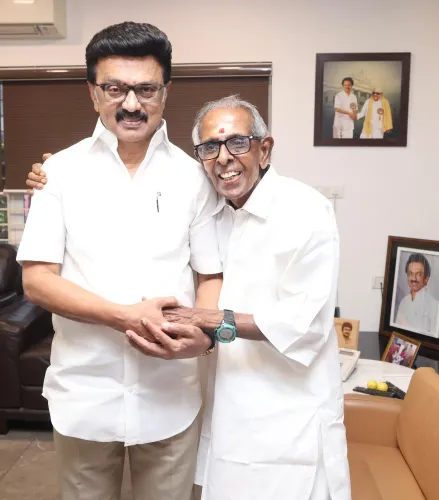
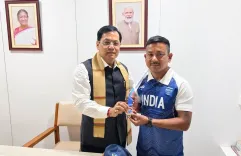
When word reached DMK president M. K. Stalin that veteran rationalist leader and Dravidar Kazhagam president K. Veeramani was unwell, the Chief Minister did not wait — he visited in person to check on his health on Tuesday, 20 October 2026.
Stalin posted about the meeting in Tamil, recounting how he urged Veeramani — affectionately addressed as Asiriyar Ayya (Teacher, Elder) — to ease his punishing schedule of long-distance travel and ceaseless work. 'I took the liberty of requesting him to reduce his frequent long-distance travels and his tireless labour,' Stalin wrote.
Veeramani, in turn, sent Stalin off with a blessing that carried the weight of a movement's confidence. He drew a direct line from a milestone of global Periyarism to a new one back home.
From Oxford to Coimbatore: Veeramani's blessing
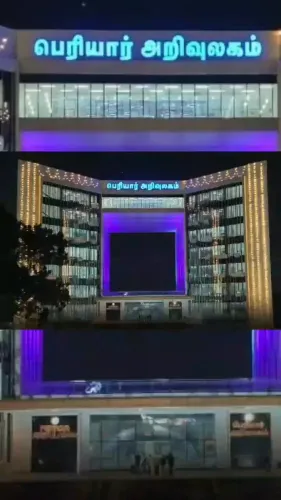
The elder leader's parting words, as quoted by Stalin, framed the newly inaugurated Periyar Arivulagam in Coimbatore as a landmark for the ages. 'Just as unveiling a portrait of Periyar in Oxford established Periyarism on the world stage, the Periyar Arivulagam — created by the #DravidianModel government and now inaugurated — will stand as a new identity for Coimbatore itself,' Veeramani said, according to Stalin's post.
The Periyar Arivulagam — roughly, the 'Periyar World of Knowledge' — is a state-supported cultural and intellectual centre in Coimbatore dedicated to the legacy of E. V. Ramasamy, popularly known as Periyar, the founding father of the Self-Respect Movement and the rationalist Dravidian social reform tradition that both the DMK and the Dravidar Kazhagam claim as their ideological inheritance.
The DMK–Dravidar Kazhagam axis and the Dravidian Model
The personal visit speaks to something more than courtesy. The DMK and the Dravidar Kazhagam occupy distinct lanes — one electoral, one a purely social organisation — but they have moved in close ideological alignment since Periyar's era. Veeramani, who succeeded Periyar as head of the Dravidar Kazhagam, has been the foremost living authority on Periyarite thought for decades.
Under Stalin's 'Dravidian Model' branding, the Tamil Nadu government has made the institutionalisation of Periyar's legacy a visible pillar of its cultural programme, using state resources to build memorials, knowledge centres, and public installations that reinforce rationalist and anti-caste messaging alongside routine governance. The Coimbatore centre fits squarely in that lineage, which DMK administrations have maintained in some form since the 1960s.
Stalin closed his post with a movement pledge: 'We shall continue to spread Periyarism to eradicate the social disease.' The kicker was as much a political signal as a tribute — the Dravidian Model, Stalin is saying, is not just a governance brand. It is a living ideology, and its chief elder is to be protected.
Point of View
Shoring up a social-reform alliance that gives the party legitimacy beyond electoral arithmetic. The framing of the Periyar Arivulagam as a Dravidian Model achievement ties state infrastructure spending directly to movement mythology — a pattern the DMK has used to distinguish itself from rivals in the Tamil cultural space. With Veeramani's advancing age, the party has an interest in demonstrating visible solidarity now. The Oxford reference in Veeramani's blessing also projects the movement's self-image as globally significant, a soft-power narrative the DMK increasingly deploys.
NationPress
20 Oct 2026
Frequently Asked Questions
Who is K. Veeramani and why did Stalin visit him?
K. Veeramani is the president of the Dravidar Kazhagam and the foremost living exponent of Periyarism. Stalin visited him personally after learning he was unwell, to check on his health and urge him to reduce his demanding travel schedule.
What is the Periyar Arivulagam in Coimbatore?
The Periyar Arivulagam is a state-supported cultural and intellectual centre in Coimbatore dedicated to the legacy of social reformer E. V. Ramasamy (Periyar). It was created by the Tamil Nadu government under its Dravidian Model framework.
What did Veeramani say about the new Periyar centre?
According to Stalin's post, Veeramani said the Periyar Arivulagam will become a new identity for Coimbatore, just as unveiling Periyar's portrait at Oxford once established Periyarism on the world stage.
What is the Dravidian Model that Stalin refers to?
The Dravidian Model is the governance and ideological brand of Stalin's DMK administration in Tamil Nadu, emphasising social justice, rationalism, welfare, and the institutionalisation of Dravidian cultural heritage.
What is the relationship between the DMK and the Dravidar Kazhagam?
The DMK is a political party and the Dravidar Kazhagam is a non-electoral social organisation; both share ideological roots in Periyar's Self-Respect Movement. They have maintained close alignment on matters of rationalist and anti-caste ideology for decades.