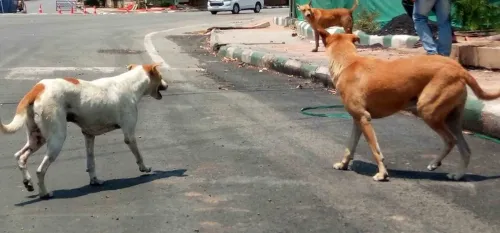
Can Stray Dogs Sense Fear and Attack Scared Individuals?

Synopsis
The Supreme Court has raised concerns about stray dogs' ability to sense fear in humans, potentially leading to attacks. As discussions on dog management continue, experts weigh in on ecological implications and animal rights.
Key Takeaways
Stray dogs can detect fear in humans.
The Supreme Court is addressing the management of stray dogs.
Ecological balance is crucial in discussions about stray dog removal.
Dogs should be returned to their original locations after capture per ABC Rules.
Engaging various stakeholders is essential for effective policies.
New Delhi, Jan 8 (NationPress) During the ongoing hearing regarding the management of stray dogs in public areas, the Supreme Court indicated on Thursday that dogs possess the ability to detect fear and may attack individuals who display signs of fright or have been bitten previously.
A panel consisting of Justices Vikram Nath, Sandeep Mehta, and N.V. Anjaria was reviewing requests to amend its November 2025 ruling, which mandated that stray dogs found in public facilities, such as schools, hospitals, bus terminals, and campuses, must be captured and not released at the same location after being vaccinated and sterilized.
During the proceedings, when a lawyer expressed disagreement with the assertion that dogs can sense fear and may attack scared individuals, Justice Nath's panel stated, “Do not shake your head. If they recognize that you are fearful, the likelihood of an attack increases. Even your pet may react similarly.”
“A dog can detect a person who is afraid of them. It will always attack when it senses this fear. This is based on personal experience,” they added.
Senior advocate C.U. Singh, representing an NGO, argued that the presence of dogs contributes to ecological balance, especially in managing rodent populations.
The advocate pointed out that the sudden removal of dogs often leads to a rise in disease-carrying rodents, referencing a prior incident in Surat to illustrate unintended effects. However, the Supreme Court questioned any proven link between dog removal and an increase in rodents.
In a lighthearted comment, the Justice Nath-led panel suggested that promoting cats, natural predators of rodents, could help mitigate the rodent issue.
“Dogs and cats are adversaries. Cats hunt rodents, so perhaps increasing cat populations and reducing dogs could be a solution. Tell us how many dogs you want wandering through hospital hallways,” the Supreme Court noted.
The panel clarified that its November 2025 order did not mandate the removal of all dogs from the streets but required that stray dogs be managed in strict accordance with the Animal Birth Control (ABC) Rules.
Senior advocate Shyam Divan, representing PETA India, referenced Rule 11(19) of the ABC Rules to argue that dogs should generally be returned to their original area after capture unless advised otherwise by experts.
Divan also mentioned that the allowed detention period for stray dogs is four days, asserting that keeping animals longer in crowded shelters could be considered cruel.
The senior counsel urged the Supreme Court to pause the directives for capturing dogs until local monitoring committees have ensured that infrastructure is adequate.
He additionally recommended forming an expert committee to review the matter, citing that scientific factors such as territorial behavior and ecological balance support the principle of returning dogs to their original locations.
Justice Mehta, however, stated that reliance on previous cases involving extinct species was not appropriate and dismissed any direct comparisons.
The Supreme Court is currently hearing arguments from various stakeholders, including dog enthusiasts, animal rights advocates, NGOs, and dog bite victims.
Point of View
It's evident that the complexities of stray dog management require a balanced approach. While public safety is paramount, the need to respect animal rights and ecological balance cannot be overlooked. The ongoing dialogue among various stakeholders is crucial for developing humane and effective policies.
NationPress
19 Sept 2026
Frequently Asked Questions
What did the Supreme Court say about stray dogs?
The Supreme Court stated that dogs can sense fear and may attack individuals who appear frightened or have been bitten before.
What is the current ruling regarding stray dogs?
The Court's ruling mandates that stray dogs in public places must be captured but not released back to the same location after sterilization and vaccination.
Why is the ecological impact of stray dogs important?
Stray dogs can play a role in maintaining ecological balance, particularly in controlling rodent populations, which can increase if dogs are removed.
What are the Animal Birth Control (ABC) Rules?
The ABC Rules govern the management of stray dogs, including guidelines for their capture and re-release in their original locations.
What is the proposed solution for managing stray dogs?
One suggestion is to consider increasing the population of cats, which are natural predators of rodents, as a way to address rodent issues.