Transforming Agriculture: A Surguja Woman's Journey into Profitable Floriculture
Synopsis
Discover how a 21-year-old woman from Surguja is revolutionizing traditional farming. By adopting modern methods and focusing on floriculture, she has turned her passion into a profitable venture, inspiring many others in her community.
Key Takeaways
Modern techniques can significantly increase farming efficiency.
Floriculture offers quick returns with multiple harvests per year.
Joining self-help groups can empower women in agriculture.
Marigold farming has a high profit potential.
Government schemes are crucial for supporting rural women.
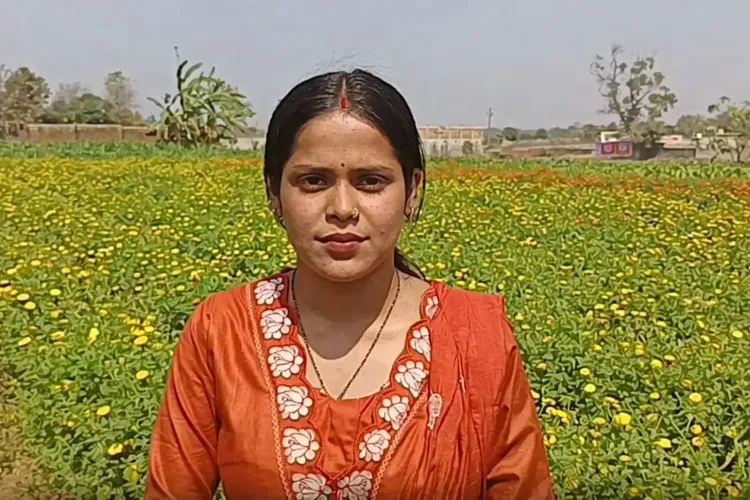
Surguja (Chhattisgarh), March 6 (NationPress) A remarkable 21-year-old woman farmer from Surguja district in Chhattisgarh has become a beacon of success by embracing modern agricultural techniques and transitioning into floriculture, earning substantial income annually.
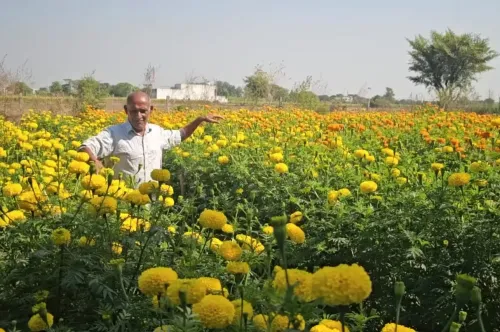
Ratna Majumdar, who hails from Digma village, chose to abandon traditional farming after her marriage to pursue innovative agricultural opportunities. She became part of a women’s self-help group under the National Rural Livelihood Mission (NRLM) and secured a loan to initiate marigold cultivation on two acres of land.
This initiative has blossomed into a lucrative business. Ratna explains that the investment for marigold farming is approximately Rs 1 lakh per acre, while the yield can yield close to Rs 2 lakh per acre. This results in an impressive profit margin of about 50 to 60 percent.
Another significant benefit of flower farming is its rapid production cycle. With one crop ready for harvest in just three months, farmers can reap up to four crops each year, ensuring consistent income year-round.
Ratna has also implemented modern techniques like drip irrigation, which enhances efficiency and reduces labor demands. She strongly believes that adopting contemporary agricultural methods can draw more youth into farming, promoting it as a sustainable livelihood.
Reflecting on her journey, Ratna noted that she joined the Maa Mahamaya women’s group after witnessing many women take loans through the group and grow their businesses.
While her initial flower cultivation was on a modest scale, it has since expanded to approximately 2–3 acres. The overall cultivation cost is between Rs 1.5 lakh and Rs 2 lakh, with profits nearing 50 percent.
The marigold saplings used in her farm are sourced from Kolkata. Ratna mentions that flowers begin to bloom around 24 days post-planting and continue to flower for nearly three months. After the harvesting cycle, old plants are cleared, and new saplings are planted for the next crop.
She also acknowledged the role of government schemes in empowering rural women towards financial independence and encouraged more women to join self-help groups and embark on their own ventures.
Ratna’s success story is not just a personal triumph but a source of inspiration for young farmers, showcasing how modern farming techniques can transform agriculture into a viable and profitable venture.
Point of View
Farmers can significantly enhance their productivity and income. Ratna's journey is a testament to the power of self-help groups and government support in fostering economic empowerment among women in agriculture.
NationPress
19 Sept 2026
Frequently Asked Questions
What motivated Ratna Majumdar to switch to flower cultivation?
After her marriage, Ratna sought new opportunities in agriculture and was inspired by other women in her community who were successfully expanding their businesses through self-help groups.
What are the financial returns of marigold farming?
Marigold farming requires an investment of around Rs 1 lakh per acre, with potential yields reaching nearly Rs 2 lakh per acre, resulting in a profit margin of 50 to 60 percent.
How long does it take for marigold flowers to bloom?
Marigold flowers typically begin to bloom around 24 days after planting and continue to flower for about three months.
What role do self-help groups play in Ratna's success?
Ratna joined a self-help group under the National Rural Livelihood Mission, which provided her with the support and financing needed to start her flower cultivation venture.
How can modern techniques improve farming efficiency?
By using methods like drip irrigation, farmers can increase the efficiency of water use, reduce labor intensity, and enhance overall productivity.