Tharoor Backs 'Cleanest Man' After SC Integrity Ruling

Synopsis
Congress MP Dr. Shashi Tharoor on 30 July 2026 invoked 'irony' after a Supreme Court ruling on political integrity, defending an unnamed figure as 'the cleanest man in Indian politics' and demanding accusers face accountability — a sharp pivot that turns the corruption narrative back on those who filed the original charges.
Key Takeaways
Shashi Tharoor posted on X on 30 July 2026 reacting to a Supreme Court ruling on a political figure's integrity.
Tharoor called the individual 'the cleanest man in Indian politics' and said the SC certificate of integrity was unnecessary.
He demanded that those who sought to implicate the figure 'ought to be thoroughly ashamed of themselves.' The post did not name the individual at the centre of the SC ruling.
The intervention follows a recurring pattern in Indian politics where apex court clearances are used to shift narrative pressure onto original accusers.
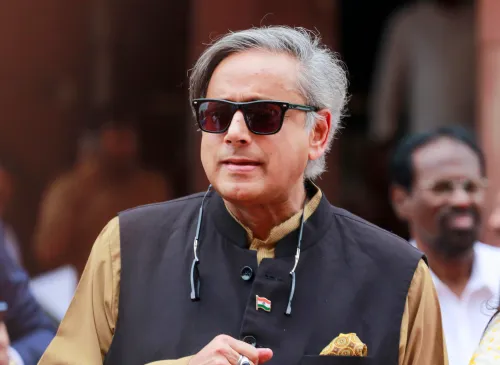
When the Supreme Court of India speaks on a politician's integrity, it does not whisper — and Congress MP Dr. Shashi Tharoor made sure no one missed the moment. On Thursday, 30 July 2026, Tharoor fired a pointed broadside on X, defending an unnamed political figure whose integrity had, in his words, been vindicated by the apex court — and turning the lens squarely on those who levelled the original charges.
Tharoor's post pulled no punches: 'Irony just died again. The cleanest man in Indian politics did not need an SC certificate of his integrity. Instead it is those who sought to implicate him in these charges who ought to be thoroughly ashamed of themselves.'
A Supreme Court Clearance and Its Political Aftershock
In Indian political life, a Supreme Court ruling touching on a leader's personal integrity rarely stays inside the courtroom. It detonates outward — into press conferences, party statements, and, increasingly, social media volleys. Tharoor's post follows a well-worn but effective playbook: the moment an apex court intervention clears a figure linked to the opposition or an ally, the narrative pressure pivots hard toward the original accusers. The phrase 'did not need an SC certificate' is doing considerable work here. It signals that the figure's reputation, in Tharoor's view, was never genuinely in doubt — and that the legal process merely confirmed what supporters already knew. The real target of the post is not the court, but the architects of the original case.Tharoor's Record as a Voice on Political Accountability
Dr. Shashi Tharoor, Congress MP from Thiruvananthapuram and former UN Under-Secretary-General, has long occupied an unusual lane in Indian politics — fluent in the language of international institutions, but increasingly willing to engage in the sharp domestic cut-and-thrust of accusation and counter-accusation. His interventions on X tend to carry weight precisely because they are framed in the idiom of principle rather than raw partisanship, even when the political intent is unmistakable. The broader pattern is familiar: mutual corruption allegations between India's major parties have become a structural feature of electoral politics, with Supreme Court rulings frequently invoked — by whichever side benefits — as the definitive moral verdict. Tharoor is playing that game with characteristic precision. The question the post leaves open — deliberately — is who exactly 'the cleanest man in Indian politics' is. That ambiguity keeps the story alive, inviting readers to fill in the blank while the political pressure lands on the accusers regardless. Watch for responses from the parties implicated in the original charges, and for whether the figure being defended steps forward to speak.Point of View
Tharoor maximises the post's reach while keeping the moral indictment of accusers front and centre. In the broader arc of Congress's political strategy, such interventions serve a dual purpose: they reinforce the party's self-image as a victim of weaponised institutions while simultaneously positioning its leaders as figures of unimpeachable character. The Supreme Court, in this framing, becomes not just a court of law but a court of political legitimacy — and Tharoor is making sure everyone hears the verdict.
NationPress
30 Jul 2026
Frequently Asked Questions
Who is Shashi Tharoor and why is he significant in Indian politics?
Dr. Shashi Tharoor is the Congress MP from Thiruvananthapuram, Kerala, and a former UN Under-Secretary-General. He is known for his command of English, his prolific writing, and his willingness to engage sharply on political and policy issues, making him one of the most prominent opposition voices in India.
What did Shashi Tharoor say about the Supreme Court ruling?
Tharoor said the figure at the centre of the case 'did not need an SC certificate of his integrity' and that those who sought to implicate him 'ought to be thoroughly ashamed of themselves,' defending the individual as 'the cleanest man in Indian politics.'
Who is the 'cleanest man in Indian politics' Tharoor referred to?
Tharoor did not name the individual in his post. The identity of the figure and the specific Supreme Court ruling he referenced were not disclosed in the tweet.
Why do Supreme Court rulings matter in Indian political corruption cases?
The Supreme Court is India's apex judicial body, and its rulings on corruption or integrity cases involving politicians are frequently treated as definitive moral and legal verdicts, often used by the benefiting side to shift public and political pressure onto accusers.
What is the broader political significance of Tharoor's post?
The post follows a well-established pattern in Indian politics where opposition MPs use apex court clearances to reframe corruption allegations as political persecution, turning the narrative pressure back onto the parties that filed the original charges.