Tharoor Backs Project to Chronicle Colombo Through Travellers' Eyes
Synopsis
Congress MP Dr. Shashi Tharoor has praised writer Ajay Kamalakaran's project to compile historic traveller narratives of Colombo, calling it 'fascinating' and urging him to produce a similar volume for India — a move that underscores Tharoor's long-standing interest in South Asian cultural heritage.
Key Takeaways
Shashi Tharoor publicly congratulated Ajay Kamalakaran on 26 July 2026 for a project compiling historic traveller accounts of Colombo .
The initiative reconstructs the Sri Lankan capital's history through the eyes of famous travellers, using both direct quotations and meticulous reconstructions.
Tharoor explicitly expressed hope that Kamalakaran would produce a similar volume focused on India .
Tharoor has a personal track record in historical narrative, including his 2012 book Pax Indica on India 's South Asian relationships.
The project taps into a rich genre of traveller-account historiography — from Ibn Battuta to Xuanzang — that has long shaped understanding of Indian Ocean port cities.
Tharoor's endorsement is expected to raise the project's profile among English-language readers across India and the Sri Lankan diaspora.
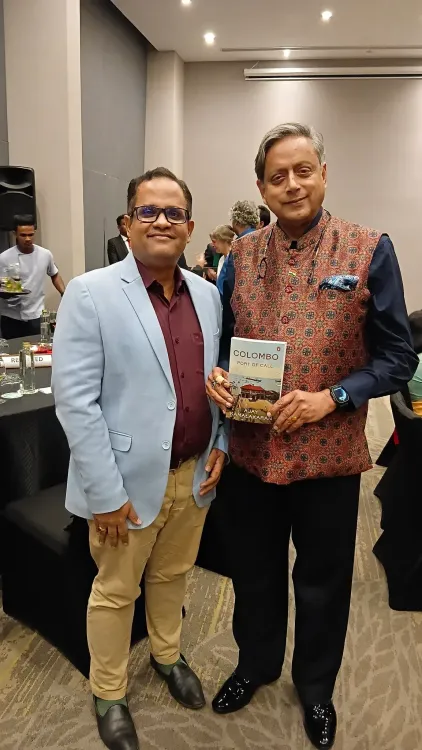
Congress MP Dr. Shashi Tharoor on Sunday, 26 July 2026, publicly congratulated writer Ajay Kamalakaran for compiling historic narratives of Colombo drawn from the accounts of famous travellers across the ages, and expressed hope that a similar volume would one day cover India.
Context
Tharoor described Kamalakaran's initiative as 'fascinating,' noting that it reconstructs the Sri Lankan capital's layered past either 'in their own words or through meticulously-recounted reconstructions of their impressions.' The project draws on the observations of notable travellers who passed through Colombo across different historical periods, weaving their perspectives into a cohesive narrative of the city's evolution.
Tharoor closed his post with a pointed wish: 'I hope he will do the same thing for India next!' — signalling both his enthusiasm for the format and a clear appetite for a comparable treatment of Indian cities and heritage sites.
Policy Backdrop
Dr. Tharoor has a long personal investment in historical narrative and cultural diplomacy. His 2012 book Pax Indica examined India's foreign-policy relationships across South Asia and beyond, including its ties with Sri Lanka. He has consistently championed projects that reconstruct pre-modern travel routes and shared cultural memory across the Indian Ocean region.
The genre of traveller-narrative compilation has a distinguished lineage in South Asian historiography. Accounts by medieval Arab, Chinese, Persian, and European visitors — from Ibn Battuta to Xuanzang — have long served as primary sources for reconstructing urban and social history in the absence of comprehensive local archives. Colombo, as a major port on the Indian Ocean trade network, features prominently in many such records.
Stakeholders and Impact
The immediate audience for Kamalakaran's Colombo project is cultural historians, heritage readers, and the South Asian diaspora with an interest in the region's pre-colonial and colonial past. Sri Lanka and India share centuries of documented cultural, religious, and trade exchange, and projects that surface these connections tend to resonate across both countries.
Tharoor's public endorsement — given his standing as a published historian, parliamentarian, and former UN Under-Secretary-General — is likely to draw wider attention to the initiative among English-language readers in India and the Sri Lankan diaspora. His expressed hope for an India-focused sequel could also encourage publishers and researchers working in the same vein.
What's Next
The most immediate development to watch is any formal announcement by Ajay Kamalakaran regarding publication details or a timeline for the Colombo volume. Tharoor's public nudge toward an India edition may also prompt conversations within literary and heritage circles about which Indian cities — Varanasi, Calicut, Mahabalipuram, or Delhi, among others — are most richly documented in traveller accounts and therefore most suited to a similar treatment. As interest in shared South Asian heritage continues to grow among general readers, projects that bridge archival scholarship and accessible narrative are well-positioned to find a broad audience.
Point of View
He is doing more than offering praise: he is signalling a gap in the popular-history market that he believes deserves filling. This fits a broader pattern in which Indian politicians with intellectual profiles use social media to shape cultural conversations rather than purely policy ones. The post is unlikely to generate political controversy but could meaningfully amplify the Colombo project's reach among the reading public.
NationPress
24 Oct 2026
Frequently Asked Questions
What is Ajay Kamalakaran's Colombo project about?
Ajay Kamalakaran's project compiles historic narratives of Colombo through the accounts of famous travellers who visited the city across different ages, presented either in their own words or through carefully reconstructed impressions of the city.
Why did Shashi Tharoor comment on this project?
Dr. Shashi Tharoor, a Congress MP and published historian, called the initiative 'fascinating' and congratulated Kamalakaran on social media, also expressing hope that a similar traveller-narrative volume would be produced for India.
What is Shashi Tharoor's connection to history and culture?
Dr. Tharoor is the author of several books on Indian history and foreign policy, including Pax Indica (2012), and has consistently championed projects that explore South Asian cultural heritage and Indian Ocean history.
Which travellers historically wrote about Colombo?
Colombo, as a major Indian Ocean port, was documented by medieval Arab, Chinese, Persian, and European travellers over the centuries; their accounts form a key primary-source base for reconstructing the city's pre-modern history.
Could a similar traveller-narrative book be made for India?
Dr. Tharoor's post explicitly expresses that hope, and cities such as Varanasi, Calicut, and Delhi feature extensively in historical traveller accounts, making them natural candidates for a comparable project.