Tharoor backs IIM Kozhikode chief's call for purpose-led education

Synopsis
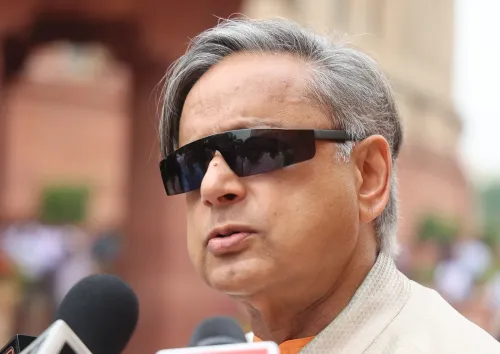
Congress MP Dr. Shashi Tharoor endorsed IIM Kozhikode Director Prof. Debashis Chatterjee's argument that Indian education must prioritise purpose over placement, that youth unrest signals institutional failure, and that judgment, empathy and trust remain beyond AI's reach.
Key Takeaways
Shashi Tharoor shared a conversation between journalist John Mary and Prof.
Debashis Chatterjee , Director of IIM Kozhikode , on 19 October 2026 .
Chatterjee argues youth restlessness should be read as 'a revolt against an outdated status quo,' not a behavioural problem.
The central claim is that education must be about purpose rather than placement outcomes.
Human qualities — judgment, empathy, and trust — are identified as beyond the current reach of artificial intelligence.
Chatterjee calls for moving Kerala 's public discourse beyond 'corrosive negativity,' a point Tharoor specifically highlights.
IIM Kozhikode , established in 1996 , is positioned as a voice in India's ongoing education debate under the NEP 2020 framework.
Youth restlessness as a symptom of systemic failure, education as a search for purpose rather than a ticket to placement, and human qualities — judgment, empathy, trust — as the last frontier AI cannot cross: these are the ideas Congress MP Dr. Shashi Tharoor amplified on Monday, 19 October 2026, sharing a conversation between senior journalist John Mary and Prof. Debashis Chatterjee, Director of IIM Kozhikode.
Tharoor described the exchange as 'a thoughtful conversation', endorsing Chatterjee's reading of youth unrest as 'a revolt against an outdated status quo' — a framing that cuts against the familiar habit of treating young people's disaffection as a discipline problem rather than a diagnostic signal about institutions.
Purpose over placement: what Chatterjee is arguing
Prof. Debashis Chatterjee, who leads IIM Kozhikode — established in 1996 as part of India's push to spread premium management education beyond the metros — has built a visible public voice on leadership and the philosophy of education. His argument, as Tharoor summarises it, is direct: education that reduces itself to a placement pipeline is not education at all. It hollows out the very qualities — judgment, empathy, the capacity to earn and extend trust — that no algorithm can replicate.
The timing is pointed. India is in the middle of implementing the National Education Policy 2020, which formally shifted the stated ambition of higher education toward holistic development and critical thinking. The gap between that stated ambition and the ground reality of entrance-exam monocultures and campus-placement obsession is precisely the terrain Chatterjee appears to be mapping.
Kerala's public discourse and the cost of corrosive negativity
Tharoor reserves particular emphasis for one strand of the conversation: Chatterjee's appeal to move Kerala's public discourse 'beyond corrosive negativity.' The state carries a paradox — among the highest literacy rates in India, a tradition of fierce democratic debate, and yet a tone in political and social conversation that can curdle into cynicism. For a sitting Thiruvananthapuram MP to amplify that appeal is itself a signal, directed squarely at the state's political and media culture.
Kerala has long been a laboratory for education debates: whether its model is exportable, whether its youth exodus to the Gulf and beyond is a policy failure or a rational choice, and now whether its institutions are equipping the next generation for a world being reshaped by artificial intelligence. Chatterjee's intervention — and Tharoor's endorsement — lands inside all three of those live conversations at once.
The AI boundary that keeps moving
The most consequential claim in the exchange, as Tharoor frames it, is the one about AI's limits. The assertion that 'judgment, empathy and trust remain beyond the reach of AI' is both a reassurance and a challenge. It is a reassurance because it locates the irreducible value of human education. It is a challenge because it demands that institutions actually cultivate those qualities — not merely claim to, while silently optimising for placement statistics.
That challenge is aimed not just at management schools but at the entire architecture of Indian higher education, which is undergoing its most significant formal redesign in decades under the NEP 2020 framework. Whether the redesign produces genuine purpose or just a new vocabulary for old habits is the open question this conversation is pressing.
The ideas Tharoor is amplifying are not new — but the moment they are being amplified in is. If India's youth restlessness is indeed a revolt, the more urgent question is whether its institutions have the imagination to respond.
Point of View
While implicitly contrasting the NEP 2020's stated aspirations with the placement-driven reality of campus culture. The Kerala-specific appeal against 'corrosive negativity' is a rare instance of a politician publicly asking his own political ecosystem to self-correct. More broadly, the post reflects a growing pattern among senior politicians of using curated intellectual content on social media to signal ideological positioning on AI and education — a constituency-building exercise aimed at students, educators, and a reform-minded middle class.
NationPress
19 Oct 2026
Frequently Asked Questions
Who is Prof. Debashis Chatterjee of IIM Kozhikode?
Prof. Debashis Chatterjee is the Director of IIM Kozhikode, an institution established in 1996 in Kerala. He is known for his work on leadership education and organisational behaviour and has become a prominent public voice on the philosophy and purpose of higher education in India.
What did Shashi Tharoor say about education and AI?
Tharoor shared a conversation in which Prof. Debashis Chatterjee argues that education must be about purpose rather than mere placement, and that qualities like judgment, empathy, and trust remain beyond the reach of artificial intelligence — making human-centred education more important, not less, in the AI era.
What is IIM Kozhikode and when was it established?
IIM Kozhikode is a premier Indian Institute of Management located in Kerala, established in 1996 as part of India's expansion of top-tier management education beyond traditional metros. It focuses on management education, research, and leadership development.
What does 'purpose over placement' in education mean?
'Purpose over placement' refers to the idea that higher education should develop critical thinking, judgment, and ethical awareness in students rather than optimising solely for campus recruitment outcomes. This argument aligns with the stated goals of India's National Education Policy 2020, which emphasises holistic development.
Why is Tharoor calling for Kerala's public discourse to change?
Tharoor endorsed Chatterjee's appeal to move Kerala's public conversation 'beyond corrosive negativity,' reflecting concern that a persistently cynical or hostile political and social tone undermines constructive debate in a state otherwise known for high literacy and civic engagement.