Tharoor Meets IYC Team on Youth Engagement Strategy
Synopsis
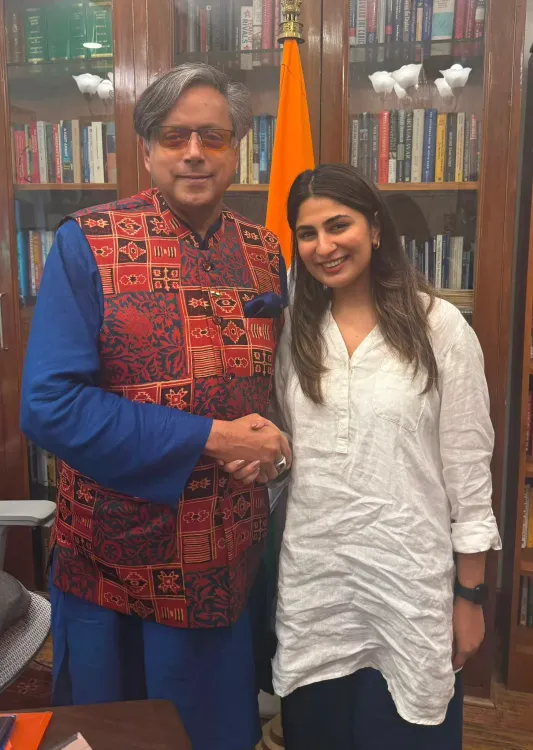
Congress MP Dr. Shashi Tharoor met Indian Youth Congress communications staffers on July 5, 2026, to discuss deepening youth engagement with the party and strengthening democratic participation among the next generation of voters.
Key Takeaways
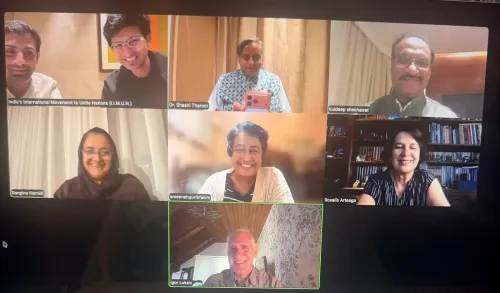
Shashi Tharoor held a meeting with IYC communications team members, including his former intern Mehar and colleague Rahul , on July 5, 2026 .
The discussion focused on recent political developments and the challenge of deepening Congress youth engagement.
The Indian Youth Congress is the party's primary mechanism for mobilising voters aged 18 to 35 .
The Congress reorganised its youth wing after the 2014 general election to strengthen digital outreach and state-level leadership pipelines.
Upcoming IYC state-level organisational elections and potential youth quotas are key indicators of whether such consultations produce structural change.
Congress MP Dr. Shashi Tharoor met with young members of the Indian National Congress communications team, including his former intern Mehar and her colleague Rahul, both handling communications for the Indian Youth Congress (IYC), on Sunday, July 5, 2026, to discuss recent political developments and strategies for deepening youth engagement with the party.
Context
Tharoor described the meeting as 'a productive discussion' focused on the 'challenge of deepening youth engagement with the Congress.' The conversation, he noted, centred on 'recent political developments' and ways to strengthen democratic participation among the next generation. The IYC serves as the primary vehicle through which the Congress attempts to mobilise voters aged 18 to 35.
The meeting brought together a former Union Minister and UN Under-Secretary-General with ground-level communications operatives — a pairing that reflects the Congress's effort to bridge senior leadership experience with youth-facing digital outreach.
Policy Backdrop
The Congress undertook a significant reorganisation of its youth wing following the 2014 general election, with a focus on improving digital outreach and building state-level leadership pipelines. The party has since intensified internal youth consultations to rebuild organisational depth and counter rivals' stronger social-media penetration among first-time voters.
Established national parties across India have recognised that cadre networks among young voters — particularly those engaging with politics for the first time — are critical to electoral outcomes in an era where digital communication shapes political narratives as much as ground-level mobilisation.
Stakeholders and Impact
IYC office-bearers and communications staff are at the centre of this effort, tasked with translating the Congress's policy positions into formats that resonate with younger, digitally active audiences. Tharoor, who maintains a significant presence on social media himself, brings both institutional credibility and a model of public engagement that the IYC team can draw on.
Young voters represent a decisive demographic in Indian elections. The Congress's ability to activate this segment — particularly in states where its organisational presence has weakened — is widely seen as a prerequisite for rebuilding its national footprint ahead of the next Lok Sabha cycle.
What's Next
Attention will now turn to whether such consultations translate into structural changes within the IYC, including state-level organisational elections or the introduction of youth quotas in party decision-making bodies. Tharoor's engagement signals that senior Congress figures are investing time in the party's generational renewal project.
The broader question is whether the Congress can convert internal dialogue into on-ground mobilisation capacity — a gap that has persisted since 2014 and one that the party's leadership has repeatedly acknowledged as a priority.
Point of View
Youth quotas, new digital campaigns — will be the real test.
NationPress
3 Oct 2026
Frequently Asked Questions
Why did Shashi Tharoor meet the Indian Youth Congress team?
Tharoor met IYC communications staffers to discuss recent political developments and explore ways to deepen youth engagement with the Congress and strengthen democratic participation among younger voters.
What is the Indian Youth Congress?
The Indian Youth Congress is the youth wing of the Indian National Congress, tasked with mobilising voters aged 18 to 35 and building the party's grassroots and digital presence among younger demographics.
What is Shashi Tharoor's role in the Congress party?
Dr. Shashi Tharoor is the Congress MP from Thiruvananthapuram, a former Union Minister, and a former UN Under-Secretary-General who is one of the party's most prominent voices on national and international affairs.
How has Congress tried to improve youth outreach since 2014?
After the 2014 general election, the Congress reorganised the IYC to improve digital outreach and state-level leadership pipelines, and has since intensified internal youth consultations to counter rivals' stronger social-media penetration among first-time voters.
What should we watch for after this meeting?
Key indicators include state-level IYC organisational elections, announcements of youth quotas in party bodies, and any new digital communication campaigns targeting first-time and young voters ahead of the next Lok Sabha cycle.