Tharoor mourns ex-colleague KP Dhanabalan, calls him 'unluckiest politician'
Synopsis
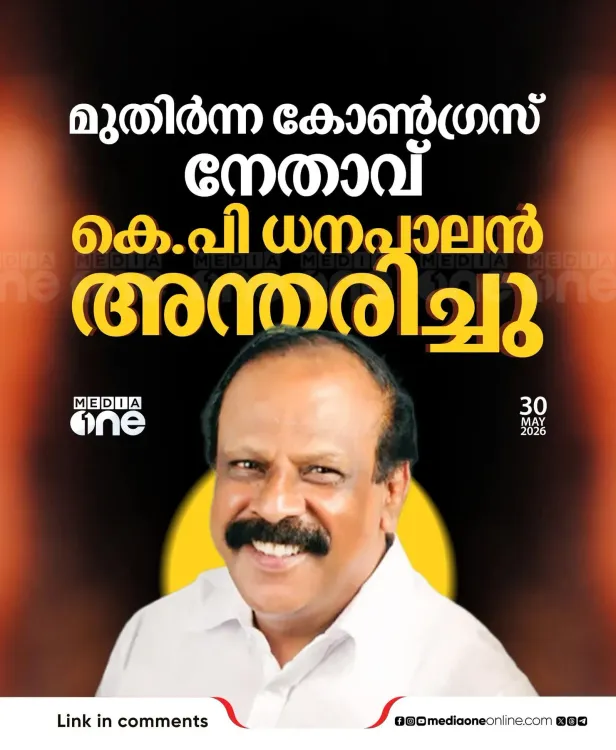
Congress MP Dr. Shashi Tharoor has mourned the passing of former Lok Sabha colleague KP Dhanabalan, who served in the 15th Lok Sabha (2009–14). Tharoor called him the 'unluckiest politician' he knew, noting Dhanabalan lost his seat in 2014 after being displaced by a party reshuffle and never returned to public office.
Key Takeaways
KP Dhanabalan , a Congress Lok Sabha MP from the 2009–2014 term, has passed away.
Shashi Tharoor described him as the 'unluckiest politician' in his experience.
Dhanabalan was shifted from his own constituency ahead of the 2014 elections to accommodate a senior Congress colleague; both men lost.
He never held public office again after the 2014 defeat .
Tharoor praised him as 'decent, hard-working and a man of integrity.' The case reflects a broader pattern of Congress candidate reshuffles that disadvantaged sitting MPs in the 2014 general elections .
Congress MP Dr. Shashi Tharoor on Saturday, 30 May 2026, paid tribute to KP Dhanabalan, a former Lok Sabha colleague who served alongside him in the 15th Lok Sabha (2009–2014), describing his passing as a deep personal loss and calling him the 'unluckiest politician' he had known in public life.
Context
Tharoor, writing on X, recalled that Dhanabalan had 'devotedly cultivated his constituency' during his tenure as a Congress MP but was displaced from it ahead of the 2014 general elections to make room for a senior party colleague. Dhanabalan was instead asked to contest from that senior colleague's seat — a decision that cost both men their parliamentary careers. 'Both lost in the 2014 rout,' Tharoor noted, adding that Dhanabalan 'always believed he could have held his own seat.'
Tharoor described him as 'decent, hard-working and a man of integrity' who 'never again held public office' after that defeat, and said he 'will be much missed.'
Policy Backdrop
The 2014 Lok Sabha elections were catastrophic for the Indian National Congress, which was reduced to just 44 seats — its worst-ever performance — from 206 seats won in the 2009 elections. The scale of the defeat was shaped by a combination of strong anti-incumbency against the UPA government and widespread organisational dysfunction, including controversial candidate selection decisions made by the party's central leadership.
Ahead of the 2014 polls, the Congress undertook significant constituency reshuffles to accommodate senior leaders, a practice that repeatedly disadvantaged sitting MPs who had invested years in building local support. Dhanabalan's case, as described by Tharoor, exemplifies a pattern that affected several first-term MPs from the 2009 batch who were moved or dropped despite credible local work.
Stakeholders and Impact
Dhanabalan's story resonates with a broader class of Congress legislators who entered Parliament in the wave of the 2009 UPA victory and found their political futures curtailed not by voter rejection but by internal party arithmetic. For many such MPs, the 2014 ticket reshuffle marked the end of their public careers, with no subsequent path back to elected office.
Tharoor's tribute, coming from a senior and internationally prominent Congress figure, lends weight to the retrospective assessment of how the party's candidate management decisions compounded its 2014 losses. The post has drawn attention to the human cost of such organisational choices on individual political careers built through grassroots constituency work.
What's Next
Formal condolence motions or tributes in the Lok Sabha may follow in the next session, as is customary upon the passing of former members of the House. Within the Congress, Dhanabalan's case may surface in ongoing organisational reviews and discussions about candidate selection processes ahead of future elections — a debate the party has revisited repeatedly since its 2014 and 2019 defeats. Tharoor's public tribute ensures the late MP's legacy and the circumstances of his political displacement remain part of the party's institutional memory.
Point of View
Tharoor draws attention to how internal accommodation of senior leaders systematically undermined ground-level workers who had earned their seats. The tribute arrives at a moment when Congress is again engaged in organisational reform discussions, making the implicit lesson pointed. It also signals that the human cost of the 2014 collapse — beyond vote counts — remains a live memory among the party's parliamentary generation from that era.
NationPress
13 Oct 2026
Frequently Asked Questions
Who was KP Dhanabalan?
KP Dhanabalan was a Congress Lok Sabha MP who served in the 15th Lok Sabha from 2009 to 2014, known for his constituency work before losing his seat in the 2014 general elections following an internal party reshuffle.
Why does Shashi Tharoor call KP Dhanabalan the 'unluckiest politician'?
Tharoor used the phrase because Dhanabalan had diligently built his constituency but was moved from it by the Congress party ahead of 2014 to accommodate a senior colleague; both Dhanabalan and the senior colleague then lost, ending Dhanabalan's political career permanently.
What happened to Congress in the 2014 elections?
Congress suffered its worst-ever electoral result in 2014, winning only 44 Lok Sabha seats compared to 206 in 2009, a collapse attributed to anti-UPA incumbency and internal organisational problems including controversial candidate selection decisions.
Did KP Dhanabalan ever return to politics after 2014?
According to Shashi Tharoor's tribute, Dhanabalan never again held public office after his 2014 defeat.
Why did Congress move candidates to different constituencies in 2014?
The Congress central leadership undertook widespread constituency reshuffles ahead of the 2014 elections to accommodate senior party leaders, a recurring feature of its candidate selection process that often displaced sitting MPs with established local support.