Is Shashi Tharoor Right to Call the Union Budget ‘Underwhelming’?
Synopsis
Congress MP Shashi Tharoor sharply criticizes the Union Budget, deeming it a missed opportunity. He highlights concerns over agriculture funding and rising unemployment, questioning the government's commitment to vital sectors.
Key Takeaways
Tharoor criticizes the Union Budget as underwhelming.
He highlights the insufficient funding for agriculture.
Concerns raised about rising unemployment rates.
Tharoor questions the effectiveness of government initiatives.
He emphasizes the need for accountability in addressing economic challenges.
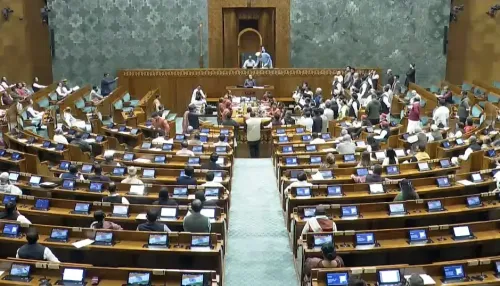
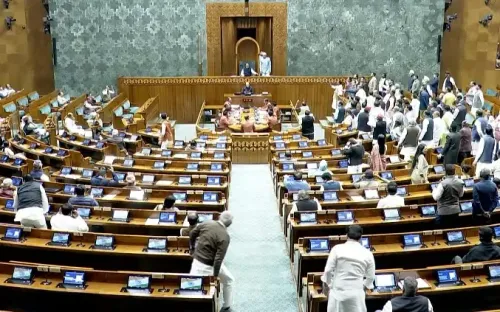
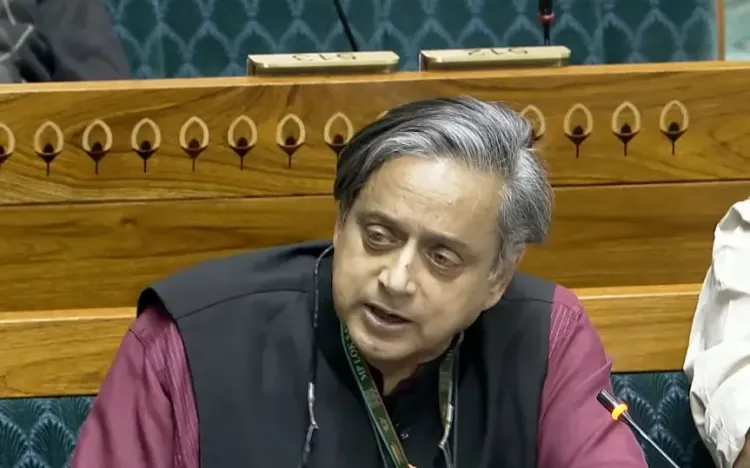
New Delhi, Feb 10 (NationPress) Congress MP Shashi Tharoor commenced the dialogue on the Union Budget in the Lok Sabha after several days of continuous disruptions as the House reconvened following its second adjournment, instigated by ongoing sloganeering from opposition members.
Participating in the discourse on behalf of the Congress, Tharoor offered a pointed critique of the Budget, labeling it as a missed opportunity to tackle urgent economic issues.
He expressed that the Union Budget resembled “a squandered opportunity akin to rearranging airbags in a vehicle that is crashing while assuring passengers of the chassis's integrity.”
Tharoor raised alarms about government spending and revenue patterns, noting that total expenditure has decreased while tax collections have not exhibited significant growth.
He further argued that the Budget indicates a shift in tax burden from corporations to individual taxpayers.
“Revenue estimates are projected at 3.1 percent from corporates while individuals will bear 3.7 percent. Thus, revenue is disproportionately coming from individual taxpayers,” he stated, adding: “It is an underwhelming Budget.”
Focusing on the agriculture sector, Tharoor pointed out the insufficient financial allocation, despite its crucial role in the Indian economy.
“It’s high time we ceased treating agriculture as an issue that will resolve itself, as 46.1 percent of India’s workforce and 60 percent of our population depend on agriculture and allied activities. Despite agriculture contributing 16-17 percent of GDP, it receives merely 3 percent of this Union Budget, Rs 1.62 lakh crore, which is a 5.1 percent reduction from last year’s Rs 1.71 lakh crore,” he remarked.
He cautioned that decreased funding is particularly alarming at a time when agriculture faces increasing challenges.
“This underinvestment is even more concerning given the existential threats confronting Indian agriculture today. This sector, vital as it is, is increasingly endangered by climate change and misaligned farming practices,” he elaborated.
Addressing climate vulnerabilities, Tharoor noted, “Nearly two-thirds of the country is susceptible to drought, and the impact of weather-related disasters has been severe. Yet, the Fasal Bima Yojana, designed to safeguard farmers, has faltered. Flawed assessments and opaque settlements have reduced compensation to minimal amounts -- Rs 1, 3, 21, as your Minister himself has acknowledged -- transforming protection into systemic injustice.”
He further alleged that reduced allocations could undermine the scheme's effectiveness.
“The situation is exacerbated by cuts that leave the scheme at its lowest budget allocation in eight years, raising concerns that new initiatives will repeat a familiar cycle of announcements without commitment, as witnessed last year with grandly announced missions on cotton technology, pulses, vegetables, fruits, and hybrid seeds, which all faded quietly, with zero funding in the revised estimates. These announcements are akin to modern courtships -- promises without commitment. That is what this government does to us,” he stated.
Highlighting the direct support to farmers, Tharoor remarked: “At a moment when farm distress is escalating, the Budget's silence on adjusting the PM-Kisan Nidhi disbursement speaks louder than any promise made elsewhere.”
He also criticized the funding cuts for agricultural research and technology development.
“While there is a pressing need for breakthroughs in research and development and AI-driven agricultural technologies, ironically, funding allocations for agricultural research and education have decreased by 4.8 percent from the previous year’s Rs 10,466 crore -- now down to Rs 9,967 crore -- falling just when the Finance Minister is announcing new AI schemes,” he elaborated.
Expressing doubts over the feasibility of technological initiatives, Tharoor said, “Frankly, doubting a new AI app when the majority of our farmers cannot afford fertilizers, harvesters, or tractors seems rather detached from reality except for the virtual kind.”
Addressing crop-specific challenges, he noted, “This Budget discusses crops from cashews to coconuts but ignores one of agriculture's most persistent issues -- pepper. Once referred to as black gold, the sector is now in distress in my state. In Kerala, a leading producer of pepper, output has dropped from over 40,000 tonnes to 30,000 tonnes and is projected to decline further by 28.7 percent in the near future.”
“The uncomfortable truth is that our spice market faces such significant challenges today that, if history repeats itself, the British might not even bother looting us for it.”
Tharoor then shifted his focus to unemployment, stating that the situation continues to worsen despite repeated discussions in Parliament.
“Next to unemployment. This House has had this conversation far too many times,” he mentioned.
“We recite the same statistics, express the same concerns, and then move on, while unemployment continues to worsen. The data at the end of 2025 makes one thing clear. Rural unemployment has stagnated at 3.9 percent, while urban unemployment continues to rise, ending at 6.7 percent in December,” he added.
Highlighting the escalating pressure in urban areas, Tharoor remarked: “The crisis is now beginning to concentrate, where aspirations and frustrations are colliding in our cities. And yet, even the Centre's flagship responses have failed to meet the moment. Under the Pradhan Mantri Kaushal Vikas Yojana, only 41 percent of certified candidates secured placements.”
Point of View
It is crucial to acknowledge Shashi Tharoor's concerns regarding the Union Budget's implications for crucial sectors like agriculture and employment. His insights reflect a broader sentiment of unease among citizens regarding the government's direction. It is imperative that we remain vigilant and demand accountability from our leaders as we navigate these challenging times.
NationPress
19 Sept 2026
Frequently Asked Questions
What are Shashi Tharoor's main criticisms of the Union Budget?
Tharoor criticizes the Union Budget for inadequate funding in agriculture, a disproportionate tax burden on individual taxpayers, and insufficient measures to address rising unemployment.
How does Tharoor view the allocation for agriculture?
He believes that agriculture, which employs a significant portion of the workforce, is underfunded, receiving only 3% of the Union Budget despite its substantial contribution to GDP.
What are the implications of decreased funding in agriculture?
Tharoor warns that reduced funding could exacerbate existing challenges in the agricultural sector, especially in the face of climate change and other pressing issues.
What does Tharoor say about unemployment?
Tharoor highlights that unemployment is worsening, particularly in urban areas, and criticizes the government's ineffective responses to the crisis.
What is the significance of Tharoor's statements?
Tharoor's statements underscore the urgent need for the government to address critical economic issues that impact a large portion of the population.