Tamil Nadu Assembly Passes Unanimous Resolution Honouring Tamil Language
Synopsis
The Tamil Nadu Legislative Assembly unanimously passed a historic resolution on 10 August 2026 affirming Tamil's antiquity, cultural identity, and civilisational significance. The Chief Minister's Office hailed it as the highest tribute to Tamil Thaai, with all parties voting in favour.
Key Takeaways
The Tamil Nadu Legislative Assembly passed a unanimous resolution on 10 August 2026 honouring the Tamil language's antiquity and cultural identity.
Every party in the Assembly voted in favour, making it a rare all-party consensus on a cultural matter.
The resolution was described as 'a tribute of the highest order to Tamil Thaai' by the Chief Minister's Office.
Tamil was officially recognised as a classical language of India by the Union government in 2004 , the first Indian language to receive that status.
Tamil Nadu governments have a long tradition of using legislative resolutions to affirm Dravidian linguistic and cultural primacy.
The post called for Tamil's glory to 'rise across the world,' signalling outreach to the global Tamil diaspora.
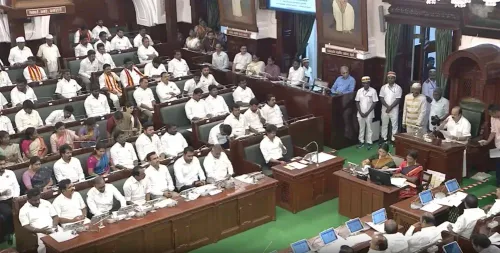
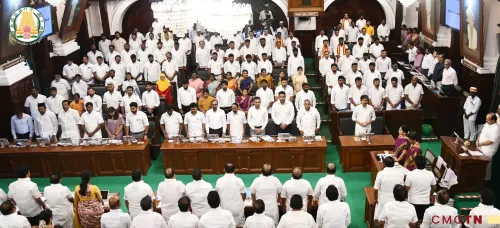
A unanimous voice in a legislative chamber can carry the weight of centuries. On Monday, 10 August 2026, the Tamil Nadu Legislative Assembly passed a historic resolution honouring the antiquity, uniqueness, and cultural glory of the Tamil language — and every single party in the House voted for it.
The Chief Minister's Office of Tamil Nadu shared the announcement on X, quoting the sentiment at the heart of the resolution: 'தமிழ் ஒரு மொழி மட்டுமன்று' — 'Tamil is not merely a language; it is thought, culture, and civilisation. Tamil is our life; Tamil is our emotion.' The post described the resolution as 'a tribute of the highest order to Tamil Thaai' — the revered personification of the Tamil language as a mother goddess — and declared the day one that 'will remain forever in the history of Tamil Nadu.'
What the All-Party Resolution Actually Says
The resolution, passed with cross-party support, is framed as a formal affirmation of Tamil's antiquity, distinctiveness, and the emotional identity it holds for Tamil people worldwide. The Chief Minister's Office expressed 'heartfelt gratitude' to all parties for supporting the measure unanimously — a phrase that signals the political significance of the moment. In Tamil Nadu's often fractious legislative politics, unanimous consent on a cultural resolution is itself a statement. The post closed with two rallying lines: 'உலகெங்கும் தமிழ்த்தாயின் புகழ் ஓங்கட்டும்!' — 'May the glory of Tamil Thaai rise across the world!' — and a call for Tamil Nadu's 'victory journey' to continue.Tamil's Classical Status and the Dravidian Policy Tradition
The resolution lands on ground with deep historical roots. In 2004, the Government of India officially recognised Tamil as a classical language — the first Indian language to receive that designation — acknowledging a literary tradition stretching back more than two millennia. Tamil Nadu governments, across administrations, have consistently used legislative resolutions and state policy to anchor Dravidian linguistic identity as a political and cultural cornerstone. Such moves have historically also served as a counterweight to perceived linguistic centralisation from New Delhi. For the Tamil diaspora — one of the most globally dispersed linguistic communities in the world — resolutions of this kind carry resonance far beyond the chamber in Chennai. The next test will be whether the resolution translates into executive action: budget allocations for Tamil classical studies, international cultural outreach, or new institutional frameworks. Words on the floor of the Assembly are the beginning. The ink on policy orders is what endures.Point of View
And this resolution reinforces that continuity. The explicit invocation of the global Tamil diaspora suggests an outward-facing dimension, potentially positioning the state as the custodian of Tamil civilisation beyond India's borders. The real measure of intent will come in the budget and executive orders that follow — or don't.
NationPress
25 Sept 2026
Frequently Asked Questions
What resolution did the Tamil Nadu Assembly pass in August 2026?
The Tamil Nadu Legislative Assembly unanimously passed a resolution on 10 August 2026 honouring the antiquity, uniqueness, and cultural significance of the Tamil language, describing it as a tribute to Tamil Thaai.
Did all parties in Tamil Nadu support the Tamil language resolution?
Yes. The Chief Minister's Office confirmed that all parties in the Tamil Nadu Legislative Assembly voted unanimously in favour of the resolution.
When was Tamil recognised as a classical language of India?
The Government of India officially recognised Tamil as a classical language in 2004 , making it the first Indian language to receive that designation.
What does Tamil Thaai mean?
Tamil Thaai literally means 'Tamil Mother' and is the revered personification of the Tamil language as a mother goddess, a central symbol in Tamil cultural and political identity.
What happens after the Tamil Nadu Assembly passes a cultural resolution?
Legislative resolutions are formal expressions of intent. The practical impact depends on subsequent executive orders, budget allocations, and policy programmes — such as funding for Tamil classical studies or international cultural outreach — that the government may announce.