TN CM Joseph Vijay Meets Army's Southern Area Commander
Synopsis
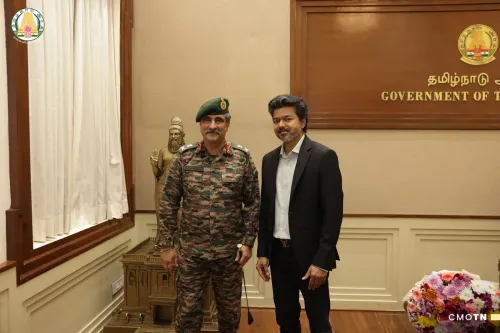
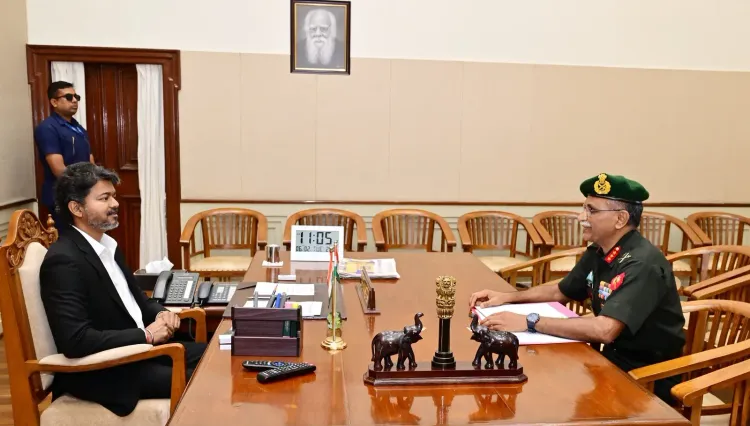
Tamil Nadu Chief Minister C. Joseph Vijay received Lt Gen V. Srihari, General Officer Commanding of the Dakshin Bharat Area, at the Chennai Secretariat on 2 June 2026. The meeting reflects the established civil-military coordination framework between southern state governments and Indian Army area commands on security, disaster response, and coastal infrastructure.
Key Takeaways
Joseph Vijay met Lt Gen V.
Srihari , GOC Dakshin Bharat Area, at the Tamil Nadu Secretariat on 2 June 2026 .
The Dakshin Bharat Area is a sub-command of the Indian Army's Southern Command , covering multiple southern states.
No specific agenda was disclosed in the official CMO communication.
Civil-military coordination meetings between Tamil Nadu and Army area commands have been institutionalised since the 2004 tsunami .
Tamil Nadu's long coastline along the Bay of Bengal gives these meetings strategic significance for coastal and maritime security.
Follow-up announcements on joint exercises or coastal security projects may emerge from this interaction.
The Chief Minister's Office of Tamil Nadu announced on Tuesday, 2 June 2026 that Chief Minister C. Joseph Vijay met Lieutenant General V. Srihari, General Officer Commanding of the Dakshin Bharat Area (Southern India Army Command), at the Tamil Nadu Secretariat in Chennai. The meeting is part of established civil-military coordination protocols between state governments and Indian Army area commands.
Context
The CMO's post, shared on the morning of 2 June 2026, confirmed that Lt Gen V. Srihari — who heads the Dakshin Bharat Area, also identified in the post by its designation ABSM General Officer Commanding — called on CM Joseph Vijay at the Chief Secretariat (Thalaimai Cheyalagam) in Chennai. No specific agenda was disclosed in the official communication.
The Dakshin Bharat Area is a sub-command under the Indian Army's Southern Command, responsible for operational, training, and administrative duties across multiple southern states. Its commander routinely engages with state administrations on matters spanning coastal security, disaster response, and logistics coordination.
Policy Backdrop
Civil-military coordination meetings between southern state chief ministers and area commanders have been a standing feature of India's federal security architecture, particularly since the 2004 Indian Ocean tsunami, which underscored the need for rapid civil-military cooperation in disaster relief. Defence remains a Union subject under the Indian Constitution, but states play a critical role in facilitating ground-level logistics, law and order, and resource allocation during joint operations.
The Indian Army's Southern Command has historically coordinated with Tamil Nadu on coastal security infrastructure, flood relief operations — including during the devastating Chennai floods — and training exercises involving state police and disaster management agencies. Such meetings provide a regular channel for commanders to brief state leadership on operational readiness and to align on shared priorities.
Stakeholders and Impact
Tamil Nadu, with its extensive coastline along the Bay of Bengal and the Palk Strait, has significant strategic relevance for southern theatre operations. The state's proximity to Sri Lanka and active maritime zones makes coordination between the state government and Army area commands particularly consequential for coastal surveillance and maritime security.
For the Tamil Nadu government, such interactions signal active engagement with national security institutions — a visible demonstration of cooperative federalism on defence-adjacent matters. For the Indian Army, state-level buy-in is essential for smooth execution of exercises, land acquisition processes, and emergency deployments.
What's Next
While no follow-up announcements have been made public, meetings of this nature often precede or accompany decisions on joint civil-military exercises, upgrades to coastal surveillance infrastructure, or formal agreements on disaster response protocols. Observers will watch for any official statements from either the Tamil Nadu government or Southern Command headquarters on outcomes of the discussion. The meeting signals that civil-military ties in the southern region remain active and institutionally grounded, even as the broader national conversation around theatre commands continues to evolve.
Point of View
Receiving the Dakshin Bharat Area commander at the Secretariat is also a signal of engagement with the national security establishment, which carries political weight in a state with significant defence infrastructure and a large military-affiliated population. The absence of a disclosed agenda keeps the meeting formally routine, but its timing and visibility suggest both sides see value in reinforcing the relationship. Analysts will track whether this leads to concrete outcomes in coastal security or disaster preparedness frameworks.
NationPress
16 Oct 2026
Frequently Asked Questions
Why did the Army commander meet Tamil Nadu CM Joseph Vijay?
Lt Gen V. Srihari , GOC Dakshin Bharat Area, met CM Joseph Vijay at the Tamil Nadu Secretariat on 2 June 2026 as part of routine civil-military coordination. Such meetings are a standard mechanism for aligning state governments and Indian Army area commands on security, disaster response, and logistics matters.
What is the Dakshin Bharat Area in the Indian Army?
The Dakshin Bharat Area is a sub-command under the Indian Army's Southern Command, responsible for operational, training, and administrative functions across southern Indian states. Its General Officer Commanding oversees military formations and coordinates with state governments in the region.
Who is Lt Gen V. Srihari?
Lieutenant General V. Srihari is the General Officer Commanding of the Dakshin Bharat Area, the Indian Army's southern sub-command. He is responsible for military coordination across multiple southern states, including Tamil Nadu.
What issues are discussed in civil-military meetings in Tamil Nadu?
Civil-military meetings in Tamil Nadu typically cover coastal security , disaster relief coordination, joint exercises, and infrastructure support. Tamil Nadu's extensive Bay of Bengal coastline makes it a priority area for the Indian Army's southern formations.
Does Tamil Nadu have a role in India's coastal security?
Yes. Tamil Nadu has a long coastline along the Bay of Bengal and the Palk Strait, making it strategically important for maritime surveillance and coastal security. The state government coordinates with the Indian Army and Coast Guard on these matters within the constitutional framework where defence is a Union subject.