Uttarakhand CM unveils Vision-2047: ₹28 lakh crore economy target
Synopsis
Uttarakhand has unveiled Viksit Uttarakhand Vision-2047, a 440-indicator roadmap targeting a ₹28 lakh crore economy, ₹20 lakh per-capita income, 22,000 MW energy capacity, and near-elimination of multidimensional poverty by 2047, with a proposed two-tier governance body for implementation.
Key Takeaways
Viksit Uttarakhand Vision-2047 uses approximately 440 indicators to set phased targets across 2030, 2035, 2040, 2047, and 2050.
The state aims to grow its economy to ₹28 lakh crore and raise per-capita income to ₹20 lakh by 2047.
Unemployment is targeted at 3.5 percent and multidimensional poverty at 0.61 percent by 2047.
Installed energy capacity is projected to reach 22,000 MW and forest cover to 46.6 percent .
A proposed Devbhoomi Parivar Pradhikaran at the state level and district officers will anchor implementation.
NITI Aayog participation signals alignment with the national Viksit Bharat @2047 framework.
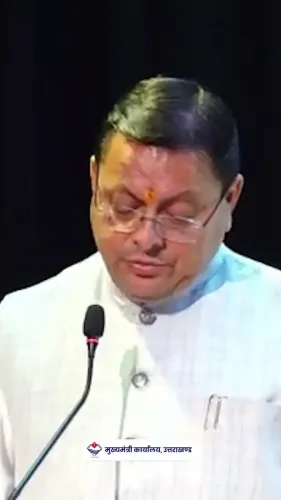
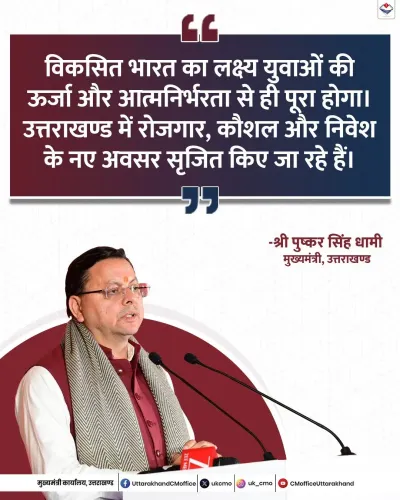
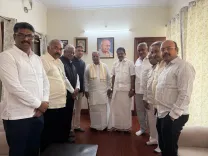
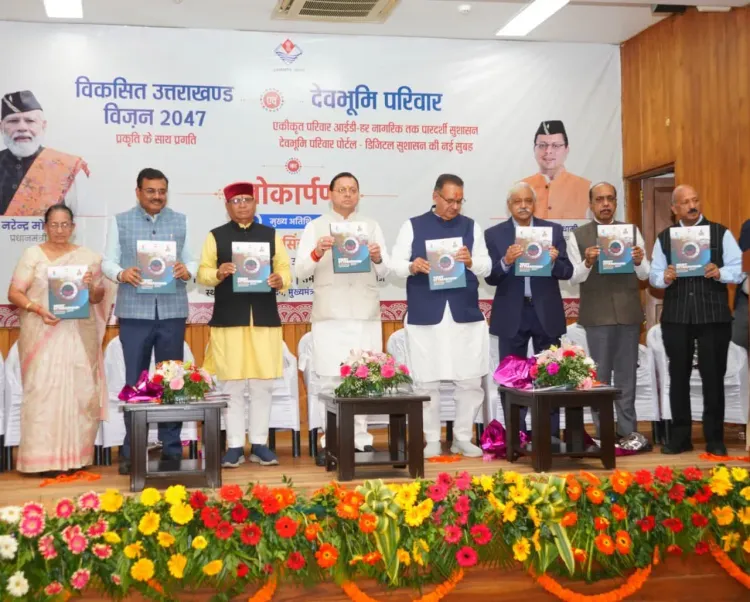
A ₹28 lakh crore economy, per-capita income touching ₹20 lakh, and an energy capacity of 22,000 MW — these are not the ambitions of a national budget. They belong to a single Himalayan state that is now charting its own course to 2047. The Chief Minister's Office of Uttarakhand shared details on Monday, 2 November 2026, of a high-level meeting where Viksit Uttarakhand Vision-2047 — the state's long-term development blueprint — was formally presented to Chief Minister Pushkar Singh Dhami and senior officials.
440 indicators, five milestone years
The state's Principal Secretary R.K. Sudhanshu walked the room through the architecture of the vision document, built around approximately 440 indicators spanning sectors from agriculture and tourism to skill development and environmental conservation. The document does not treat 2047 as a single distant horizon — it sets distinct targets for 2030, 2035, 2040, 2047, and 2050, giving each government department a phased action-plan framework and a mandate for regular progress reviews.
The headline numbers are striking: unemployment to be brought down to 3.5 percent, and multidimensional poverty compressed to just 0.61 percent by 2047. Forest cover — already a defining feature of the state's identity — is targeted to reach 46.6 percent, alongside the sharp jump in installed energy capacity.
Devbhoomi Parivar Pradhikaran: the governance layer
The vision's delivery architecture drew particular attention. A state-level body called Devbhoomi Parivar Pradhikaran is proposed to oversee implementation, with corresponding District Devbhoomi Parivar Officers anchoring the effort at the grassroots. The two-tier structure signals an intent to move beyond a paper document toward institutionalised accountability — though the authority's exact legal mandate is yet to be formalised.
Setu Aayog, Uttarakhand's state planning body, has been the primary architecture behind the document. Its Chief Executive Officer Shatrughan Singh and adviser Dinesh Aggarwal were present, alongside NITI Aayog Programme Director Dr. Sonia Pant — whose participation signals alignment with the national Viksit Bharat @2047 framework launched by the Government of India in 2022-23.
Who was in the room — and why it matters
The meeting brought together Cabinet Ministers Ganesh Joshi and Khajan Das, MLA Savita Kapoor, Chief Secretary Anand Bardhan, and senior official Aditya Kumar. District magistrates and district-level officers across the state joined via video link, underscoring that this was not a Dehradun-only exercise. The Chief Minister, the CMO noted, expressed confidence that combined efforts of government, administration, and public participation would accelerate Uttarakhand's development trajectory and contribute meaningfully to the Prime Minister's Viksit Bharat vision.
The sectors singled out for priority — agriculture, tourism, industry, education, health, employment, skill development, connectivity, and environmental conservation — map closely onto Uttarakhand's existing economic identity as a hill state where geography shapes every opportunity and every constraint.
From vision to verifiable milestones
The immediate test will come when individual departments translate the 440-indicator framework into concrete annual plans and the first formal review of 2030 targets falls due. Whether the proposed Devbhoomi Parivar Pradhikaran clears legislative hurdles and gains statutory teeth will determine how much of this vision becomes machinery — and how much remains aspiration.
Uttarakhand, a state with a population of roughly 11 million and an economy historically dependent on government employment, tourism, and remittances, is making a deliberate bet that indicator-driven planning can compress decades of development into a generation. The numbers are ambitious. The architecture is being built. Now comes the hard part.
Point of View
If legislatively constituted, would represent a rare institutionalisation of vision monitoring at the district level, moving accountability below the secretariat. The inclusion of NITI Aayog in the room signals that the Centre is actively curating state alignment, not just issuing guidelines. The real political test arrives when the 2030 milestone reviews begin and the gap between projections and performance becomes publicly auditable.
NationPress
2 Nov 2026
Frequently Asked Questions
What is Viksit Uttarakhand Vision-2047?
Viksit Uttarakhand Vision-2047 is a long-term development blueprint prepared by the Uttarakhand government using approximately 440 indicators to set phased economic, social, and environmental targets for the state through the year 2047.
What is the GDP target of Uttarakhand by 2047?
Uttarakhand's Vision-2047 sets a target to grow the state economy to approximately ₹28 lakh crore and achieve a per-capita income of approximately ₹20 lakh by 2047.
What is Devbhoomi Parivar Pradhikaran?
Devbhoomi Parivar Pradhikaran is a proposed state-level authority that, along with district-level Devbhoomi Parivar Officers, is intended to oversee and implement schemes under the Vision-2047 framework in Uttarakhand.
What are Uttarakhand's energy and forest cover targets for 2047?
Uttarakhand aims to raise its installed energy capacity to approximately 22,000 MW and expand forest cover to 46.6 percent of the state's area by 2047.
How does Uttarakhand's Vision-2047 relate to Viksit Bharat @2047?
The state document is aligned with the Government of India's national Viksit Bharat @2047 vision, launched in 2022-23, which targets developed-nation status by India's centenary of independence. NITI Aayog participated in the Uttarakhand vision presentation meeting.