Will Tamil Nadu Ever Accept Hindi Imposition? CM Stalin Speaks on Language Martyrs’ Day
Click to start listening
Synopsis
On Language Martyrs' Day, CM M.K. Stalin leads a powerful tribute to those who fought against Hindi imposition in Tamil Nadu. He calls for continued resistance to protect linguistic rights and cultural identity, reaffirming the state's commitment to its rich heritage. Join us as we explore the significance of this day and its impact on Tamil Nadu's political landscape.
Key Takeaways
- CM M.K. Stalin led the observance of Language Martyrs' Day.
- The day honors those who resisted Hindi imposition.
- Significant historical movements shaped this observance.
- The commemoration reflects Tamil Nadu's commitment to linguistic rights.
- Thalamuthu and Natarasan are key figures in this struggle.
Chennai, Jan 25 (NationPress) Chief Minister M.K. Stalin led the state's commemoration of Language Martyrs' Day, honoring the brave individuals who sacrificed their lives during the significant anti-Hindi protests that shaped Tamil Nadu's linguistic and political landscape.
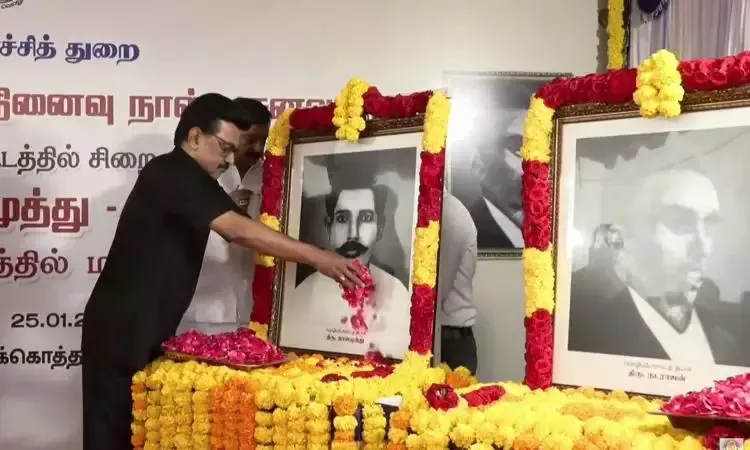
Attired in black as a symbol of remembrance and defiance, the Chief Minister paid his respects at the Thalamuthu-Natarasan Memorial in Moolakothalam, Chennai, to honor the martyrs of the language struggle.
At the memorial, CM Stalin laid floral tributes at the portraits of Thalamuthu and Natarasan, two young men who lost their lives during protests against the imposition of Hindi.
In a moment of solemnity, the Chief Minister chanted, “Salutations to the martyrs of the language struggle,” emphasizing the state's unwavering commitment to linguistic pride and federal values.
On his X handle, the Chief Minister declared that Hindi has no place in Tamil Nadu.
"Language Martyrs' Day: A Tribute of Glory: Neither in the past, nor in the present, nor ever will Hindi find a foothold here! This is a state that cherishes its language as its very essence, uniting to resist Hindi imposition. Each time it was enforced, it met with steadfast opposition. We safeguarded the rights and identity of various language-centered communities across the Indian subcontinent. I extend my heartfelt tribute to those martyrs who sacrificed their lives for Tamil. May no more lives be lost in this linguistic struggle; may our Tamil identity endure! We will persist in resisting Hindi imposition forever!" Stalin expressed in Tamil on X.
Language Martyrs' Day is annually observed on January 25 to honor those who perished in the fight against compulsory Hindi, particularly during the anti-Hindi movements of the 1930s and the large-scale protests of 1965. These movements emerged from concerns that enforcing Hindi in education and administration would undermine Tamil and compromise regional autonomy.
The agitation of 1965, characterized by extensive student involvement and public demonstrations throughout Tamil Nadu, resulted in numerous casualties and left a lasting impact on the state's collective memory. This agitation also influenced national language policy.
In response to persistent protests in Tamil Nadu, the Union government assured the continuation of English as an associate official language alongside Hindi, a compromise that alleviated tensions and reinforced India's multilingual nature.
Deputy Chief Minister Udhayanidhi Stalin, Ministers P.K. Sekar Babu and M.P. Saminathan, as well as Chennai Mayor R. Priya, were present during this homage. Senior officials, party leaders, and members of the public also attended, highlighting the ongoing relevance of linguistic issues in Tamil Nadu's public discourse.
Later in the day, the Chief Minister is set to unveil the statues of Thalamuthu and Natarasan at the Thalamuthu-Natarasan Mansion complex in Egmore. This unveiling is anticipated to attract students, language advocates, and representatives from diverse organizations.
By spearheading this observance, CM Stalin reaffirmed the Dravidian movement’s longstanding belief that linguistic rights are essential to social justice, self-respect, and India’s federal ethos—principles that continue to shape Tamil Nadu’s political and cultural identity.
Point of View
I recognize the profound significance of Language Martyrs' Day in Tamil Nadu. CM Stalin's remarks underscore the state's unwavering commitment to linguistic rights. The historical context of the anti-Hindi movements highlights the ongoing struggle for cultural identity, an issue that resonates not just in Tamil Nadu but across the nation.
NationPress
25/01/2026
Frequently Asked Questions
What is Language Martyrs' Day?
Language Martyrs' Day is observed on January 25 each year to honor those who sacrificed their lives fighting against the imposition of Hindi, particularly during the protests of the 1930s and 1965.
Why is CM Stalin opposed to Hindi imposition?
CM Stalin believes that imposing Hindi undermines Tamil language and culture, threatening regional autonomy and linguistic diversity.
What historical events led to the observance of this day?
The anti-Hindi movements of the 1930s and the mass agitation of 1965 were pivotal in shaping the observance of Language Martyrs' Day, highlighting the struggle for linguistic rights in Tamil Nadu.
Who were Thalamuthu and Natarasan?
Thalamuthu and Natarasan were young martyrs who lost their lives during protests against Hindi imposition, and they are commemorated on Language Martyrs' Day.
How does this day impact Tamil Nadu’s political landscape?
Language Martyrs' Day reinforces the importance of linguistic rights in Tamil Nadu's political discourse and reflects the state's commitment to preserving its cultural identity.