Yadav Asks Why Congress Opposes Change and Development
Synopsis
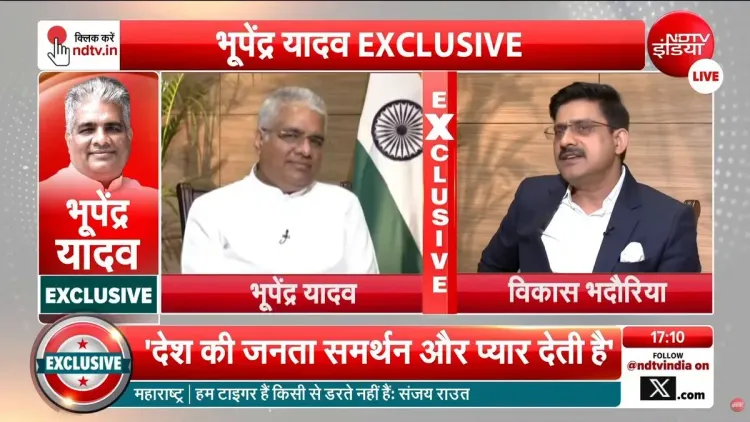
Union Environment Minister Bhupender Yadav on June 17, 2026, publicly challenged Congress, asking why the party consistently opposes new voices of development and change in India — a pointed rhetorical broadside reflecting the BJP's long-standing reform-versus-obstruction political narrative.
Key Takeaways
Union Environment Minister Bhupender Yadav posted a pointed question on X on June 17, 2026 , asking why Congress opposes development and change.
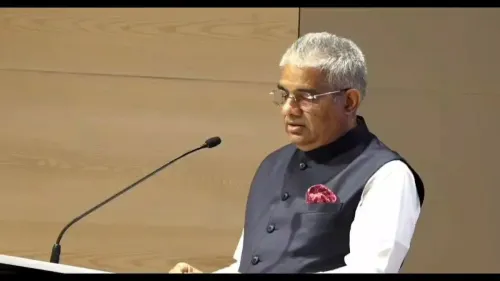
The post was in Hindi and accompanied by a video , though the specific trigger was not disclosed.
The statement reflects the BJP 's established rhetorical strategy of contrasting its governance record with Congress obstruction since 2014 .
The framing — development versus opposition — has been a recurring theme across economic reforms, legislative changes, and policy debates.
Congress is expected to respond with a counter-narrative defending its opposition record.
The exchange signals that the development-versus-obstruction debate will remain central to Indian political discourse ahead of future elections.
Union Environment Minister Bhupender Yadav on Wednesday, June 17, 2026, took aim at the Indian National Congress, questioning why the principal opposition party consistently finds itself on the opposing side whenever new voices of development and transformation emerge in the country.
Context
Posting on X, Yadav wrote in Hindi: 'ये तो कांग्रेस को बताना चाहिए कि जब-जब देश में परिवर्तन के साथ विकास के नए स्वर उठते हैं तो कांग्रेस विरोध में क्यों होती है?' — translated as: 'Congress should explain why, whenever new voices of development and change rise in the country, Congress is in opposition to them.' The pointed rhetorical question was accompanied by a video, suggesting the remark was made in a specific public or political setting, though the precise trigger was not specified in the post.
The statement follows a well-established pattern of BJP leaders framing the ruling party's governance agenda as transformative and progressive, while portraying Congress as an obstructionist force resistant to reform and national progress.
Policy Backdrop
Since the BJP came to power at the Centre in 2014, its leadership has consistently positioned the party's economic, structural, and legislative reform agenda in contrast to the record of the previous Congress-led UPA government. This framing — development versus obstruction — has been deployed across a wide range of policy debates, from economic reforms and infrastructure expansion to environmental legislation and social welfare schemes.
Bhupender Yadav, as a senior BJP leader and Union Cabinet minister, has been among the prominent voices articulating this contrast, both in parliamentary proceedings and on social media. His remarks on June 17 are consistent with the broader political communication strategy the party has maintained over more than a decade in government.
Stakeholders and Impact
The statement directly targets Congress, which remains the principal national opposition party and the primary political rival the BJP seeks to define itself against ahead of electoral cycles. For policy reformers and governance advocates, the exchange reflects the ongoing tension between the ruling dispensation's self-image as an agent of change and the opposition's role in scrutinising and challenging government initiatives.
For ordinary citizens and voters, such public exchanges sharpen the political narrative around which party stands for progress and which is seen as a barrier to it — a framing that has proved electorally significant in multiple national and state contests since 2014.
What's Next
Statements of this nature from senior BJP ministers typically surface ahead of parliamentary sessions or during election-season positioning, when the ruling party seeks to consolidate its pro-reform image. Congress is likely to respond with a counter-narrative, defending its opposition record and challenging the government on specific policy outcomes. The exchange signals that the development-versus-obstruction debate will remain a central axis of political contestation in the months ahead.
Point of View
Likely targeting a specific policy debate or legislative moment. By framing the question as one Congress 'should answer,' Yadav places the opposition on the defensive without needing to specify a single concrete grievance — a technique that has proven durable across multiple electoral cycles. The statement is less about any single policy and more about reinforcing the BJP's foundational identity as the party of transformation against a status-quo opposition.
NationPress
16 Sept 2026
Frequently Asked Questions
What did Bhupender Yadav say about Congress on June 17 2026?
Bhupender Yadav posted on X asking why Congress consistently opposes new voices of development and change in India, saying Congress should explain its stance.
Why does BJP accuse Congress of opposing development?
The BJP has since 2014 framed its reform agenda against the Congress-led UPA's record, regularly accusing the opposition of obstructing economic, legislative, and social progress.
Who is Bhupender Yadav?
Bhupender Yadav is the Union Minister of Environment, Forest and Climate Change and a senior leader of the Bharatiya Janata Party.
What is the BJP's development versus obstruction narrative?
It is a long-standing BJP political framing that positions the ruling party as a pro-reform, pro-development force and portrays Congress as a party that resists change and national progress.
How did Congress respond to Bhupender Yadav's statement?
No formal Congress response had been issued at the time of this report; the party is expected to counter with its own narrative defending its opposition record.