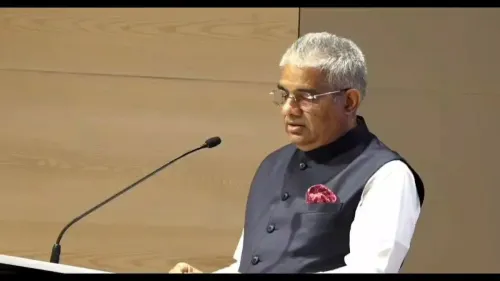
Bhupender Yadav Reaffirms 'Nation First' as Core Governance Value
Synopsis
Union Environment Minister Bhupender Yadav posted on X on 22 June 2026, declaring that 'the spirit of nation first is at the centre' — a restatement of the BJP-led government's core ideological principle that has shaped domestic policy and India's positions at international climate forums since 2014.
Key Takeaways
Bhupender Yadav , Union Minister of Environment, Forest and Climate Change, posted on X on 22 June 2026 invoking the 'nation first' principle.
The Hindi phrase Rashtra Pratham ki bhavna kendr mein hai translates to 'The spirit of nation first is at the centre.' The post was accompanied by a video , contents of which were not independently verified at publication.
The BJP-led government has used the 'nation first' framework consistently across policy domains since 2014 .
The Environment Ministry is expected to be active ahead of upcoming COP sessions, where India's national-interest posture shapes climate negotiations.
The statement reinforces India's established position that development imperatives must be balanced with emission-reduction commitments at multilateral forums.
Union Environment Minister Bhupender Yadav on Monday, 22 June 2026 posted a brief but pointed message on X, invoking the principle of 'nation first' as the central guiding value of governance — a phrase that has served as a cornerstone of the Bharatiya Janata Party's political and policy messaging since it came to power at the Centre in 2014.
In Hindi, the minister wrote: 'राष्ट्र प्रथम की भावना केंद्र में है' — translating to 'The spirit of nation first is at the centre.' The post was accompanied by a video, the contents of which were not independently verifiable at the time of publication.
Context
The phrase Rashtra Pratham — 'nation first' — has been a recurring motif across BJP-led government communications, appearing in speeches, policy documents, and social media outreach by senior ministers and party functionaries alike. Yadav, who holds the portfolio of Environment, Forest and Climate Change, has previously aligned India's environmental commitments with this broader national-interest framework, particularly in multilateral settings.
The post arrives at a time when the Environment Ministry is expected to be active in the run-up to upcoming international climate negotiations, including future sessions of the Conference of the Parties (COP) to the UN Framework Convention on Climate Change.
Policy Backdrop
Since 2014, the ruling party has consistently framed domestic policy — from environmental regulation to foreign affairs — through the lens of national interest. This ideological emphasis has shaped India's positions at multilateral climate and trade forums, where the government has argued that development imperatives must be balanced against emission-reduction commitments.
Yadav has represented India at several high-profile climate summits, where he has articulated the view that developed nations must fulfil historical obligations on climate finance before placing additional burdens on emerging economies. The 'nation first' sentiment underpins precisely this negotiating posture.
Stakeholders and Impact
Statements of this nature from senior Union ministers carry weight across multiple audiences: domestic policymakers drawing cues on legislative priorities, India's negotiating teams at international forums, and the general public for whom such messaging reinforces the government's stated ideological commitments.
For the Environment Ministry specifically, the 'nation first' framing has practical implications — it signals that India will continue to resist externally imposed timelines on phasing out fossil fuels or accelerating climate targets where these are seen as conflicting with domestic growth and energy-security goals.
What's Next
Observers of India's climate and governance policy will watch for follow-up communications from the Ministry of Environment, Forest and Climate Change that may give this reaffirmation concrete policy shape — whether in the form of legislative action in Parliament, updated nationally determined contributions, or India's formal positions ahead of the next COP cycle. The minister's continued use of social media to broadcast core ideological principles suggests a sustained effort to keep the 'nation first' narrative visible in public discourse well into 2026.
Point of View
The minister reinforces a governance identity that the party has cultivated across twelve years in power. For the Environment portfolio specifically, the framing is strategically useful: it pre-positions India's negotiating stance ahead of any international pressure on climate timelines, signalling that national interest will remain the non-negotiable filter. The consistency of this messaging — across ministers, portfolios, and years — suggests it functions as much as party discipline as it does as policy communication.
NationPress
21 Sept 2026
Frequently Asked Questions
What did Bhupender Yadav post on X on 22 June 2026?
Bhupender Yadav posted in Hindi that 'the spirit of nation first is at the centre,' reaffirming the BJP government's core ideological principle of Rashtra Pratham.
What does 'Rashtra Pratham' mean?
'Rashtra Pratham' is a Hindi phrase meaning 'nation first.' It has been a central slogan of the BJP-led government since 2014, applied across policy areas from environment to foreign affairs.
Why is Bhupender Yadav significant in Indian politics?
Bhupender Yadav is a senior BJP leader and serves as Union Minister of Environment, Forest and Climate Change. He has represented India at major international climate negotiations including COP summits.
How does the 'nation first' principle affect India's climate policy?
The 'nation first' framework shapes India's stance at multilateral climate forums, where the government argues that development needs and energy security must be weighed against emission-reduction commitments imposed by developed nations.
What should we watch for after this post by Yadav?
Observers should monitor Environment Ministry communications ahead of upcoming COP sessions or parliamentary debates on climate legislation, where this ideological reaffirmation may translate into concrete policy positions.