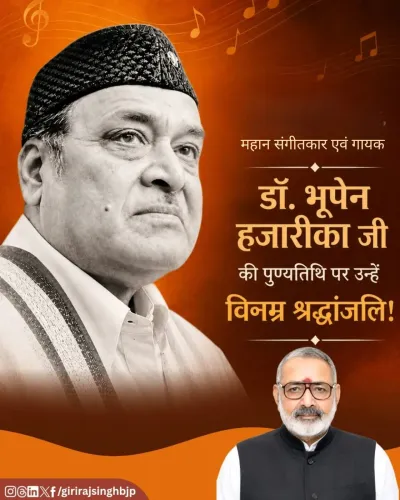
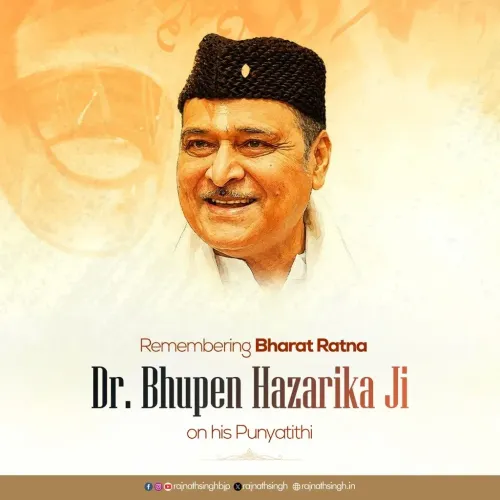
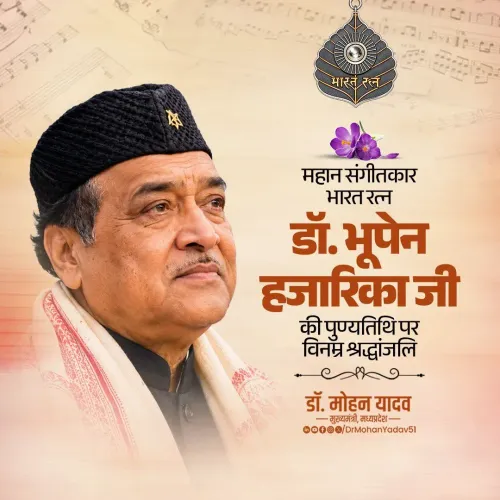
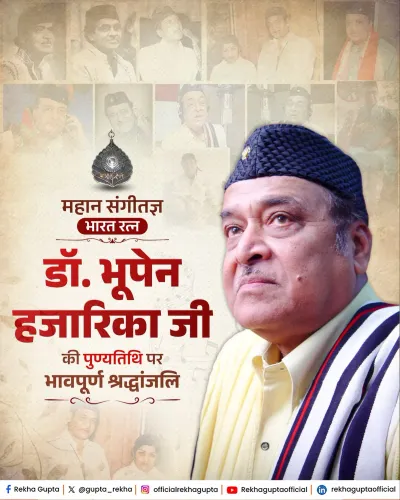
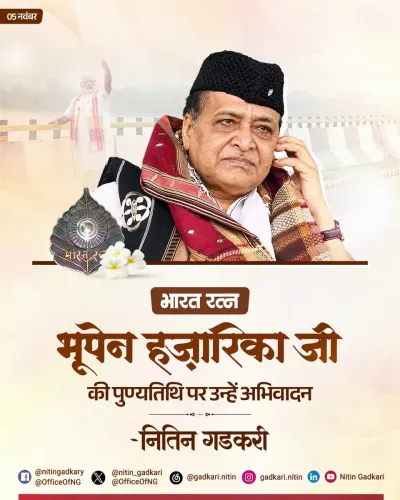
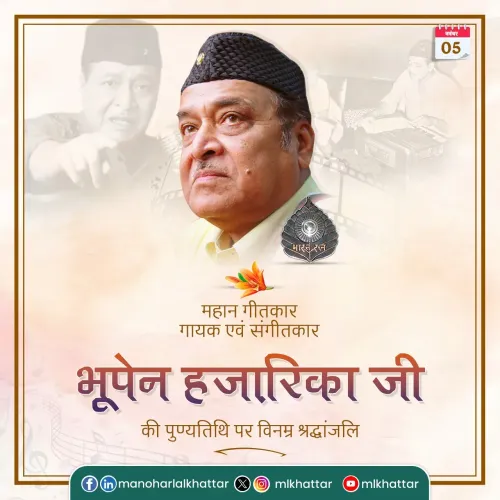
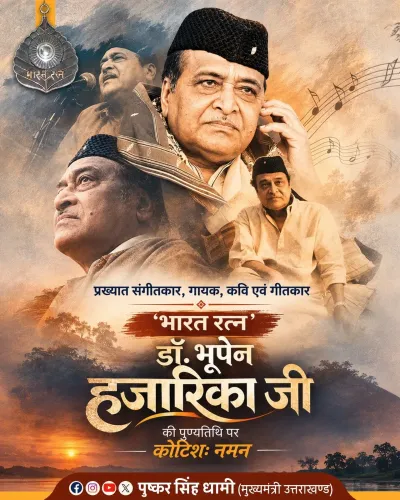
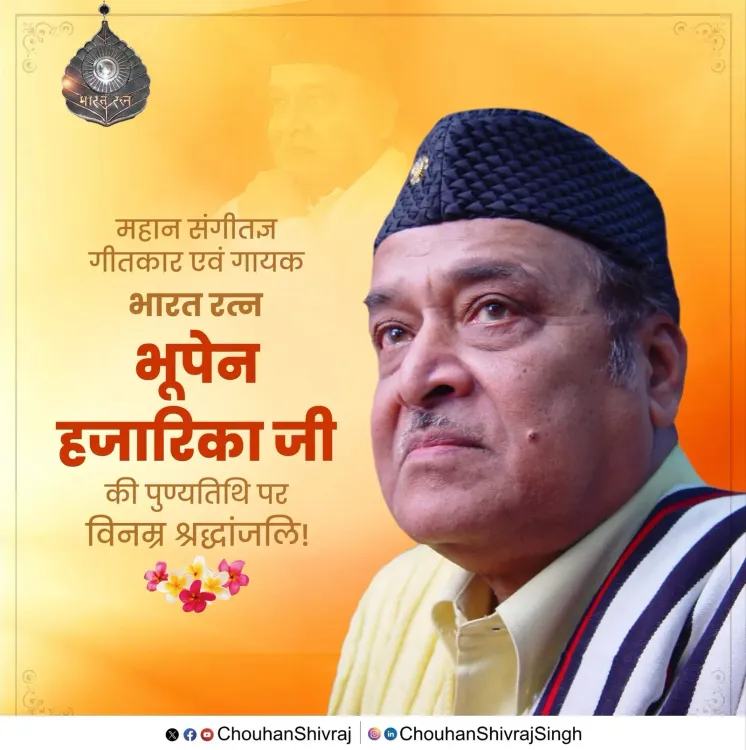
Shivraj Singh Chouhan pays tribute to Bharat Ratna Bhupen Hazarika
Synopsis
Union Agriculture Minister Shivraj Singh Chouhan paid tribute to Bharat Ratna Bhupen Hazarika on his death anniversary, honouring the Assamese singer-lyricist-composer through songs like 'Dil Hoom Hoom Kare' and 'Ganga Bahati Ho Kyun' that continue to define India's musical conscience.
Key Takeaways
Union Agriculture Minister Shivraj Singh Chouhan posted a tribute to Bhupen Hazarika on his death anniversary, 5 November 2026 .
Chouhan called Hazarika a 'true servant of music' and a great singer, lyricist, and composer.
He specifically cited three iconic songs: 'Dil Hoom Hoom Kare' , 'Ganga Bahati Ho Kyun' , and 'Samay O Dheere Chalo' .
Bhupen Hazarika was awarded the Bharat Ratna in 2019 for his lifelong contribution to Indian music and culture.
Hazarika passed away on 5 November 2011 ; annual cultural programmes across Assam and India mark his anniversary.
A voice that made the Brahmaputra sing and the Ganga weep lives on — and Union Agriculture Minister Shivraj Singh Chouhan paused on 5 November 2026 to honour the man behind it. On the death anniversary of Bharat Ratna recipient Bhupen Hazarika, Chouhan posted a heartfelt tribute on X, calling the legendary singer, lyricist and composer a 'true servant of music' (sangeet ke sachche sevak).
Chouhan invoked three of Hazarika's most enduring compositions — 'Dil Hoom Hoom Kare', 'Ganga Bahati Ho Kyun', and 'Samay O Dheere Chalo' — writing that through countless such songs, 'you will always live in all our hearts.' The tribute reflects the quiet but consistent manner in which Indian political leaders mark the anniversaries of cultural icons who transcend regional boundaries.
The artist who sang for a nation, not just a river
Bhupen Hazarika was born in Assam and built a musical universe that stretched far beyond it. His compositions moved effortlessly between Assamese folk traditions and Hindi cinema, carrying within them the sorrow of displacement, the breadth of a river, and the pulse of rural India. 'Ganga Bahati Ho Kyun' became an anthem for social conscience; 'Dil Hoom Hoom Kare' — featured in the 1997 film Rudaali — reached millions who had never seen the Brahmaputra. That is the rare alchemy he commanded.
The Government of India awarded him the Bharat Ratna — the country's highest civilian honour — in 2019, recognising a lifetime of contributions to music, film, and the cultural fabric of the northeast. Hazarika passed away on 5 November 2011, and every year on this date, cultural programmes and remembrances mark his legacy across Assam and beyond.
Why tributes to Hazarika carry a political subtext
Chouhan's tribute is ceremonial, but it is not context-free. Assam and India's northeast have been a sustained focus for the BJP, and honouring Hazarika — a towering symbol of Assamese identity and pride — signals cultural respect for a region that holds considerable political and strategic weight. It is a reminder that the softest gestures in Indian politics are rarely without a deeper register. Still, none of that diminishes the genuine reverence millions feel for a musician whose work outlasted every government that honoured him.
On the fifteenth anniversary of his passing, Bhupen Hazarika's melodies remain as alive as the rivers he immortalised — and that, more than any tribute, is the real measure of his genius.
Point of View
Reinforcing the party's sustained cultural outreach to India's northeast. Hazarika is not merely a regional figure — his Bharat Ratna status and pan-India resonance make tributes to him a low-risk, high-goodwill gesture that bridges regional pride and national sentiment. For a senior leader like Chouhan, whose political base is rooted in central India, the tribute also signals an awareness of the northeast's growing weight in national politics. The ceremony is sincere on its surface and strategic in its subtext — both things can be true.
NationPress
5 Nov 2026
Frequently Asked Questions
When did Bhupen Hazarika pass away?
Bhupen Hazarika passed away on 5 November 2011 . His death anniversary is marked each year with cultural tributes across India, particularly in Assam.
Why was Bhupen Hazarika awarded the Bharat Ratna?
Bhupen Hazarika was awarded the Bharat Ratna in 2019 in recognition of his extraordinary lifelong contributions to Indian music, cinema, and cultural life, particularly as a singer, lyricist, and composer who gave voice to the traditions and social concerns of Assam and northeast India.
What are some of Bhupen Hazarika's most famous songs?
Among his most beloved compositions are 'Dil Hoom Hoom Kare' , 'Ganga Bahati Ho Kyun' , and 'Samay O Dheere Chalo' . 'Dil Hoom Hoom Kare' was memorably featured in the 1997 Hindi film Rudaali .
Who is Shivraj Singh Chouhan?
Shivraj Singh Chouhan is a senior BJP leader and Union Minister for Agriculture and Farmers Welfare and Rural Development. He is a former four-term Chief Minister of Madhya Pradesh and one of the party's most prominent faces.
Why do Indian politicians tribute Bhupen Hazarika every year?
Bhupen Hazarika is considered a cultural giant whose music bridged Assamese, Bengali, and Hindi traditions and spoke to themes of social justice and national identity. As a Bharat Ratna awardee, his anniversary attracts tributes from across the political spectrum as an acknowledgement of his place in India's shared cultural heritage.