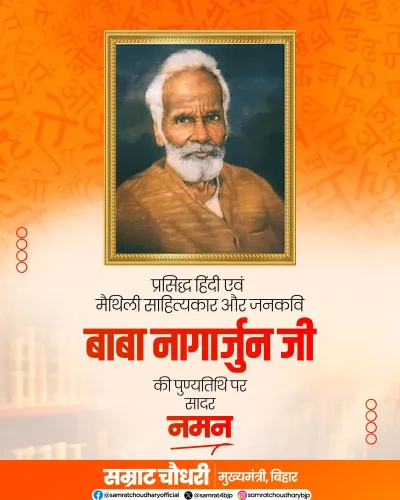
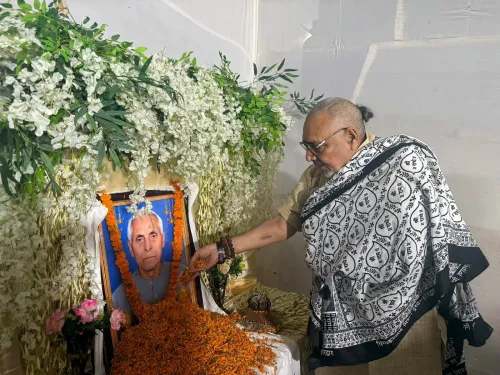
Giriraj Singh pays tribute to Baba Nagarjun on death anniversary
Synopsis
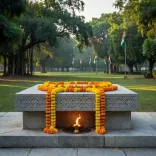
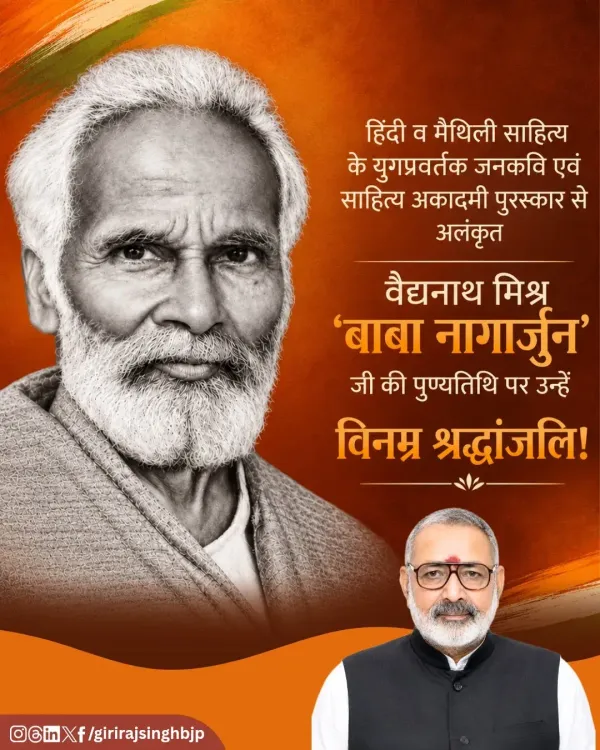
Union Textiles Minister Giriraj Singh paid homage to epoch-making Hindi and Maithili poet Vaidyanath Mishra 'Baba Nagarjun' on his death anniversary, calling his literary contribution 'an invaluable heritage' and noting that his thoughts and compositions will continue to guide future generations.
Key Takeaways
Giriraj Singh posted a tribute on X on 5 November 2026 marking Baba Nagarjun's death anniversary.
Nagarjun's full name was Vaidyanath Mishra ; he wrote in both Hindi and Maithili .
He was widely known as Janakavi — the people's poet — for his socially rooted, politically charged verse.
Nagarjun received the Sahitya Akademi Award , India's highest national literary honour.
Singh, an MP from Begusarai, Bihar , shares the same Gangetic heartland as Nagarjun's literary roots.
A voice that bent Hindi and Maithili verse toward the common people never truly falls silent. Union Textiles Minister Giriraj Singh marked the death anniversary of poet Vaidyanath Mishra 'Baba Nagarjun' on Thursday, 5 November 2026, offering a public tribute on X to one of Indian literature's most celebrated rebel voices.
Posting in Hindi, Singh described Nagarjun as 'Hindi va Maithili sahitya ke yugpravartak, janakavi' — 'the epoch-making people's poet of Hindi and Maithili literature' — and recalled the Sahitya Akademi Award conferred on him for his literary contributions. 'His literary contribution is an invaluable heritage for all of us,' Singh wrote. 'His thoughts and compositions will continue to guide us always.'
Who was Baba Nagarjun?
Vaidyanath Mishra, who wrote under the pen name Baba Nagarjun, remains one of the towering figures of twentieth-century Indian letters. Known as the Janakavi — the people's poet — he crafted verse in both Hindi and Maithili, giving literary weight to the dialects and struggles of rural, working-class India. His prose and poetry are read as a chronicle of post-independence social tensions, agrarian life, and political dissent.
He was honoured with the Sahitya Akademi Award, India's foremost national recognition for letters, affirming his place in the canon of Indian language literature. His work continues to be taught, performed, and debated in literary circles across Bihar, Delhi, and wherever Hindi and Maithili are alive.
Ministers, memory, and regional literary heritage
Singh's tribute fits a consistent pattern among senior central ministers: publicly honouring writers and poets associated with regional languages on their birth or death anniversaries — a gesture that keeps cultural memory visible in the national conversation. For Singh, an MP from Begusarai, Bihar, saluting a Maithili literary icon carries particular resonance. Nagarjun's roots and readership run deep in the same Gangetic heartland Singh represents in Parliament.
The acknowledgment also signals something broader: the ongoing effort to frame regional-language literary traditions not as peripheral but as foundational to India's cultural identity. Nagarjun's voice — earthy, unsparing, deeply political — belongs to that tradition in full.
The people's poet is gone, but his lines keep finding new readers. That, in the end, is the only immortality a writer needs.
Point of View
A practice that simultaneously asserts cultural continuity and broadens their appeal beyond party politics. For Giriraj Singh, whose constituency of Begusarai sits in the Bihar heartland that Nagarjun's verse made famous, the tribute is as much about regional identity as it is about literary respect. The fact that Nagarjun wrote in Maithili — a language with its own distinct literary tradition and political assertions in Bihar — adds texture to the acknowledgment. At a time when language and cultural heritage are live debates in Indian public life, ministerial salutes to multilingual literary titans carry weight beyond mere ceremony.
NationPress
5 Nov 2026
Frequently Asked Questions
Who was Baba Nagarjun?
Baba Nagarjun was the pen name of Vaidyanath Mishra , a celebrated Hindi and Maithili poet and novelist. Known as the Janakavi or 'people's poet,' he was honoured with the Sahitya Akademi Award for his landmark contributions to Indian literature.
Why is Giriraj Singh paying tribute to Baba Nagarjun?
Union Textiles Minister Giriraj Singh paid tribute to Baba Nagarjun on the poet's death anniversary on 5 November 2026 , calling his literary work 'an invaluable heritage' that will continue to guide future generations.
What award did Baba Nagarjun receive?
Baba Nagarjun received the Sahitya Akademi Award , India's foremost national recognition for literary achievement, in honour of his contributions to Hindi and Maithili literature.
What languages did Baba Nagarjun write in?
Baba Nagarjun wrote in both Hindi and Maithili , making him one of the rare literary figures to achieve canonical status in two distinct Indian language traditions.
What does Janakavi mean?
Janakavi translates literally as 'the people's poet' in Hindi. The title was widely applied to Baba Nagarjun because his poetry drew from the lives, struggles, and speech of ordinary, working-class Indians.