Giriraj Singh pays tribute to satirist Harishankar Parsai
Synopsis
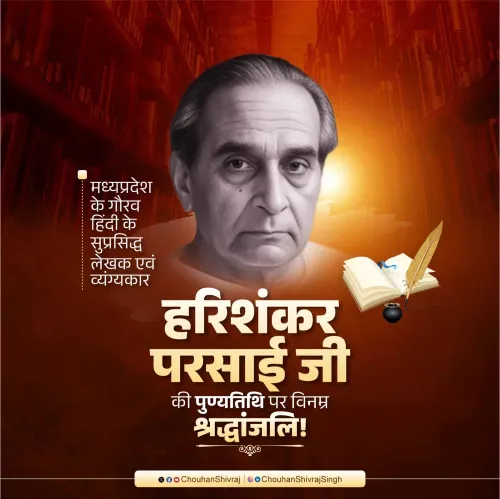
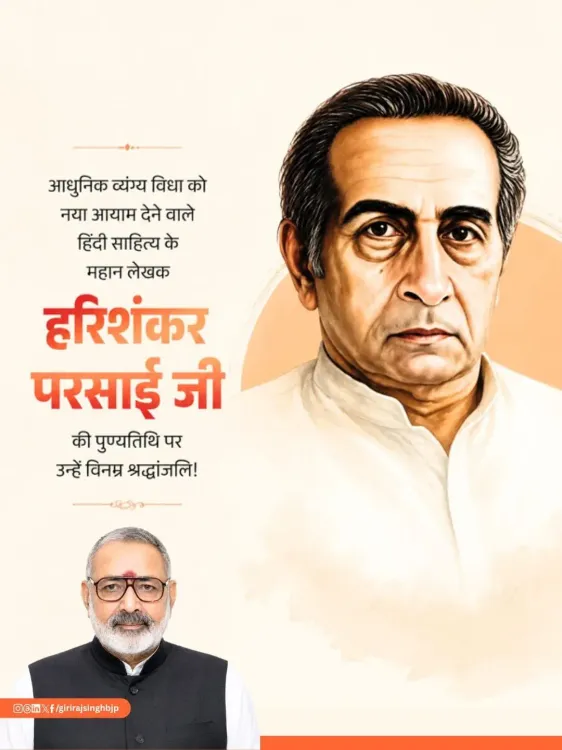
Union Textiles Minister Giriraj Singh paid homage to celebrated Hindi satirist Harishankar Parsai on his death anniversary, calling him a writer who gave Indian satire a new dimension and whose sharp commentary on social and political life remains enduringly relevant.
Key Takeaways
Giriraj Singh posted a tribute to Hindi satirist Harishankar Parsai on his death anniversary on 10 August 2026 .
Parsai is celebrated for using satire to expose social and political contradictions in Indian life.
He was a recipient of the Sahitya Akademi Prize , conferred by India's National Academy of Letters established in 1954 .
Singh described Parsai as someone who gave 'a new dimension to the modern art of satire.' Union ministers periodically mark the anniversaries of prominent Hindi writers as part of cultural engagement on social media.
On the death anniversary of one of Hindi literature's most fearless voices, Union Textiles Minister Giriraj Singh paused to honour the man who turned satire into a scalpel — Harishankar Parsai, Sahitya Akademi laureate and the writer who made India's social and political hypocrisies impossible to ignore.
Singh, posting on 10 August 2026, offered a tribute in Hindi: 'Aadhunik vyangya vidha ko naya aayam dene wale' — 'one who gave a new dimension to the modern art of satire' — saluting Parsai's razor-sharp pen and his gift for exposing the contradictions embedded in Indian society and politics. 'His literary contribution will always be remembered,' Singh wrote.
The writer who weaponised wit
Harishankar Parsai occupies a singular place in the Hindi literary canon. Where other writers of his era reached for lyric beauty, Parsai reached for irony — and drew blood. His essays and short pieces dissected bureaucratic absurdity, religious pretension, and political doublespeak with a precision that made readers laugh and wince in the same breath. The Sahitya Akademi, India's National Academy of Letters founded in 1954, recognised that contribution with its prize, cementing his place among the greats of Indian literature.
Ministers, anniversaries, and the politics of cultural memory
Union ministers marking the death anniversaries of celebrated Hindi writers on social media has become a recognisable pattern of cultural engagement — a way for the political class to signal respect for India's literary heritage. Singh's tribute fits that tradition, though Parsai's legacy carries a particular charge: a satirist whose targets were always the powerful, his work remains as relevant to contemporary readers as it was in his own time.
Point of View
Including figures whose work was often subversive of authority. Such tributes serve a dual purpose: cultural legitimacy and soft-power signalling to Hindi-speaking constituencies. The Sahitya Akademi's continued centrality in these narratives underscores its role as the state's primary instrument for validating literary prestige.
NationPress
24 Sept 2026
Frequently Asked Questions
Who was Harishankar Parsai?
Harishankar Parsai was a prominent Hindi writer and satirist, widely regarded as one of the greatest practitioners of the satirical form in modern Hindi literature. He received the Sahitya Akademi Prize for his sharp commentary on social and political issues.
What is the Sahitya Akademi Prize?
The Sahitya Akademi Prize is an annual literary honour conferred by the Sahitya Akademi, India's National Academy of Letters, which was established in 1954. It recognises outstanding works of literature across Indian languages.
Why did Giriraj Singh pay tribute to Harishankar Parsai?
Giriraj Singh posted the tribute on Harishankar Parsai's death anniversary, honouring the writer's literary legacy and his contribution to Hindi satire and social commentary.
What is Harishankar Parsai known for?
Parsai is known for his razor-sharp satirical essays and short pieces that exposed bureaucratic absurdity, religious pretension, and political hypocrisy in Indian society, giving the modern Hindi satirical form a distinctive new voice.
Who is Giriraj Singh?
Giriraj Singh is a senior BJP leader, Union Minister of Textiles, and a Lok Sabha Member of Parliament from Begusarai, Bihar.