Giriraj Singh pays tribute to Veer Savarkar on Jayanti
Synopsis
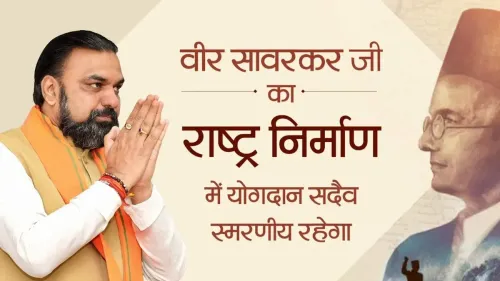
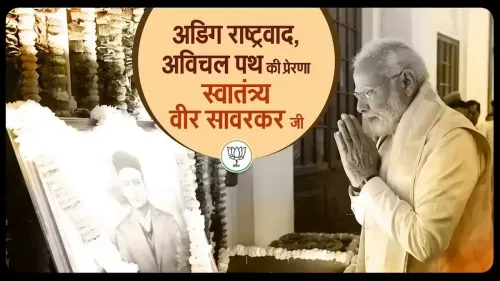
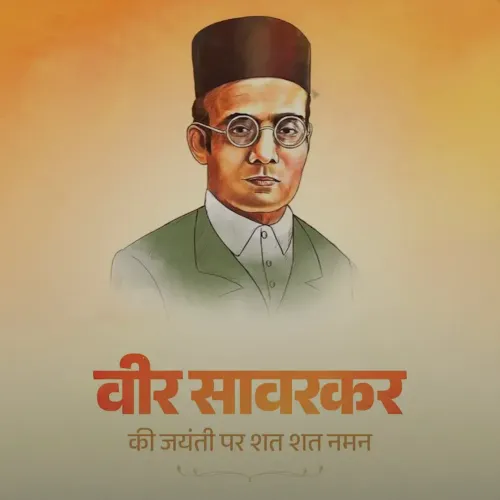
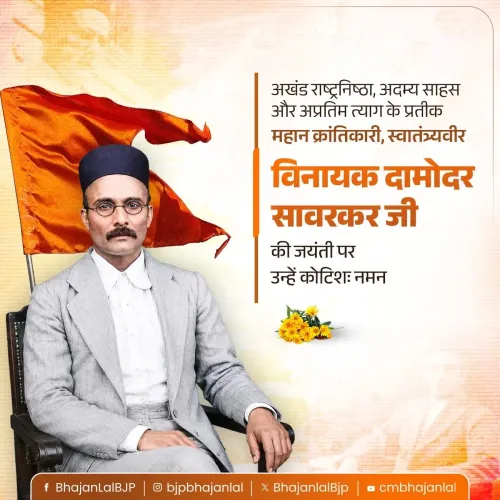
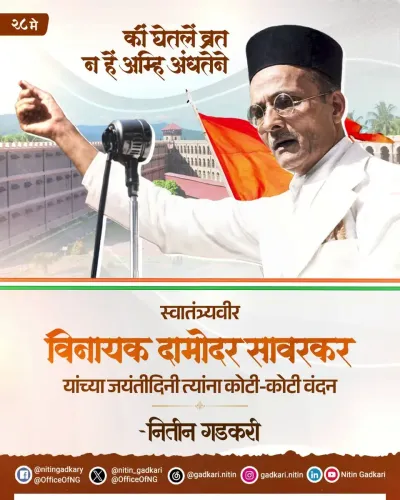
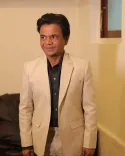
Union Textiles Minister Giriraj Singh on 28 May paid tribute to Vinayak Damodar Savarkar on his birth anniversary, calling him a unique devotee of knowledge and arms and a great revolutionary whose ideals of sacrifice and social equality continue to inspire national service.
Key Takeaways
Union Textiles Minister Giriraj Singh posted a tribute to Vinayak Damodar Savarkar on his birth anniversary, 28 May .
Singh described Savarkar as a 'unique worshipper of scripture and arms,' a 'fierce nationalist,' and a 'great revolutionary.' The minister said Savarkar's life of sacrifice, courage, and resolve, and his ideas on social equality, will 'always inspire us in the service of the nation.' The tribute is part of the BJP's sustained annual practice of commemorating Savarkar on his Jayanti, dating back to the portrait unveiled in Parliament's Central Hall in 2003 .
The post carried hashtags #VeerSavarkar , #SavarkarJayanti , and #Rashtrabhaakti , signalling coordinated social media outreach.
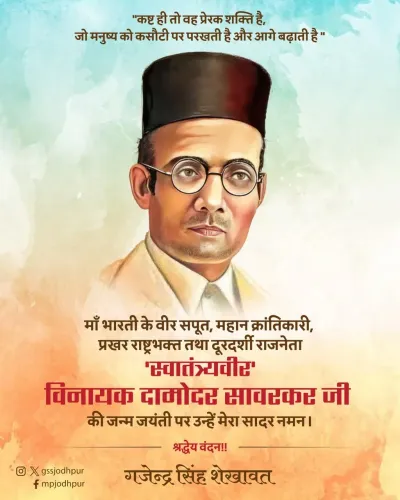
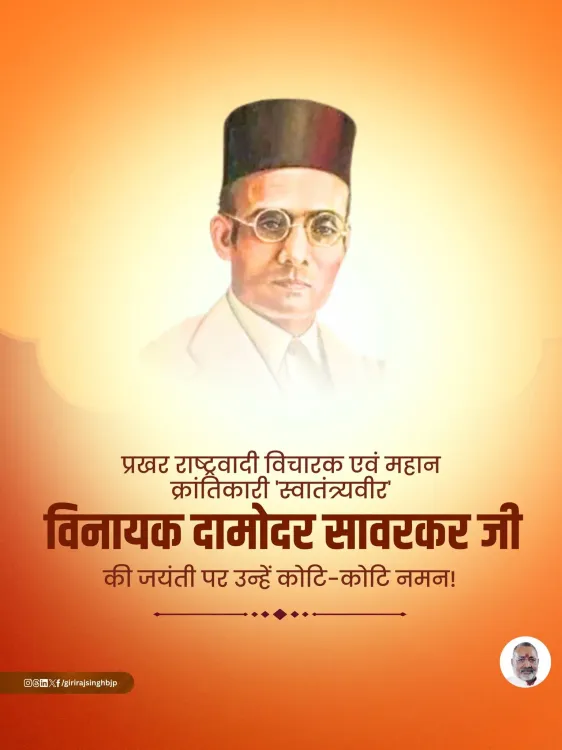
Union Textiles Minister Giriraj Singh on Thursday, 28 May paid tribute to freedom fighter and ideologue Vinayak Damodar Savarkar on his birth anniversary, hailing him as a unique worshipper of knowledge and arms, a fierce nationalist, and a great revolutionary. The minister offered his salutations on the occasion of Savarkar Jayanti, sharing the message on his official X account.
In his post, Singh wrote in Hindi: 'Shastra aur Shastra ke anoothe upasak, prakhar rashtravadi, mahan krantikari Swatantryaveer Vinayak Damodar Savarkar ji ki jayanti par unhe koti-koti naman' — translated as: 'Heartfelt salutations to the unique devotee of scripture ('Shastra') and arms ('Shastra'), the ardent nationalist and great revolutionary 'Swatantryaveer' Vinayak Damodar Savarkar on his birth anniversary.' He added that Savarkar's life, enriched by sacrifice, courage and resolve, and his ideas on social equality, 'will continue to inspire us always in the service of the nation.'
Context
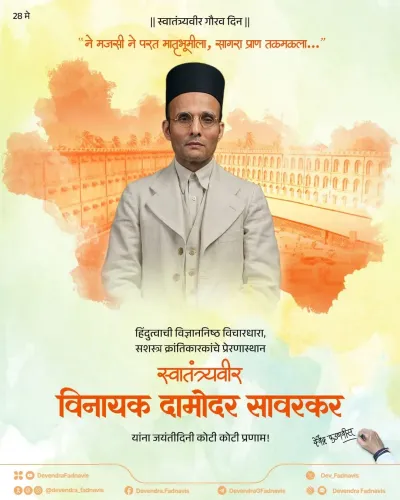
Vinayak Damodar Savarkar, born on 28 May 1883 in Bhagur, Maharashtra, was an independence activist, prolific writer, and the principal architect of the Hindutva political philosophy. He was imprisoned by British colonial authorities and spent years in the notorious Cellular Jail in Port Blair, Andaman and Nicobar Islands, enduring harsh conditions for his revolutionary activities. He is widely referred to as 'Swatantryaveer' — meaning 'brave freedom fighter' — a honorific that underscores his place in nationalist iconography.
Savarkar remains one of the most contested figures in Indian political history. Admirers credit him with articulating a muscular, culturally rooted nationalism at a time of colonial subjugation, while critics have long debated his ideology and his petitions to the British government during imprisonment. His legacy sits at the heart of ongoing debates about the nature and ownership of India's independence movement.
Policy Backdrop
The Bharatiya Janata Party has consistently foregrounded Savarkar as a nationalist icon, positioning him alongside — and at times in contrast to — figures canonised by the Congress-led freedom movement narrative. A landmark moment came in 2003, when the then NDA government unveiled a portrait of Savarkar in the Central Hall of Parliament, a move that drew both acclaim and sharp opposition at the time.
Since then, annual tributes by BJP ministers and MPs on 28 May have become a consistent feature of the party's political calendar. These commemorations are part of a broader, sustained effort to expand the pantheon of recognised freedom fighters and to emphasise the revolutionary and Hindutva strands of the independence struggle.
Stakeholders and Impact
For BJP supporters and Hindutva ideological circles, tributes like Singh's reaffirm the party's commitment to reclaiming Savarkar's legacy for mainstream national discourse. The hashtags #VeerSavarkar, #SavarkarJayanti, and #Rashtrabhaakti used in the post signal an effort to drive coordinated social media engagement around the anniversary.
Opposition parties, particularly the Congress, have historically pushed back against the elevation of Savarkar, viewing it as a political appropriation that sidelines the Gandhian and Nehruvian traditions of the freedom struggle. The anniversary therefore tends to reignite periodic exchanges between the ruling dispensation and the opposition over the interpretation of India's independence history.
What's Next
Tributes from other senior BJP leaders and Union Ministers are expected to follow through the day, as is customary on Savarkar Jayanti. Any formal government events, parliamentary references, or opposition responses will sharpen the political contours of the commemoration. As the ruling party continues to institutionalise recognition of Savarkar — through portraits, postage stamps, and official observances — the anniversary is likely to remain a recurring flashpoint in India's culture-war politics, with each iteration testing how far the Savarkar narrative can be moved from the margins to the mainstream of national memory.
Point of View
Singh is engaging a long-running effort to counter the perception that Savarkar's legacy is solely about Hindutva majoritarian politics. The annual cycle of tributes, opposition rebuttals, and media debate around Savarkar Jayanti has itself become a predictable but revealing barometer of how India's ruling establishment and its challengers contest the meaning of the independence movement. As BJP's institutional commemoration of Savarkar deepens — portraits, stamps, official observances — the question of whether the party can fully mainstream his legacy without reigniting a culture-war backlash remains a live political calculation.
NationPress
11 Oct 2026
Frequently Asked Questions
Why do BJP leaders pay tribute to Savarkar on 28 May every year?
28 May is the birth anniversary of Vinayak Damodar Savarkar, and the BJP has made annual tributes on this date a consistent political tradition since at least 2003, when the NDA government unveiled his portrait in Parliament's Central Hall. The party regards Savarkar as a key nationalist icon representing the revolutionary and Hindutva strands of India's independence movement.
Who is Vinayak Damodar Savarkar and why is he controversial?
Vinayak Damodar Savarkar (1883–1966) was an independence activist, writer, and the principal architect of Hindutva ideology who spent years in the Cellular Jail in the Andaman Islands for revolutionary activities against British rule. He is celebrated by the BJP and Hindutva groups but remains controversial due to debates over his ideology and his petitions to the British government during his imprisonment.
What did Giriraj Singh say about Savarkar on his Jayanti?
Giriraj Singh described Savarkar as a 'unique devotee of scripture and arms,' a 'fierce nationalist,' and a 'great revolutionary,' and said his life of sacrifice, courage, and resolve, along with his ideas on social equality, will always inspire people in the service of the nation.
What is Swatantryaveer Savarkar Jayanti?
Swatantryaveer Savarkar Jayanti is the birth anniversary of Vinayak Damodar Savarkar, observed on 28 May each year. 'Swatantryaveer' is an honorific meaning 'brave freedom fighter,' and the day is marked by tributes from political leaders, especially those affiliated with the BJP and allied organisations.
What is the BJP's position on Savarkar's legacy?
The BJP has consistently sought to mainstream Savarkar as a national hero, arguing he was a pioneering freedom fighter whose contributions were sidelined by the Congress-dominated post-independence establishment. Landmark steps include the 2003 portrait in Parliament's Central Hall, and annual ministerial tributes on his birth and death anniversaries.