CM Fadnavis pays tribute to Savarkar on birth anniversary
Synopsis
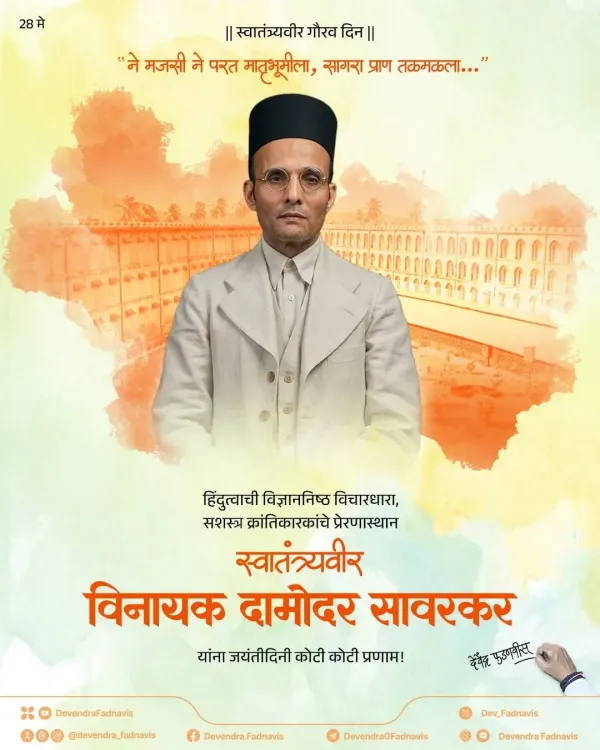
Maharashtra Chief Minister Devendra Fadnavis on 28 May 2026 paid homage to Swatantryaveer Vinayak Damodar Savarkar on his birth anniversary, calling him a true devotee of freedom and an inspiration to armed revolutionaries, continuing the BJP's tradition of publicly honouring the nationalist icon.
Key Takeaways
Maharashtra Chief Minister Devendra Fadnavis posted a tribute to Swatantryaveer Vinayak Damodar Savarkar on his birth anniversary on 28 May 2026 .
Savarkar was born on 28 May 1883 in Bhagur, Nashik, Maharashtra and was a key figure in India's independence movement and the proponent of Hindutva ideology.
Fadnavis described Savarkar as a 'true worshipper of the goddess of freedom' and an inspiration for armed revolutionaries, in both English and Marathi.
The post was tagged under #SwatantryaVeerGauravDin , reflecting the BJP's framing of the day as a national pride observance.
The tribute continues a pattern of BJP leaders publicly honouring Savarkar to elevate his place in India's official historical narrative.
State-level commemorations and further institutional references to Savarkar may follow in Maharashtra in the coming days.
Maharashtra Chief Minister Devendra Fadnavis on Thursday, 28 May 2026 paid tribute to Swatantryaveer Vinayak Damodar Savarkar on his birth anniversary, honouring the freedom fighter's contributions to India's independence struggle and his ideological legacy.
Context
In a post on X, Fadnavis wrote in English and Marathi, calling Savarkar a 'true devotee of the goddess of freedom' and a 'source of inspiration for armed revolutionaries.' The Marathi portion of the post reads: 'स्वातंत्र्यदेवीचे सच्चे उपासक, हिंदुत्वाची विज्ञाननिष्ठ विचारधारा, सशस्त्र क्रांतिकारकांचे प्रेरणास्थान' ['a true worshipper of the goddess of freedom, the science-rooted ideology of Hindutva, the inspiration of armed revolutionaries']. He offered 'crores of salutations' to Savarkar on the occasion, marking the day under the hashtag #SwatantryaVeerGauravDin — meaning 'Swatantryaveer Pride Day'.
Savarkar was born on 28 May 1883 in Bhagur, Nashik district, Maharashtra. He went on to become one of the most debated figures in Indian nationalist history — celebrated by many as a pioneering revolutionary and ideologue, and a subject of ongoing historical and political discourse.
Policy Backdrop
Savarkar was sentenced to transportation for life and imprisoned in the Cellular Jail in the Andaman and Nicobar Islands by British colonial authorities for his role in the independence movement. He is also widely recognised as a key proponent of the Hindutva political philosophy, which he articulated in his 1923 work 'Hindutva: Who Is a Hindu?'
During Fadnavis's earlier tenure as Chief Minister of Maharashtra from 2014 to 2019, the state government promoted public events and educational references that highlighted Savarkar alongside other regional icons. This positioned him more prominently in Maharashtra's official cultural and historical narrative.
Stakeholders and Impact
BJP leaders across India routinely issue tributes on Savarkar's birth anniversary as part of a sustained effort to elevate him as a central figure in the national freedom struggle — a framing that contrasts with the historical emphasis prevalent during the Congress-led governments of earlier decades. In Maharashtra, such observances carry particular resonance given Savarkar's roots in the state and the party's long-standing focus on regional pride and cultural symbolism.
The tribute is directed at BJP workers, Maharashtrian citizens, and a broader national audience that follows debates around the recognition of nationalist figures in India's official historical memory.
What's Next
State-level commemorations, public events, and potential curriculum or institutional references to Savarkar may follow in the days ahead, particularly with Maharashtra's legislative calendar in view. The annual birth anniversary observance also tends to renew public and political debate around Savarkar's legacy and the question of a Bharat Ratna posthumous award — a demand that BJP leaders have raised in the past. How the state government translates this tribute into concrete commemorative action remains to be seen.
Point of View
Where Savarkar's legacy intersects with regional pride. By invoking both his revolutionary credentials and his Hindutva philosophy in a single post, the Chief Minister signals continuity between the party's cultural politics and its governance agenda. The annual observance also serves as a rallying moment for the party's base ahead of any legislative or civic activity. The framing of Savarkar as a 'science-rooted' ideologue is a notable rhetorical choice, aimed at countering critiques that reduce his legacy to communal politics alone.
NationPress
12 Oct 2026
Frequently Asked Questions
Who was Swatantryaveer Vinayak Damodar Savarkar?
Vinayak Damodar Savarkar (1883–1966) was an Indian independence activist, writer, and political thinker who advocated armed revolution against British rule. He was sentenced to transportation for life and imprisoned in the Cellular Jail in the Andaman Islands, and is widely known as a key proponent of the Hindutva ideology.
Why did CM Fadnavis pay tribute to Savarkar on 28 May 2026?
28 May is Savarkar's birth anniversary. Maharashtra Chief Minister Devendra Fadnavis posted a tribute on X to mark the occasion, honouring Savarkar's contributions to India's freedom struggle and his ideological legacy.
What is SwatantryaVeer Gaurav Din?
SwatantryaVeer Gaurav Din, meaning 'Swatantryaveer Pride Day', is the name used by BJP leaders and supporters to observe Savarkar's birth anniversary as a day of honour and pride for his contributions to the nation.
What is the BJP's position on Savarkar's legacy?
The BJP consistently recognises Savarkar as a central freedom fighter and ideological influence. The party and its leaders regularly issue tributes on his birth and death anniversaries and have in the past demanded a posthumous Bharat Ratna for him.
What did Fadnavis say about Savarkar in his post?
Fadnavis called Savarkar a 'true devotee of the goddess of freedom', a proponent of a 'science-rooted ideology of Hindutva', and an inspiration for armed revolutionaries, offering 'crores of salutations' to him on his birth anniversary.