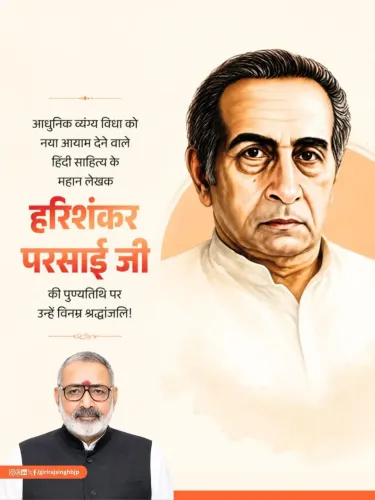
Shivraj pays tribute to Hindi satirist Harishankar Parsai
Synopsis
Union Agriculture Minister Shivraj Singh Chouhan marked the death anniversary of celebrated Hindi satirist Harishankar Parsai on 10 August 2026, honouring the Madhya Pradesh writer who elevated vyangya in Hindi literature and used satire to critique social contradictions.
Key Takeaways
Shivraj Singh Chouhan posted a Hindi tribute to Harishankar Parsai on his death anniversary on 10 August 2026 .
Parsai is credited with elevating vyangya (satire) to a respected literary form within Hindi literature.
Chouhan described Parsai as 'the pride of Madhya Pradesh ' and a devoted servant of the Hindi language.
The tribute follows an established pattern of Madhya Pradesh political leaders publicly honouring the state's Hindi literary figures on their anniversaries.
Parsai's writing is known for its sharp critique of social hypocrisy, bureaucratic rot, and everyday contradictions in Indian life.
On the death anniversary of one of Hindi literature's sharpest voices, Union Agriculture Minister Shivraj Singh Chouhan paused to remember the man who turned satire into a weapon of social conscience — Harishankar Parsai, Madhya Pradesh's celebrated Hindi writer and satirist.
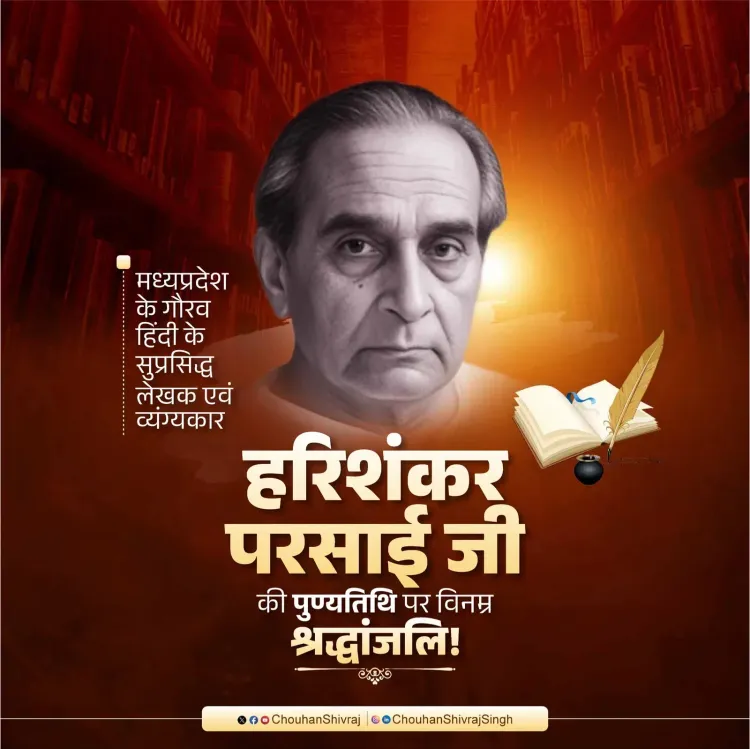
Chouhan posted a heartfelt tribute on Monday, 10 August 2026, writing in Hindi: 'मध्यप्रदेश के गौरव, हिंदी के सुप्रसिद्ध लेखक एवं व्यंग्यकार हरिशंकर परसाई जी की पुण्यतिथि पर विनम्र श्रद्धांजलि अर्पित करता हूँ!' ('I humbly pay tribute on the death anniversary of Harishankar Parsai, the pride of Madhya Pradesh, a celebrated Hindi writer and satirist!'). He added that Parsai would always be remembered as the satirist who gave vyangya — the art of satire — its rightful place in Hindi literature and struck hard at social contradictions.
The man who made Hindi satire respectable
Harishankar Parsai is widely regarded as the father of modern Hindi vyangya. At a time when satire was considered a lesser literary form, Parsai's prose elevated it into a serious vehicle for social and political commentary. His writing skewered hypocrisy, bureaucratic rot, and the absurdities of everyday Indian life with a precision that few writers — in any language — have matched.
Born in Madhya Pradesh, Parsai remained rooted in the heartland even as his readership spread across the Hindi belt. His works are staples of Hindi literary curricula and continue to be cited whenever Indian writers grapple with the question of how literature can hold power to account.
MP's political class and the Hindi literary tradition
Chouhan's tribute fits a well-established pattern: leaders from Madhya Pradesh — a state that has produced a disproportionate share of Hindi literature's giants — regularly mark the death anniversaries of its writers with public statements. For Chouhan, a politician whose public identity has long been tied to Madhya Pradesh's cultural pride, the tribute carries an additional layer of personal resonance beyond routine protocol.
The minister closed his post with a salutation — 'हिंदी के अनन्य सेवक को प्रणाम!' ('Salutations to the devoted servant of Hindi!') — a phrase that frames Parsai not merely as a literary figure but as a guardian of the language itself. In a political climate where Hindi's status remains a live and sometimes contentious issue, that framing is deliberate and pointed.
Parsai's legacy endures not because politicians remember him once a year, but because his targets — corruption, hollow ritual, the gap between public virtue and private conduct — have never gone out of season.
Point of View
Even if the intent is purely cultural. The framing of Parsai as a 'devoted servant of Hindi' also plugs into the BJP's broader project of championing Hindi as a national cultural pillar. For Chouhan specifically, such gestures reinforce his carefully cultivated identity as Madhya Pradesh's most prominent son — a regional-cultural brand that remains politically valuable even from a Union cabinet seat in Delhi.
NationPress
24 Sept 2026
Frequently Asked Questions
Who was Harishankar Parsai?
Harishankar Parsai was a celebrated Hindi writer and satirist from Madhya Pradesh, widely regarded as the father of modern Hindi vyangya (satire). He used his writing to critique social hypocrisy, corruption, and the absurdities of Indian public life.
Why did Shivraj Singh Chouhan pay tribute to Harishankar Parsai?
Chouhan paid tribute on Parsai's death anniversary, honouring him as the pride of Madhya Pradesh and acknowledging his role in giving vyangya a respected place in Hindi literature.
What is vyangya in Hindi literature?
Vyangya is the Hindi term for satire as a literary form. Harishankar Parsai is credited with elevating it from a minor genre to a serious and respected mode of social and political commentary in Hindi letters.
What did Shivraj Chouhan say about Harishankar Parsai?
Chouhan called Parsai 'the pride of Madhya Pradesh' and said he would always be remembered as the satirist who gave vyangya its rightful place in Hindi literature and struck hard at social contradictions. He concluded with the salutation 'Salutations to the devoted servant of Hindi!'
When did Shivraj Singh Chouhan post the Parsai tribute?
Chouhan posted the tribute on Monday, 10 August 2026, marking Harishankar Parsai's death anniversary.