Shivraj Singh Chouhan pays tribute to Mahakavi Nirala on death anniversary
Synopsis
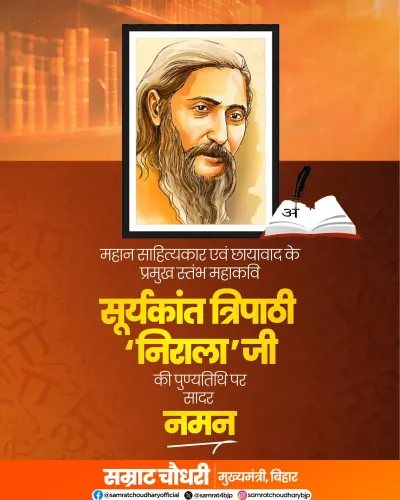
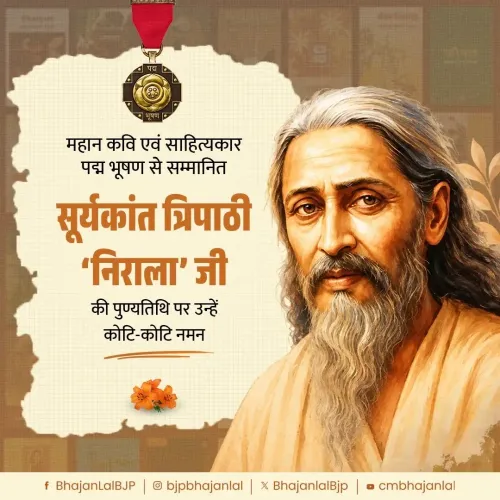
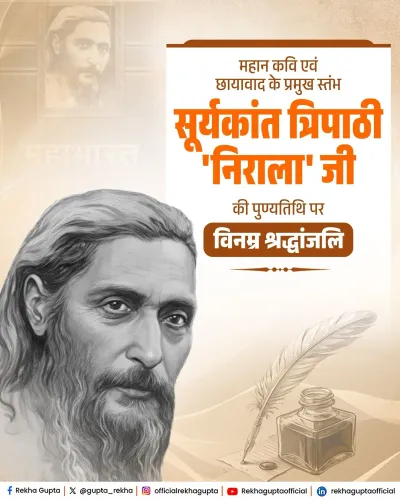
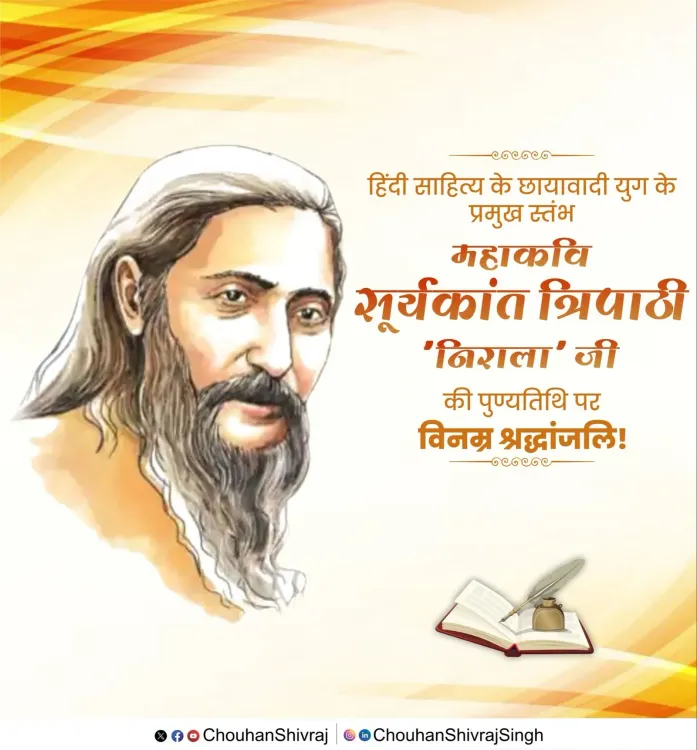
Union Agriculture Minister Shivraj Singh Chouhan marked the death anniversary of Chhayavad poet Mahakavi Suryakant Tripathi 'Nirala' on October 15, 2026, calling his works an invaluable treasure of Hindi literature and paying homage to one of modern Hindi's most celebrated literary voices.
Key Takeaways
Union Agriculture Minister Shivraj Singh Chouhan posted a tribute to Mahakavi Suryakant Tripathi 'Nirala' on his death anniversary on October 15, 2026 .
Chouhan described Nirala as a 'blessed son of Mother Saraswati' and called his work an 'invaluable treasure of the literary world.' Nirala was a central figure of the Chhayavad movement , the early-twentieth-century romantic-mystical school of Hindi poetry.
His works — poetry, novels, and short fiction — remain core to Hindi literary education across India.
The tribute reflects a wider pattern of Hindi-heartland political leaders publicly honouring canonical literary figures on social media.
A century after Suryakant Tripathi 'Nirala' reshaped the Hindi literary world, one of India's most senior political voices paused on a Thursday morning to honour him. Union Agriculture Minister Shivraj Singh Chouhan posted a heartfelt tribute on X on October 15, 2026, marking the death anniversary of the Chhayavad era's most towering poet.
Posting in Hindi, Chouhan described Nirala as 'माँ सरस्वती के वरद पुत्र' — 'a blessed son of Mother Saraswati' — and called his body of work an 'invaluable treasure of the literary world.' He added that Nirala's poems, stories, and novels 'will continue to illuminate the hearts of literature lovers with unmatched joy for all time,' closing with a bow to 'Hindi's most devoted servant.'Who was Mahakavi Nirala — and why does he still matter
Suryakant Tripathi 'Nirala' (1896–1961) was the defining rebel of the Chhayavad movement, the romantic-mystical school that dominated Hindi poetry in the early twentieth century alongside Jaishankar Prasad, Sumitranandan Pant, and Mahadevi Varma. Where others wrote in metre, Nirala broke the mould — his free verse was electric, defiant, spiritual all at once. Works like Ram Ki Shakti Puja and Saroj Smriti, a devastating elegy for his daughter, remain milestones of modern Hindi literature. His prose — novels, essays, short fiction — was equally restless.
He lived in poverty for much of his later life, yet his output never faltered. That combination of literary genius and personal struggle has made him a near-mythic figure in the Hindi belt — celebrated in school syllabi, university curricula, and annual commemorations across Uttar Pradesh and Madhya Pradesh.
A political salute to Hindi's cultural backbone
Indian political leaders — particularly those from the Hindi heartland — routinely mark the birth and death anniversaries of canonical literary figures on social media. It is a form of soft cultural diplomacy: an affirmation of regional identity, linguistic pride, and civilisational continuity. For Chouhan, a four-term former Chief Minister of Madhya Pradesh whose political career is deeply rooted in the state's Hindi-speaking, culturally rich electorate, the gesture carries an additional resonance. Nirala spent significant years in Allahabad (Prayagraj), the literary capital of the Hindi world, and his legacy is woven into the cultural fabric of precisely the region Chouhan has long represented.
The tribute carries no immediate policy dimension. But it is a reminder that in Indian public life, honouring literature is never entirely separable from honouring language — and language, in the Hindi belt, is always political terrain.
Point of View
Invoking Nirala is a signal of linguistic and civilisational pride, not merely a literary footnote. Such gestures quietly reinforce the BJP's longstanding positioning as a guardian of Hindi identity and cultural heritage. There is no immediate policy consequence, but the cumulative effect of such tributes shapes how the party is perceived by Hindi-speaking, culturally literate constituencies.
NationPress
15 Oct 2026
Frequently Asked Questions
Who was Suryakant Tripathi 'Nirala'?
Suryakant Tripathi 'Nirala' (1896–1961) was one of the foremost Hindi poets of the twentieth century and a defining voice of the Chhayavad movement. He is celebrated for works including Ram Ki Shakti Puja and Saroj Smriti , and is known for pioneering free verse in Hindi poetry.
Why did Shivraj Singh Chouhan pay tribute to Nirala?
October 15 marks the death anniversary of Mahakavi Nirala. Union Agriculture Minister Shivraj Singh Chouhan posted a tribute on X honouring his literary legacy and contributions to Hindi literature.
What is the Chhayavad movement in Hindi literature?
Chhayavad was a romantic-mystical literary movement that flourished in Hindi poetry in the early twentieth century. Its four principal figures — Nirala, Jaishankar Prasad, Sumitranandan Pant, and Mahadevi Varma — brought symbolism, individualism, and nature mysticism into modern Hindi verse.
What did Shivraj Singh Chouhan say about Nirala?
Chouhan called Nirala a 'blessed son of Mother Saraswati,' described his works as an 'invaluable treasure of the literary world,' and said his poems, stories, and novels would continue to illuminate readers' hearts for all time.
Is Shivraj Singh Chouhan the Chief Minister of Madhya Pradesh?
No. Shivraj Singh Chouhan is currently the Union Minister of Agriculture and Farmers Welfare and Rural Development. He served four terms as Chief Minister of Madhya Pradesh before joining the Union Cabinet.