Pralhad Joshi Remembers APJ Abdul Kalam on Birth Anniversary
Synopsis
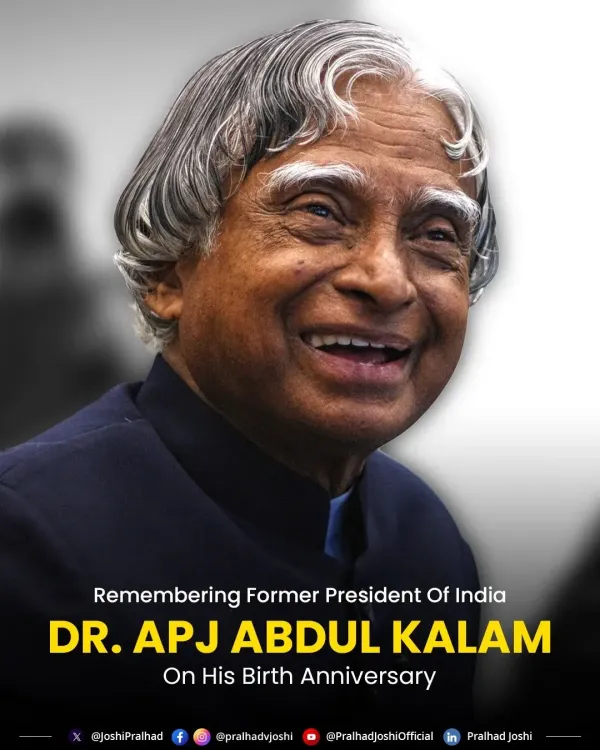
Union Minister Pralhad Joshi paid tribute to Bharat Ratna Dr. APJ Abdul Kalam on his birth anniversary, honouring the aerospace legend's vision for a self-reliant, technologically advanced India and his lifelong mission to inspire youth.
Key Takeaways
Union Minister Pralhad Joshi posted a tribute to Dr.
APJ Abdul Kalam on his birth anniversary, October 15, 2026 .
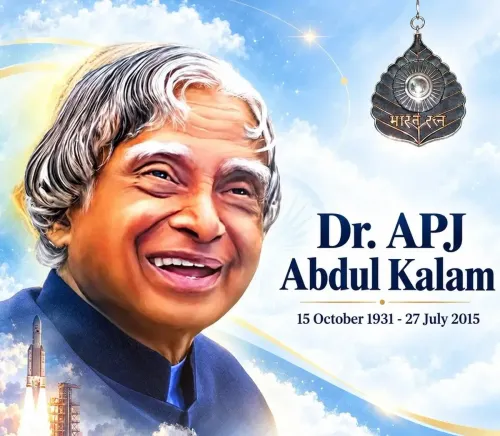
Kalam served as the 11th President of India from 2002 to 2007 and was widely known as the 'People's President.' He was awarded the Bharat Ratna in 1997 for his contributions to science and technology, including missile development at DRDO and space research at ISRO.
October 15 is observed as World Students' Day in India in Kalam's honour, recognising his deep commitment to youth empowerment.
Joshi's tribute was posted in both English and Kannada , reflecting his outreach to his Karnataka constituency.
Kalam's vision of technological self-reliance continues to resonate as India advances its space, defence, and renewable-energy programmes.
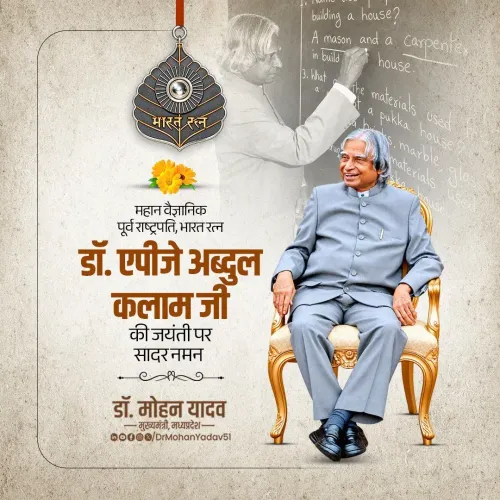
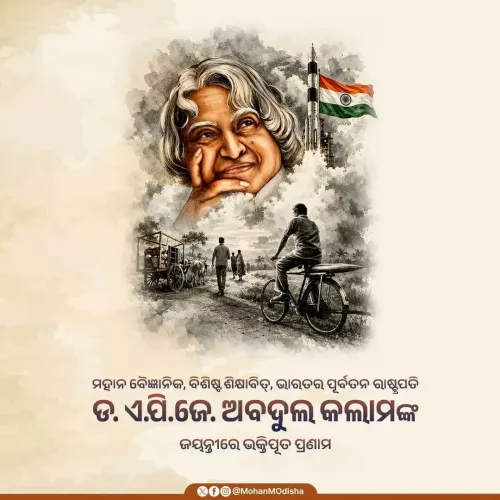
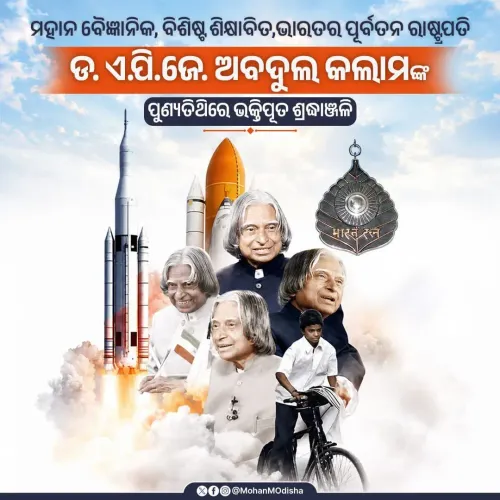
On the birth anniversary of one of India's most beloved scientific minds, Union Consumer Affairs Minister Pralhad Joshi on Thursday, October 15, paid tribute to Bharat Ratna Dr. APJ Abdul Kalam, honouring the man whose rockets shaped a nation's ambitions and whose words shaped a generation's dreams.
In his post, Minister Joshi described Kalam as India's 'People's President' whose 'pioneering work in aerospace science and unwavering faith in the power of young minds left an indelible mark on the nation.' In Kannada, he offered his salutations to Bharatada 'Missile Man' — India's Missile Man — calling him a lifelong inspiration for youth to dream big and strive harder.
From Rameswaram to Rashtrapati Bhavan
Dr. Avul Pakir Jainulabdeen Abdul Kalam rose from modest beginnings in Rameswaram, Tamil Nadu, to become the 11th President of India, serving from 2002 to 2007. Before the presidency, his decades at DRDO and ISRO earned him the sobriquet 'Missile Man of India' — a title rooted in his central role in India's indigenous ballistic missile development programme. The nation recognised his contributions with the Bharat Ratna in 1997, India's highest civilian honour.
His presidency was defined less by protocol and more by people — particularly students. He was known to address school children with the same intensity he brought to scientific briefings, insisting that a developed India by 2020 was not a politician's slogan but an engineer's blueprint waiting to be executed.
October 15 as World Students' Day
October 15 is observed across India as World Students' Day in Kalam's honour — a designation that captures the essence of his life's second calling. Long after his work on guided missiles was classified legacy, his books, lectures, and relentless campus visits to universities and colleges became his most enduring output. For millions of young Indians, he remains the scientist who made dreaming feel like a national duty.
Minister Joshi's tribute, offered in both English and Kannada, reflects a wider tradition: on this date each year, leaders across party lines set aside political differences to invoke the Kalam legacy — a consensus figure in a fractious era, whose vision of technological self-reliance has only grown more relevant as India accelerates its space, defence, and clean-energy ambitions.
The Missile Man never stopped looking up. India, it seems, never stopped following his gaze.
Point of View
Making him a useful touchstone for any government prioritising indigenisation in defence and space. For a minister overseeing renewable energy, invoking Kalam's legacy of scientific self-reliance carries a quiet programmatic signal: that India's clean-energy transition is framed as an extension of the same nation-building ethos Kalam championed. The bipartisan reverence for Kalam also functions as a rare moment of political common ground — one the BJP, like its predecessors, has consistently leveraged to project a forward-looking, science-friendly identity.
NationPress
15 Oct 2026
Frequently Asked Questions
Why is October 15 celebrated as World Students' Day in India?
October 15 is observed as World Students' Day in India to mark the birth anniversary of Dr. APJ Abdul Kalam, honoring his extraordinary dedication to inspiring youth and his belief that young minds are the foundation of a developed nation.
Why was APJ Abdul Kalam called the Missile Man of India?
Dr. Kalam earned the title 'Missile Man of India' for his pivotal role in developing India's indigenous ballistic missile programme at DRDO, which included the Agni and Prithvi missile series that significantly advanced the country's defence capabilities.
What was APJ Abdul Kalam's role as President of India?
Dr. APJ Abdul Kalam served as the 11th President of India from 2002 to 2007. He was widely called the 'People's President' for his accessibility, particularly his frequent interactions with students and his emphasis on youth-driven national development.
When did APJ Abdul Kalam receive the Bharat Ratna?
Dr. APJ Abdul Kalam was conferred the Bharat Ratna, India's highest civilian honour, in 1997, in recognition of his extraordinary contributions to science, technology, and national defence.
Who is Pralhad Joshi and why did he pay tribute to Kalam?
Pralhad Joshi is a senior BJP leader from Karnataka and Union Minister of Consumer Affairs, Food and Public Distribution, as well as New and Renewable Energy. He paid tribute to Dr. Kalam on October 15, his birth anniversary, joining national leaders across party lines in honoring the scientist-president's enduring legacy.