Maharashtra forms transit task force under Viksit Maharashtra 2047 plan
Synopsis
Maharashtra has formally constituted a high-level task force to plan the expansion of metro corridors, railways, and RRTS across the Mumbai Metropolitan Region under the Viksit Maharashtra 2047 framework. With MMR's suburban rail carrying 7.5 million passengers daily and over 120 km of new metro under construction, the panel's recommendations — due in six months — could define the region's commuter infrastructure for the next two decades.
Key Takeaways
The Maharashtra government issued a Government Resolution (GR) on 15 October 2026 constituting a high-level Transit Task Force under the Viksit Maharashtra 2047 vision.
The task force is chaired by the CMD, Mumbai Railway Vikas Corporation (MRVC) and must submit recommendations within six months .
Its mandate covers metro corridors , railway expansion , RRTS , and semi-high-speed rail across the Mumbai Metropolitan Region (MMR) and other urban areas.
MMR's suburban rail spans over 435 km , carrying roughly 7.5 million passengers daily ; metro ridership has crossed 1.6 million passengers daily.
Over 120 km of additional metro tracks are under construction or approval, covering Lines 2B, 4, 4A, 5, 6, 9, and 12 .
Six metropolitan region development authorities — including from Pune , Nagpur , Nashik , and Chhatrapati Sambhajinagar — are invited to the task force deliberations.
The Maharashtra government has issued a Government Resolution (GR) to establish a high-level Task Force tasked with drafting a comprehensive framework for expanding railway networks, metro corridors, and Regional Rapid Transit Systems (RRTS) across the Mumbai Metropolitan Region (MMR) and other major urban areas in the state. The move, announced on 15 October 2026, is aligned with the state's 'Viksit Maharashtra 2047' vision for systematic and integrated transit planning.
Background and Formation
The task force's constitution follows a high-level meeting held on 7 October, chaired by the Additional Chief Secretary (Urban Development-1). The body has been mandated to submit its strategic recommendations and a full report within six months of its formation.
The task force will be chaired by the Chairman and Managing Director, Mumbai Railway Vikas Corporation (MRVC), with the Chief Manager (Planning), MRVC serving as member secretary.
Key Responsibilities of the Task Force
The panel's core mandate spans three broad areas. First, it will formulate policy recommendations and coordination measures to ensure seamless integration of public transit networks in line with Viksit Maharashtra 2047 goals. Second, it will conduct in-depth assessments of the feasibility, suitability, and economic viability of transport systems for specific regions. Third, it will evaluate the expansion of railway networks, implementation of metro corridors and RRTS, and the potential linking of major cities via semi-high-speed rail.
Task Force Composition
Core members include the Joint Secretary (UD-7) of the Urban Development Department; Director (Planning/Projects), Maharashtra Metro Rail Corporation Ltd. (Maha-Metro), Nagpur; Director (Projects), Maha-Metro, Pune; Director (Planning), Mumbai Metro Rail Corporation Ltd. (MMRCL), Mumbai; and the Head (Transport and Communications), Mumbai Metropolitan Region Development Authority (MMRDA), Mumbai.
Invitees drawn from planning departments include representatives from CIDCO (Navi Mumbai), the Pune Metropolitan Region Development Authority, the Nashik Metropolitan Region Development Authority, the Chhatrapati Sambhajinagar Metropolitan Region Development Authority, the Nagpur Metropolitan Region Development Authority, and Maha Mumbai Metro Operation Corporation Limited. The task force chairman retains the authority to co-opt additional members as required.
Mumbai's Current Transit Landscape
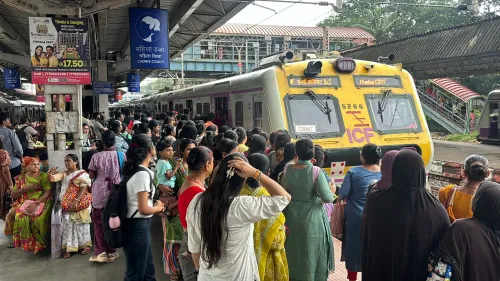
The MMR already operates one of Asia's most complex multi-modal transit systems. The suburban rail network spans over 435 km across three primary trunk routes — the Western Line, Central Line, and Harbour Line — and carries roughly 7.5 million passengers daily, making it among the busiest commuter rail grids on the continent.
The metro network has grown to an operational length of roughly 80 km. Operational lines include Line 1 (Blue Line): Versova to Ghatkopar (11.4 km, operational since 2014); Line 2A (Yellow Line): Dahisar East to Andheri West (18.6 km); Line 7 (Red Line): Dahisar East to Gundavali (16.5 km); and Line 3 (Aqua Line): Cuffe Parade to Aarey Colony (33.5 km, fully underground, completed in phases through late 2025). Daily metro ridership has crossed 1.6 million passengers.
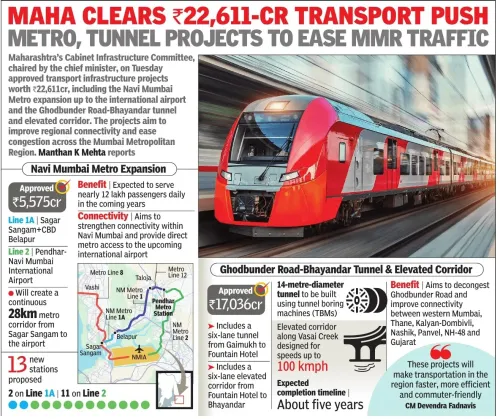
Over 120 km of additional metro tracks are currently in various phases of construction or approval, including Lines 2B, 4, 4A, 5, 6, 9, and 12, intended to interconnect Thane, Navi Mumbai, Kalyan, and Mira-Bhayander. Extensive bus fleets operated by BEST, TMT, KDMT, and NMMT continue to serve as critical first- and last-mile connectors. Notably, a single monorail corridor also operates within the city, though its service reliability has historically faced bottlenecks.
What Comes Next
With the task force now formally constituted, the next milestone is the delivery of its recommendations within six months. Industry observers will watch whether the panel moves beyond planning exercises to produce an actionable, time-bound implementation roadmap — an area where past urban mobility initiatives in Maharashtra have at times fallen short. The outcome of this exercise is expected to shape transit investments and commuter experience across the MMR and Maharashtra's other growing urban centres well into the 2040s.
Point of View
Metro corridors have faced years of construction overruns, and the monorail stands as a cautionary tale of underutilised infrastructure. The six-month deadline for recommendations is tight, but the real accountability test is whether those recommendations carry financial commitments and enforceable timelines. Bringing in development authorities from Pune, Nagpur, Nashik, and Chhatrapati Sambhajinagar is a meaningful signal that this exercise is intended to extend beyond Mumbai — but ambition at the planning stage has rarely been Maharashtra's problem.
NationPress
15 Oct 2026
Frequently Asked Questions
What is the Maharashtra transit task force formed under Viksit Maharashtra 2047?
It is a high-level panel constituted by the Maharashtra government through a Government Resolution on 15 October 2026 to draft a comprehensive framework for expanding metro corridors, railway networks, and RRTS across the Mumbai Metropolitan Region and other urban areas. The task force must submit its recommendations within six months.
Who chairs the new transit task force?
The task force is chaired by the Chairman and Managing Director of the Mumbai Railway Vikas Corporation (MRVC). The Chief Manager (Planning) of MRVC serves as member secretary, and the panel includes senior officials from MMRDA, Maha-Metro, and MMRCL.
Which cities and regions are covered under this initiative?
The primary focus is the Mumbai Metropolitan Region, but the exercise extends to other major urban centres. Development authorities from Pune, Nagpur, Nashik, Chhatrapati Sambhajinagar, and Navi Mumbai (CIDCO) have been invited as participants.
What is the current state of Mumbai's metro and suburban rail network?
Mumbai's suburban rail spans over 435 km and carries roughly 7.5 million passengers daily, while the operational metro network covers approximately 80 km with daily ridership exceeding 1.6 million. Over 120 km of additional metro tracks are under construction or approval.
What does the Viksit Maharashtra 2047 vision aim to achieve in transport?
Viksit Maharashtra 2047 is a long-range state development framework that seeks to plan and expand transit networks more effectively and systematically. The transit task force is one of its first concrete institutional steps, focused on integrating metro, rail, RRTS, and semi-high-speed rail across the state's growing urban regions.