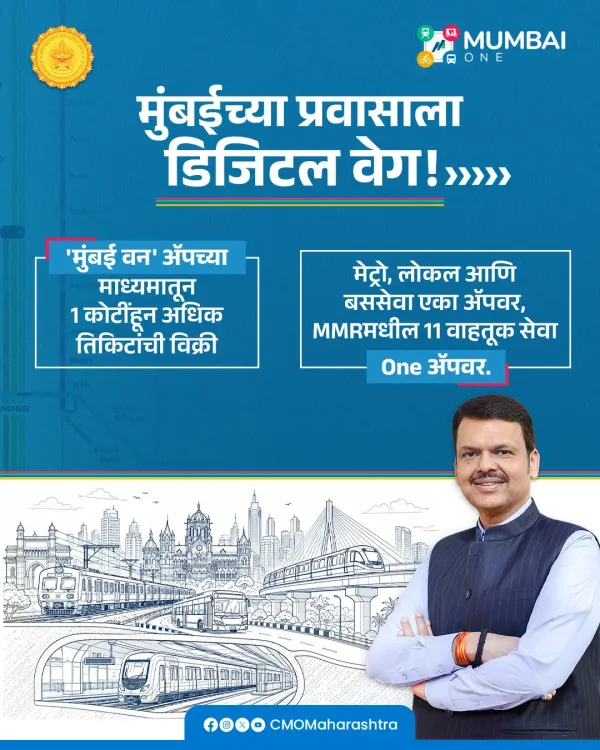
CM Fadnavis: Mumbai One App crosses 1 crore riders
Synopsis
The Chief Minister's Office of Maharashtra announced that the Mumbai One App — which integrates ticketing across metro, suburban rail, and bus — has been chosen by 1 crore passengers, marking a landmark for the city's multimodal transit ambitions under CM Devendra Fadnavis.
Key Takeaways
The Mumbai One App has recorded 1 crore passenger journeys , according to the Chief Minister's Office of Maharashtra.
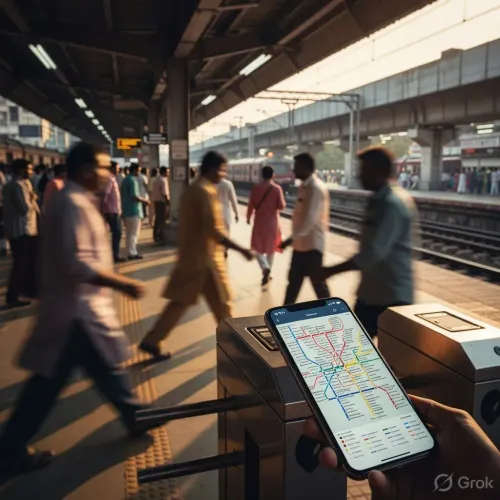
The app provides unified ticketing and journey planning across Mumbai's metro, suburban local trains, and bus networks .
Chief Minister Devendra Fadnavis was directly tagged in the announcement, reflecting his administration's ownership of the milestone.
Mumbai's suburban rail alone carries roughly 7 million passengers daily , making the app's adoption scale significant.
The milestone marks a turning point for Maharashtra's long-running push toward digital multimodal transport integration in the Mumbai Metropolitan Region.
One app, three networks, one crore journeys — Mumbai's commuters have handed the Mumbai One unified mobility platform its biggest endorsement yet. The Chief Minister's Office of Maharashtra announced on Wednesday, 12 August 2026 that the app has become the first choice for 1 crore passengers travelling across metro, local train, and bus services in the city.
What Mumbai One actually does
The Mumbai One App is a single-window platform that lets commuters plan journeys and buy tickets across Mumbai's suburban rail, the expanding metro network, and city bus services — all without switching between separate apps or queues. The idea is deceptively simple: stitch together three distinct transit operators under one digital roof. Getting there has taken years of coordination between state agencies and transport bodies.
Chief Minister Devendra Fadnavis, tagged directly in the post, has been among the most vocal champions of multimodal integration in the Mumbai Metropolitan Region, backing metro expansion and digital ticketing as twin pillars of the city's transport future.
Why 1 crore matters in a city of 7 million daily rail riders
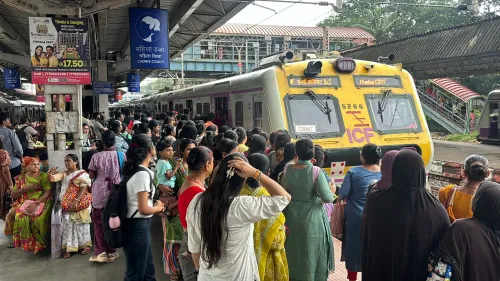
Mumbai's suburban rail alone moves roughly 7 million passengers every day — one of the densest commuter flows on the planet. Against that backdrop, 1 crore cumulative users choosing a single unified app signals that multimodal digital ticketing has cleared its hardest hurdle: habit change. Mumbai commuters are notoriously loyal to familiar routines; a milestone at this scale suggests the platform has moved beyond early adopters.
Maharashtra governments have pursued digital transport integration for years, but fragmentation — separate ticketing for metro, rail, and bus — long frustrated the vision of a seamless commute. The Mumbai One milestone is the clearest sign yet that the integration is holding in practice, not just on paper.
What comes next for the platform
The announcement arrives as Mumbai's metro network continues to expand, adding corridors that bring new commuter pools into the multimodal ecosystem. Analysts and transport planners will watch whether the app adds payment features, integrates auto or cab aggregators, or extends to the wider Mumbai Metropolitan Region beyond the city core. Each addition widens the addressable ridership — and raises the stakes for reliability.
For now, the number speaks plainly: one crore passengers chose to plan and pay for their commute through a single platform. In a megacity where the morning rush is a daily act of endurance, that is not a small thing.
Point of View
Who has staked credibility on Mumbai's metro expansion and digital transit integration. Unified ticketing platforms typically face a 'cold start' problem — low utility until enough modes are onboarded, low adoption until utility is proven — so crossing a crore users suggests that loop has been broken. The broader pattern is Maharashtra using Mumbai as a showcase for urban governance, with each transport milestone feeding the state's pitch as an investor-friendly, well-managed megacity. The real test now is whether ridership growth outpaces the platform's reliability and whether integration deepens before the next election cycle makes it a campaign talking point.
NationPress
26 Sept 2026
Frequently Asked Questions
What is the Mumbai One App?
The Mumbai One App is a unified mobility platform that lets commuters plan journeys and purchase tickets across Mumbai's suburban local trains, metro lines, and bus services through a single application.
How many people have used the Mumbai One App?
According to the Chief Minister's Office of Maharashtra, the Mumbai One App has been used by 1 crore (10 million) passengers , making it the preferred choice for multimodal travel in the city.
Which transport modes does Mumbai One App cover?
The app covers three major public transport modes in Mumbai: the suburban local train network, the metro rail system, and city bus services.
Who launched or backs the Mumbai One App?
The Mumbai One App is backed by the Maharashtra state government. Chief Minister Devendra Fadnavis has been a prominent supporter of multimodal transport integration in the Mumbai Metropolitan Region.
Why is the Mumbai One App milestone significant?
Mumbai's suburban rail alone carries roughly 7 million passengers daily. Reaching 1 crore users on a unified app signals that digital multimodal ticketing has achieved mainstream adoption in one of the world's busiest transit cities.