Mandaviya pays tribute to Dr. Kalam on birth anniversary
Synopsis
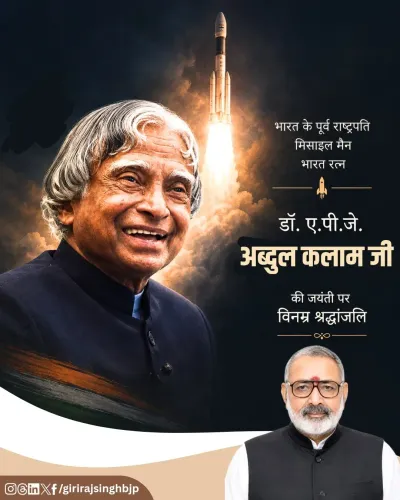
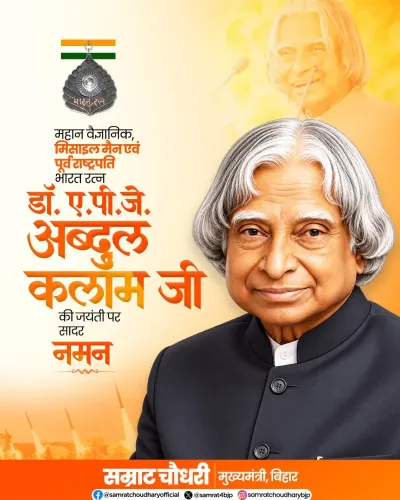
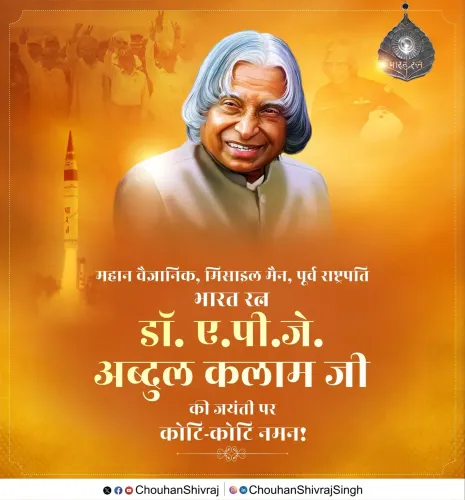
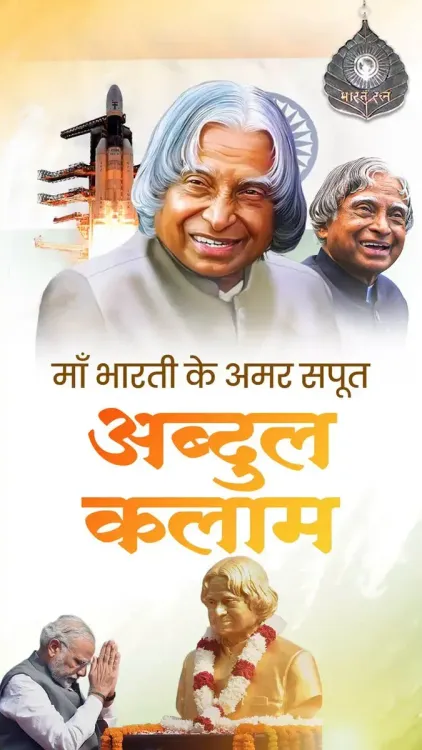
Union Minister Mansukh Mandaviya on 15 October 2026 paid tribute to former President and Bharat Ratna Dr. A.P.J. Abdul Kalam on his birth anniversary, honouring his legacy of using science as a tool for nation-building and inspiring generations of Indian youth.
Key Takeaways
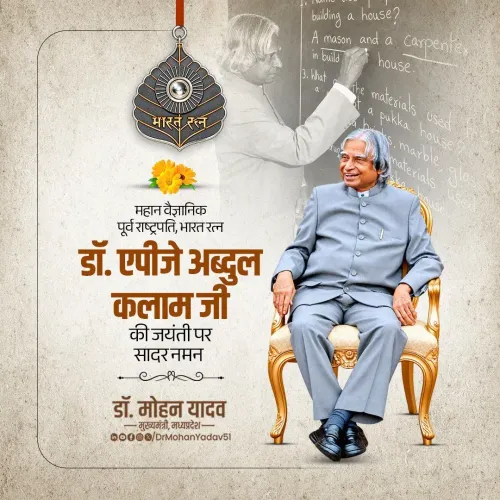
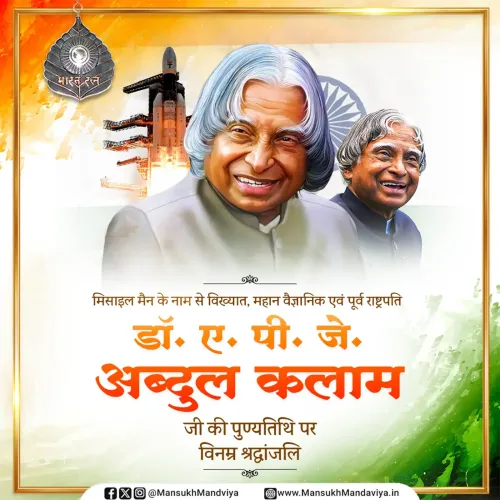
Union Minister Mansukh Mandaviya posted a tribute on X honouring Dr.
Abdul Kalam on his birth anniversary, 15 October 2026 .
Kalam, born 15 October 1931 in Rameswaram, Tamil Nadu , was the principal architect of India's ballistic missile programme and is known as the 'Missile Man of India'.
He served as India's 11th President from 2002 to 2007 and was awarded the Bharat Ratna in 1997 .
15 October is observed as National Students' Day in his honour, marking his enduring connection to youth and education.
Leaders across India's political spectrum issue annual tributes on this date, reflecting Kalam's rare standing as a unifying national figure.
On the birth anniversary of Dr. A.P.J. Abdul Kalam, Union Labour and Sports Minister Mansukh Mandaviya paused to honour the man who made a generation believe that science and service to the nation are the same calling — on 15 October 2026.
Posting in Hindi on X, Mandaviya wrote: 'विज्ञान को राष्ट्रनिर्माण का माध्यम बनाकर युवाओं में राष्ट्रसेवा की ज्योति प्रज्वलित करने वाले' — 'one who made science a medium of nation-building and lit the flame of national service in the hearts of the youth' — offering his 'respectful salutations' to the 'great scientist, former President, Bharat Ratna Dr. A.P.J. Abdul Kalam.'From missile labs to Rashtrapati Bhavan
Dr. Avul Pakir Jainulabdeen Abdul Kalam was born on 15 October 1931 in Rameswaram, Tamil Nadu. An aerospace engineer who rose through India's defence research establishment, he was the scientific architect behind the country's ballistic missile programme — earning him the popular title 'Missile Man of India.' His journey culminated in his election as India's 11th President, a post he held from 2002 to 2007.
The nation's highest civilian honour, the Bharat Ratna, was conferred on him in 1997 — five years before he entered Rashtrapati Bhavan — in recognition of his foundational contributions to science and national security. That rare sequence, scientist first and head of state second, is precisely what set his public image apart from virtually every other Indian leader of the modern era.
Why 'People's President' still resonates with young India
Kalam wore the presidency differently. He visited schools, answered students' letters, and consistently framed India's future in the language of laboratories and classrooms rather than legislatures. His books, particularly Wings of Fire, became a fixture on the shelves of engineering students across the country and remain so today. The phrase 'dream, dream, dream' — distilled from his public addresses — entered the informal vocabulary of Indian youth motivation in a way few political figures ever manage.
That legacy is why, each year on 15 October — observed as National Students' Day — political leaders, scientists, and educators across party lines renew their tributes. The day has become a quiet but steady reminder that the nation continues to measure its scientific ambition, at least in part, against the standard he set.
Point of View
Invoking his legacy aligns neatly with its 'Viksit Bharat' science-and-technology narrative, framing national ambition in the idiom Kalam made popular. The annual ritual also quietly reinforces the state's claim to the mantle of youth inspiration — particularly relevant given the government's expanding portfolio in youth affairs, which Mandaviya himself oversees. That a Labour and Sports Minister leads with Kalam's science-and-nation-building framing, rather than a purely presidential one, signals how comprehensively Kalam's image has been absorbed into the broader discourse of Indian youth policy.
NationPress
15 Oct 2026
Frequently Asked Questions
When is APJ Abdul Kalam's birthday?
Dr. A.P.J. Abdul Kalam was born on 15 October 1931 in Rameswaram, Tamil Nadu. The date is observed annually as National Students' Day across India.
Why is APJ Abdul Kalam called the Missile Man of India?
Kalam earned the title 'Missile Man of India' for his central role in developing India's ballistic missile programme through the Defence Research and Development Organisation (DRDO) , including the Agni and Prithvi missiles.
What is APJ Abdul Kalam's Bharat Ratna?
Dr. Kalam was awarded the Bharat Ratna — India's highest civilian honour — in 1997 , in recognition of his extraordinary contributions to science and national security.
When did APJ Abdul Kalam become President of India?
Dr. Kalam served as India's 11th President from 2002 to 2007 . He was the first scientist to occupy Rashtrapati Bhavan.
What did Mansukh Mandaviya say about APJ Abdul Kalam?
On 15 October 2026 , Union Minister Mansukh Mandaviya posted a Hindi tribute on X honouring Kalam as a 'great scientist' who 'made science a medium of nation-building and lit the flame of national service in the hearts of the youth.'