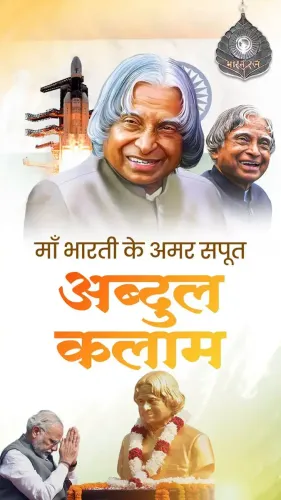
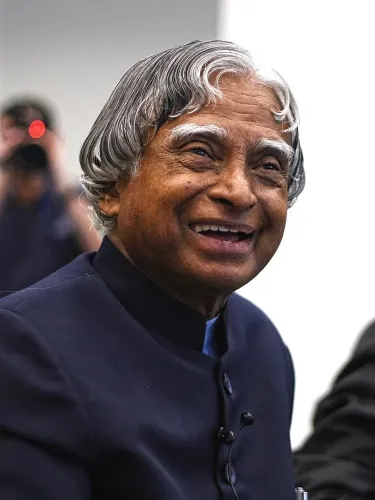
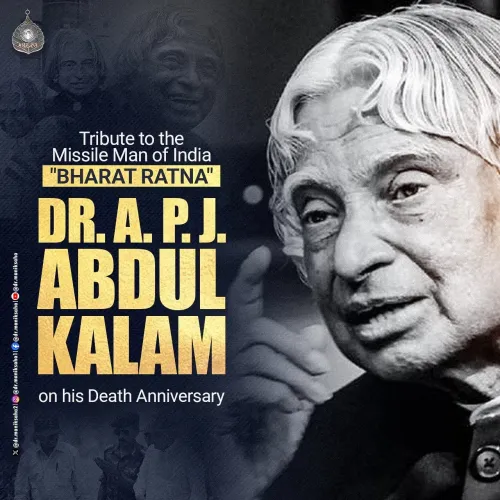
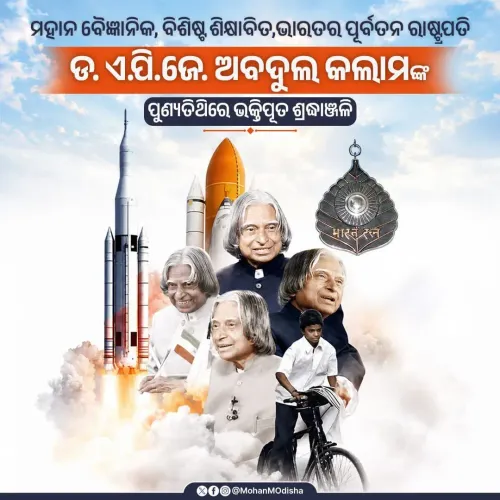
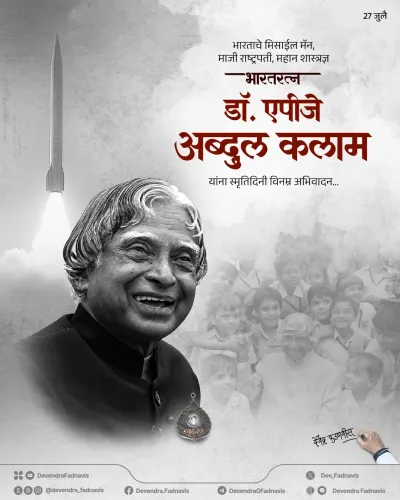
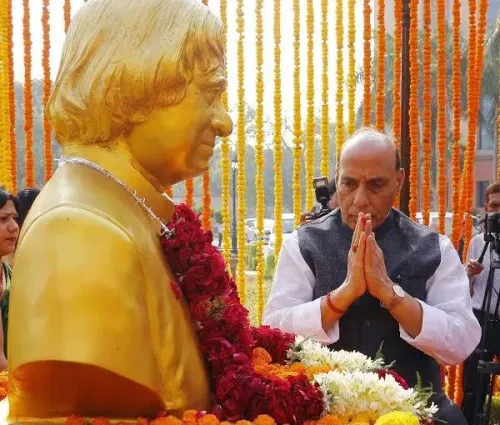
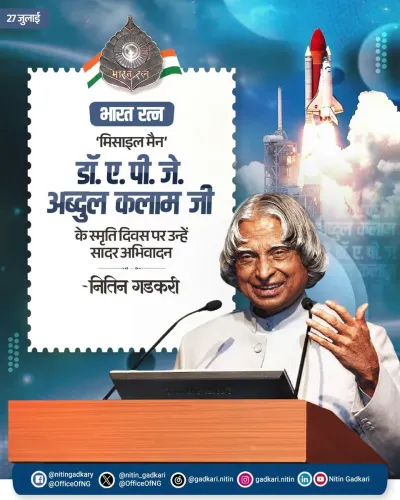
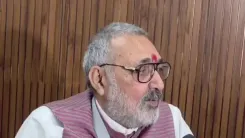
Mandaviya pays tribute to Missile Man Kalam on death anniversary
Synopsis
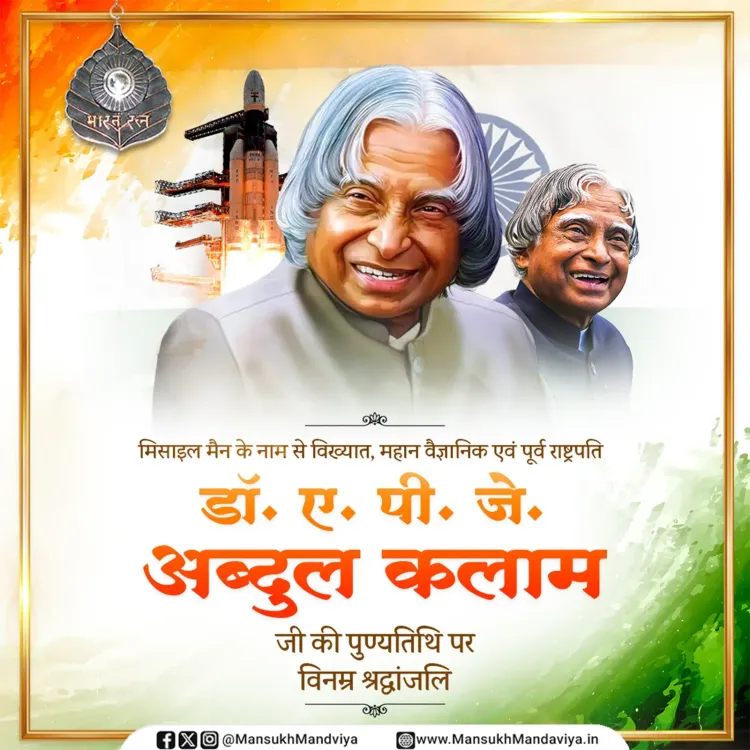
Union Minister Mansukh Mandaviya marked the death anniversary of former President and 'Missile Man' Dr. A.P.J. Abdul Kalam on July 27, 2026, paying tribute to the Bharat Ratna awardee whose contributions to India's missile programme and science education remain a lasting national legacy.
Key Takeaways
Mansukh Mandaviya , Union Minister of Labour, Employment, Youth Affairs and Sports, paid tribute to Dr.
Abdul Kalam on his death anniversary, July 27, 2026 .
Kalam served as India's 11th President from 2002 to 2007 and passed away on July 27, 2015 .
He was awarded the Bharat Ratna in 1997 for his contributions to science and public service.
Kalam led development of India's Agni and Prithvi missile series at DRDO and ISRO , earning the title 'Missile Man of India'.
Leaders across party lines routinely mark July 27 with tributes, reflecting Kalam's cross-partisan status as a national icon.
Union Labour and Sports Minister Mansukh Mandaviya on Monday, July 27, 2026, paid tribute to former President and aerospace scientist Dr. A.P.J. Abdul Kalam on his death anniversary, honouring the late leader with a post on X.
In his post, Minister Mandaviya wrote: 'महान वैज्ञानिक, 'मिसाइल मैन' और 'भारत रत्न' डॉ. ए.पी.जे. अब्दुल कलाम जी की पुण्यतिथि पर उन्हें शत-शत नमन।' — translated as: 'Heartfelt salutations to the great scientist, 'Missile Man' and 'Bharat Ratna' Dr. A.P.J. Abdul Kalam on his death anniversary.'
Context
Dr. Avul Pakir Jainulabdeen Abdul Kalam served as the 11th President of India from 2002 to 2007 and passed away on July 27, 2015, while delivering a lecture at the Indian Institute of Management, Shillong. He was 83 years old at the time of his death. His death anniversary is widely observed across India as a day of national remembrance.
Kalam earned the sobriquet 'Missile Man of India' for his pivotal role at DRDO and ISRO, where he led the development of India's indigenous ballistic missile programme, including the Agni and Prithvi series of missiles. He was conferred the Bharat Ratna — India's highest civilian honour — in 1997, a decade before he completed his presidential term.
Policy Backdrop
Tributes to Dr. Kalam on July 27 have become a consistent feature of India's political calendar, with leaders across party lines marking the occasion. The annual observance reflects Kalam's enduring status as a cross-partisan national icon, particularly in domains of science, defence technology, and youth inspiration.
His legacy intersects with sustained government emphasis on indigenous defence manufacturing under the Atmanirbhar Bharat framework and science-education outreach programmes targeting young Indians. Commemorative events at DRDO laboratories, ISRO centres, and educational institutions are customary around this date each year.
Stakeholders and Impact
The scientific community and India's youth — constituencies Kalam championed throughout his public life — remain the primary audiences for such tributes. Kalam's autobiography and public addresses have been institutionalised in school curricula, making him a figure of particular resonance for students and educators.
For a minister holding the Sports and Youth Affairs portfolio, invoking Kalam carries added significance: Kalam was renowned for his direct engagement with young people and his vision of India 2020 as a developed nation driven by science and technology.
What's Next
Commemorative programmes at scientific institutions and universities typically mark the July 27 anniversary each year. The occasion also serves as a recurring moment for policymakers to reaffirm commitments to indigenous technology development and youth-focused initiatives that Kalam championed during his lifetime.
Point of View
Bipartisan ritual of remembrance that underscores Kalam's rare status as a figure claimed by no single political camp. For a minister holding the Youth Affairs portfolio, the invocation of Kalam is particularly pointed: Kalam's brand of aspirational, science-driven nationalism maps closely onto current government messaging around Atmanirbhar Bharat and youth empowerment. The consistency of such tributes across administrations signals how Kalam's legacy has been institutionalised as a durable instrument of national identity. What distinguishes individual tributes is less their content than the platform and portfolio of the person offering them.
NationPress
26 Oct 2026
Frequently Asked Questions
When did APJ Abdul Kalam die?
Dr. A.P.J. Abdul Kalam passed away on July 27, 2015 , while delivering a lecture at the Indian Institute of Management, Shillong . He was 83 years old.
Why is APJ Abdul Kalam called the Missile Man of India?
Kalam earned the title 'Missile Man of India' for leading the development of India's indigenous ballistic missile programme at DRDO and ISRO , including the Agni and Prithvi missile series.
What is Bharat Ratna and did APJ Abdul Kalam receive it?
The Bharat Ratna is India's highest civilian honour. Dr. A.P.J. Abdul Kalam was conferred the award in 1997 in recognition of his contributions to science and national service.
What did Mansukh Mandaviya say about APJ Abdul Kalam?
Minister Mansukh Mandaviya posted on X offering 'heartfelt salutations' to Dr. Kalam on his death anniversary, referring to him as a 'great scientist,' the 'Missile Man,' and a 'Bharat Ratna' awardee.
Which number President was APJ Abdul Kalam?
Dr. A.P.J. Abdul Kalam served as the 11th President of India , holding office from 2002 to 2007 .