CM Rekha Gupta pays tribute to poet Nirala on death anniversary
Synopsis
Delhi Chief Minister Rekha Gupta honoured Hindi poet Suryakant Tripathi 'Nirala' on his death anniversary, praising his Chhayavad legacy of rebellion against injustice, sensitivity to suffering, and deep faith in human values as an enduring inspiration for future generations.
Key Takeaways
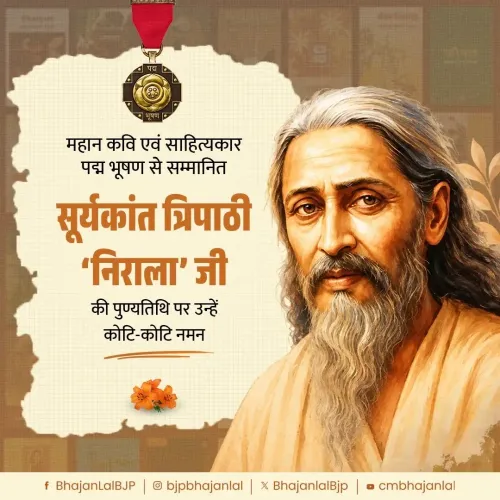
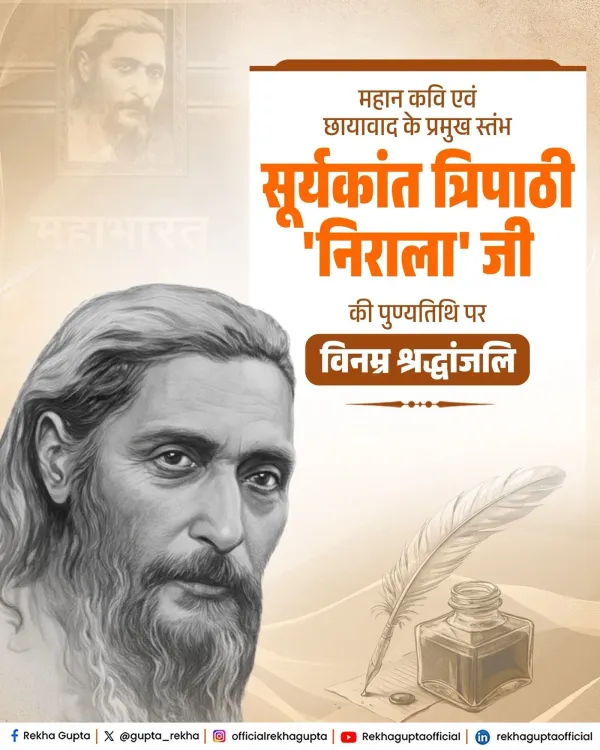
Delhi CM Rekha Gupta posted a tribute to Hindi poet Suryakant Tripathi 'Nirala' on his death anniversary, 15 October 2026 .
Nirala was a leading figure of the Chhayavad movement and lived from 1896 to 1961 .
CM Gupta highlighted three pillars of his work: sensitivity to social suffering, rebellion against injustice, and faith in human values.
She described his works as 'timeless,' crediting them with giving Hindi literature 'a new consciousness and expression.' The tribute follows a wider pattern of Indian political leaders publicly honouring literary icons on death anniversaries.
On the death anniversary of one of Hindi literature's most enduring voices, Delhi Chief Minister Rekha Gupta paused to honour the poet who gave modern Hindi verse its rebellious conscience. On Thursday, 15 October 2026, she posted a heartfelt tribute on X to Suryakant Tripathi 'Nirala', a towering pillar of the Chhayavad movement.
In her post, CM Gupta wrote that Nirala's pen carried 'sensitivity towards society's suffering, rebellion against injustice, and deep faith in human values' — samvedna, vidroh aur maanviya moolyon ke prati gehri nishtha [sensitivity, rebellion and deep faith in human values]. She added that his timeless works gave Hindi literature 'a new consciousness and expression.'
Who was Nirala — and why he still matters
Suryakant Tripathi 'Nirala' was born in 1896 and passed away in 1961, leaving behind a body of work that fundamentally reordered Hindi poetry. As a central figure of the Chhayavad movement — Hindi literature's romantic-modernist turn of the early twentieth century — Nirala broke from rigid metrical conventions, championed free verse, and turned his gaze unflinchingly on caste, poverty, and the dignity of labour.
His poems such as 'Saroj Smriti' and 'Kukurmutta' remain staples of Hindi curricula across India. His verse could be lyrical and anguished in the same breath — qualities that make him as resonant in classrooms today as he was in the freedom-movement era.
A ritual of remembrance — and what it signals
Indian political leaders across the spectrum regularly mark the death anniversaries of major literary and cultural figures, situating Hindi language and literature within the broader project of national identity. CM Gupta's tribute fits that pattern — but her specific framing is pointed. By invoking Nirala's 'rebellion against injustice' and 'social harmony,' she connects a century-old poetic legacy to contemporary conversations about truth, self-respect, and social cohesion — values her post explicitly names as the inheritance Nirala leaves for future generations.
The literary community and educators who keep Chhayavad alive in syllabi and seminars across Delhi and Uttar Pradesh — Nirala's home state — will recognise the resonance. A Chief Minister invoking a poet's social conscience is, in its quiet way, a statement about whose voice a government chooses to amplify.
Nirala wrote for those the world overlooked. That his words are still worth quoting from the highest office in Delhi, more than six decades after his death, is the most honest measure of their power.
Point of View
' CM Gupta aligns BJP's governance narrative in Delhi with the progressive-humanist strand of classical Hindi literature. Invoking Chhayavad icons is a recurring strategy among North Indian political leaders to signal rootedness in Hindi cultural identity. The framing of Nirala's legacy around 'truth, self-respect, and social cohesion' also maps neatly onto recurring BJP rhetorical themes, without making any explicit political claim.
NationPress
15 Oct 2026
Frequently Asked Questions
Who was Suryakant Tripathi 'Nirala'?
Suryakant Tripathi 'Nirala' (1896–1961) was a pioneering Hindi poet and a central figure of the Chhayavad movement, celebrated for his free verse, social commentary, and works addressing poverty, caste, and human dignity.
When is Nirala's death anniversary?
Nirala's death anniversary falls on 15 October , marking the day the poet passed away in 1961 .
What is the Chhayavad movement in Hindi literature?
Chhayavad was a romantic-modernist literary movement in Hindi poetry in the early twentieth century. It emphasised individualism, nature imagery, mysticism, and a break from rigid classical metres — with Nirala, Jaishankar Prasad, Mahadevi Varma, and Sumitranandan Pant as its four pillars.
What did Delhi CM Rekha Gupta say about Nirala?
CM Rekha Gupta said Nirala's writing embodied sensitivity towards society's suffering, rebellion against injustice, and deep faith in human values, and that his timeless works gave Hindi literature a new consciousness and expression.
Why do Indian politicians pay tribute to literary figures?
Indian political leaders routinely mark the birth and death anniversaries of major literary figures to affirm cultural identity, connect governance to national heritage, and signal respect for languages and traditions that resonate with large voter communities.