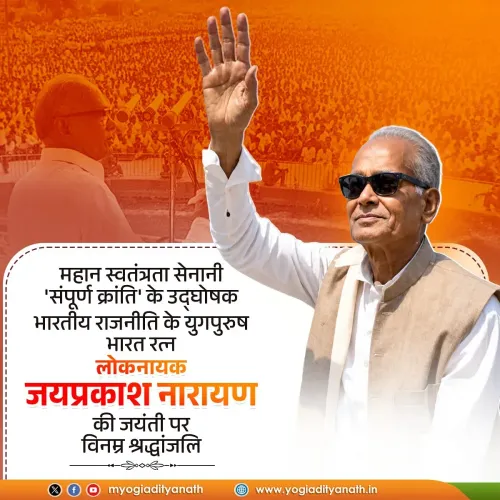
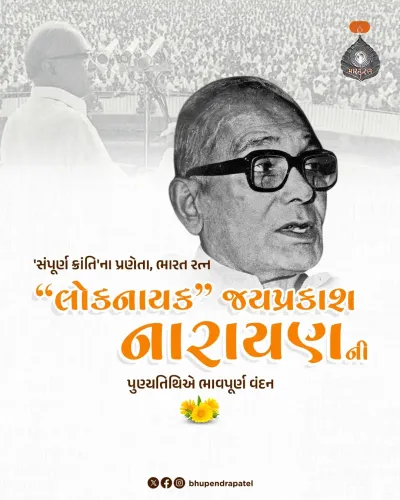
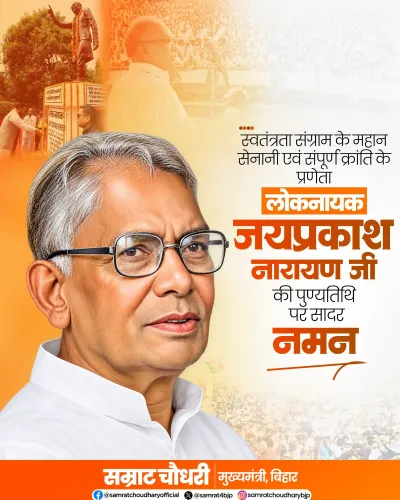
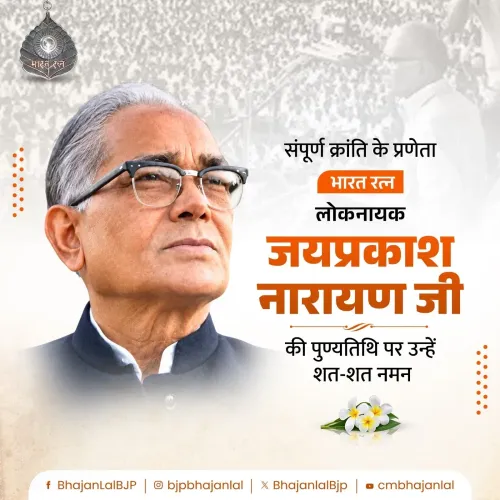
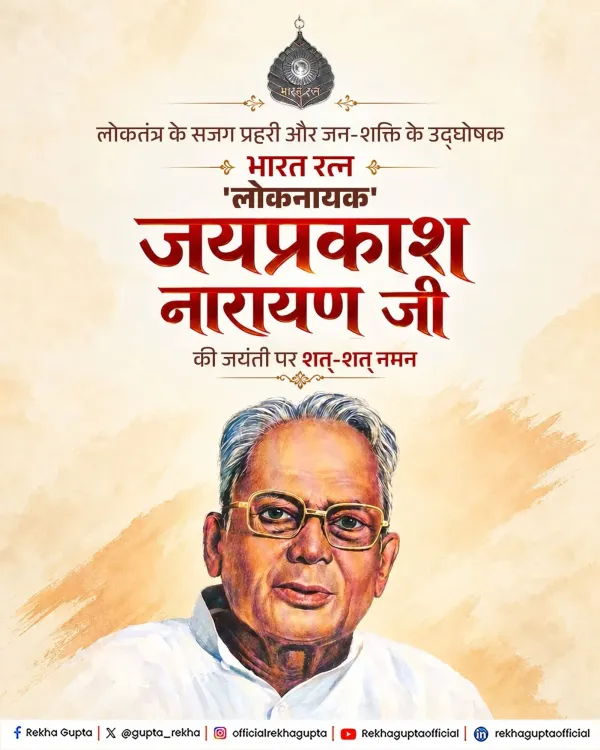
CM Rekha Gupta pays tribute to JP Narayan on his birth anniversary
Synopsis
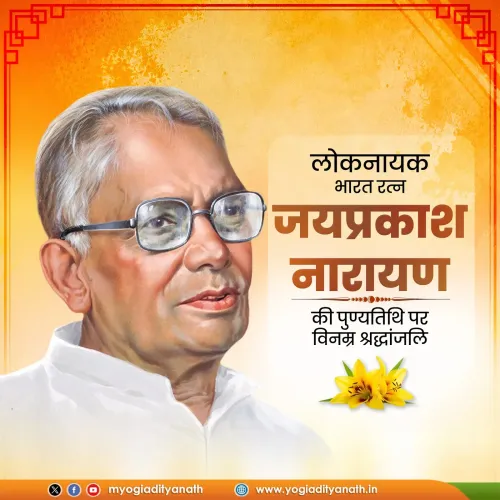
Delhi Chief Minister Rekha Gupta paid tribute to Loknayak Jayaprakash Narayan on his birth anniversary, honouring his 'Total Revolution' movement and his resistance to the 1975 Emergency, while explicitly naming Congress as the force that 'crushed civil rights' during that period.
Key Takeaways
Delhi CM Rekha Gupta posted a tribute to Loknayak Jayaprakash Narayan on his birth anniversary, October 11, 2026 .
She invoked his 'Sampoorna Kranti' (Total Revolution) call as a defining moment in India's democratic history.
The post explicitly blamed the Congress party for imposing the 1975 Emergency and attempting to crush civil rights and free conscience.
JP Narayan, born October 11, 1902 , in Sitab Diara, Bihar , was awarded the Bharat Ratna posthumously in 1999 .
The Emergency lasted 21 months (1975–1977) and ended with a general election that swept Congress from power for the first time since Independence.
Gupta's tribute frames JP's legacy as proof that 'organised society and awakened public power are democracy's greatest strength.'
On the birth anniversary of one of independent India's most consequential democratic voices, Delhi Chief Minister Rekha Gupta on Sunday, October 11, 2026, offered her homage to Loknayak Jayaprakash Narayan — the man who stared down a constitutional emergency and forced an entire nation to choose between power and principle.
In her post, CM Gupta wrote — 'Rashtra nishtha, tyag aur loktantrik mulyon ke prati atoot samarpan ke pratik' — hailing JP Narayan as 'a symbol of national dedication, sacrifice, and unwavering commitment to democratic values.' She invoked his landmark call for 'Sampoorna Kranti' (Total Revolution), describing how, when the Congress government imposed the Emergency and 'attempted to crush the free conscience of the nation and the civil rights of its citizens,' Narayan sounded the conch of public awakening, placing national interest above all else.
The Emergency that made JP a legend
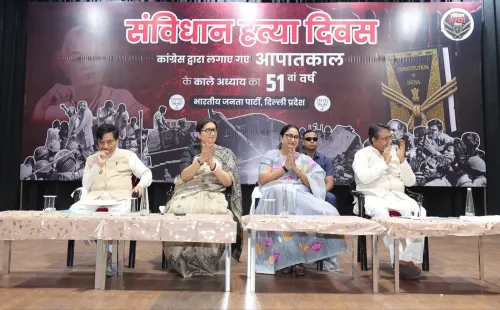
The reference to the Emergency is pointed and deliberate. On June 25, 1975, then Prime Minister Indira Gandhi declared a national Emergency that suspended fundamental rights, muzzled the press, and imprisoned political opponents for 21 months. Jayaprakash Narayan, already a towering figure from the freedom struggle, became the moral spine of the resistance — his June 1975 Patna rally drawing hundreds of thousands and his call for 'Total Revolution' galvanising students, farmers, and opposition parties into a unified front. The Emergency ended in 1977, and the subsequent general election — widely seen as a verdict on those 21 months — swept the Congress from power for the first time since Independence.
Why JP's legacy remains a live political wire
CM Gupta's tribute is not merely ceremonial. Invoking JP Narayan on his birth anniversary — October 11 — has become a ritual across the political spectrum, but the framing matters enormously. By anchoring her tribute in the Emergency narrative and naming Congress explicitly, Gupta uses JP's legacy as a mirror held up to the present-day opposition. Her post argues that 'an organised society, an awakened public, and selfless dedication to the nation are democracy's greatest strengths' — a line that functions simultaneously as historical tribute and contemporary political assertion.
Jayaprakash Narayan was born on October 11, 1902, in Sitab Diara, Bihar, and died on October 8, 1979. He was awarded the Bharat Ratna posthumously in 1999. His journey — from socialist firebrand to Gandhian social worker to the architect of the movement that ended Emergency rule — makes him a figure claimed, in different ways, by nearly every strand of Indian democratic politics.
Delhi's BJP government has consistently used anniversaries of national icons to reinforce its ideological positioning, and today's tribute from the Chief Minister fits squarely within that pattern — warm in its reverence for JP, sharp in its reminder of who stood on which side of history in 1975.
Point of View
She converts a birth anniversary post into a political argument about democratic legitimacy. This is consistent with the BJP's broader strategy of owning the anti-Emergency narrative as a founding moral credential. The framing also signals how the 1975 Emergency continues to function as a live fault-line in Indian politics, not a settled chapter of history — each anniversary reactivates it as a referendum on the Congress legacy.
NationPress
11 Oct 2026
Frequently Asked Questions
When is Jayaprakash Narayan's birth anniversary?
Jayaprakash Narayan was born on October 11, 1902 , and his birth anniversary is observed every year on October 11.
What was JP Narayan's 'Sampoorna Kranti' or Total Revolution?
'Sampoorna Kranti' or Total Revolution was JP Narayan's 1974–75 call for a comprehensive transformation of India's political, social, and economic order, which became the rallying cry of the mass movement against the Indira Gandhi government and the 1975 Emergency.
What was India's Emergency of 1975?
The Emergency was declared by Prime Minister Indira Gandhi on June 25, 1975 , suspending fundamental rights and press freedom for 21 months until March 1977, and is widely regarded as the darkest chapter in post-Independence Indian democratic history.
Was Jayaprakash Narayan awarded the Bharat Ratna?
Yes. Jayaprakash Narayan was awarded India's highest civilian honour, the Bharat Ratna, posthumously in 1999 .
Why did Delhi CM Rekha Gupta mention Congress in her JP Narayan tribute?
CM Gupta's post explicitly blamed the Congress party for imposing the 1975 Emergency, framing JP Narayan's resistance as a democratic counter to Congress authoritarianism — a political framing the BJP has consistently used to contrast its own democratic credentials with the Congress legacy.