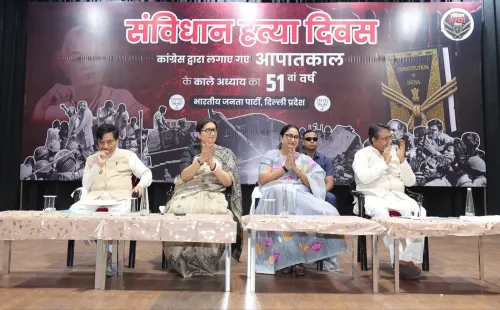
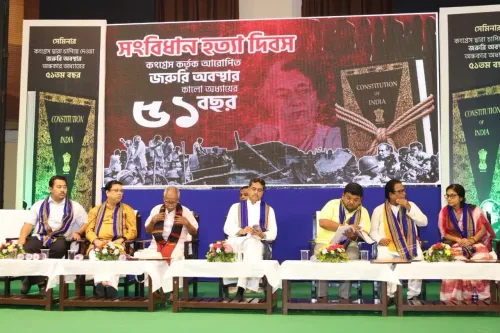
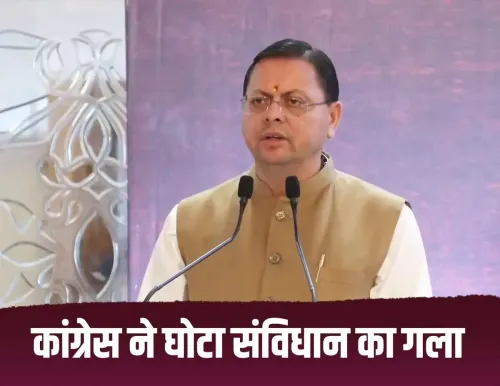
CM Rekha Gupta marks Samvidhan Hatya Diwas, slams 1975 Emergency
Synopsis
Delhi Chief Minister Rekha Gupta marked Samvidhan Hatya Diwas on 25 June 2026, calling the 1975 Emergency India's darkest democratic moment and accusing Congress of retaining the authoritarian mindset that produced it.
Key Takeaways
Delhi Chief Minister Rekha Gupta posted on 25 June 2026 marking Samvidhan Hatya Diwas , calling the 1975 Emergency the 'darkest chapter' in Indian democratic history.
She attributed the Emergency directly to the Congress government under Indira Gandhi and called it the 'greatest symbol of Congress's dictatorial mindset.' The 1975 Emergency lasted 21 months and involved suspension of fundamental rights, press censorship, and mass detention of political opponents.
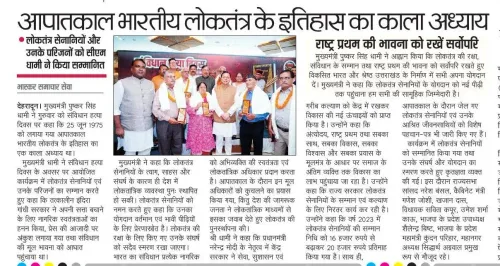
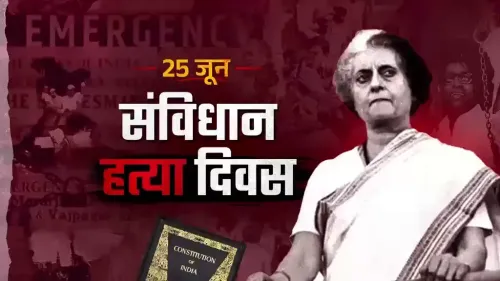
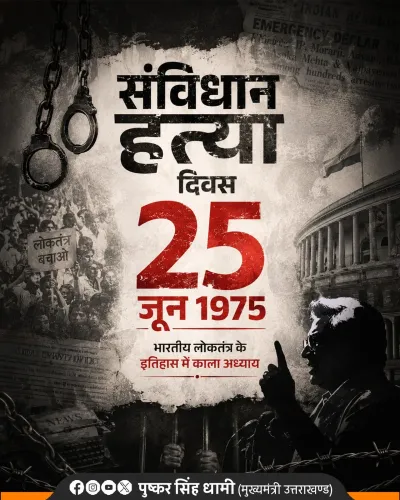
Samvidhan Hatya Diwas is an annual BJP-led observance on 25 June to mark the Emergency as an assault on the Constitution.
Gupta stated that those who fought to protect democracy 'faced repression and unbearable torture' during the Emergency period.
The statement closes with a call to strengthen commitment to 'democratic values, constitutional dignity, and citizens' rights.'
Delhi Chief Minister Rekha Gupta on Thursday, 25 June 2026, marked Samvidhan Hatya Diwas by calling the imposition of the 1975 Emergency the 'darkest chapter in the history of Indian democracy,' and accused the Indian National Congress of still carrying the same authoritarian mindset that led to it.
Context
In her post, Rekha Gupta described the night of 25 June 1975 as an assault on the Constitution and on democratic institutions. Translating her words: 'Aapatkaal Bharat ke loktantra aur Samvidhan par hua sabse bada aaghaat tha' — 'The Emergency was the biggest blow ever struck against India's democracy and Constitution.' She recalled that civil rights were trampled, press freedom was locked away, and freedom of expression was strangled during that period.
She attributed the decision directly to the Congress government led by then Prime Minister Smt. Indira Gandhi, calling it 'the greatest symbol of Congress's dictatorial mindset.' She added that Congress 'remains afflicted by the same mindset even today.'
Policy Backdrop
The Emergency lasted 21 months, from June 1975 to March 1977, during which fundamental rights were suspended, opposition leaders were detained en masse, and the press operated under strict censorship. The period ended when Indira Gandhi called elections in 1977, resulting in a historic Congress defeat and the formation of India's first non-Congress central government.
Samvidhan Hatya Diwas — Constitution Murder Day — is an annual observance on 25 June that the BJP has institutionalised to mark this period as a constitutional crisis. BJP leaders and governments have formally commemorated the date with official statements and public events, framing it as a reminder of the dangers of unchecked executive power. Rekha Gupta's post carries the hashtag #SamvidhanHatyaDiwas, situating it within this coordinated annual observance.
Stakeholders and Impact
The statement resonates with citizens, civil liberties advocates, and media organisations that experienced or documented the suppression of rights during the 1975–1977 period. Many who resisted the Emergency faced detention and what Gupta described as 'unbearable torture,' a reference to the documented repression of political opponents and activists of that era.
For the Congress, the annual revival of Emergency memory presents a recurring political challenge, as the party has historically been reluctant to formally acknowledge or apologise for the period. The framing of the observance as 'Constitution murder' — rather than a policy disagreement — sharpens the rhetorical contrast between the two parties ahead of any legislative or electoral contest.
What's Next
Responses from Congress leaders are expected, as the party typically contests the BJP's characterisation of the Emergency and its legacy. The commemoration may also surface in upcoming parliamentary sessions or state-level events later in 2026, where both sides are likely to invoke constitutional values as a political touchstone. Rekha Gupta's statement closes with a call to strengthen resolve in defence of 'democratic values, constitutional dignity, and citizens' rights' — a pledge that signals continued political mobilisation around this historical moment.
Point of View
Designed to fix a 50-year-old constitutional crisis as a live indictment of the Congress party. By labelling the event 'Constitution murder' rather than a political misstep, the framing elevates historical grievance into a standing charge about institutional character. The timing — coordinated with the national hashtag and likely mirrored by BJP leaders across states — suggests a disciplined effort to keep the Emergency as a recurring fault line in Indian political identity. Congress's response, or silence, will itself become part of the narrative cycle.
NationPress
23 Sept 2026
Frequently Asked Questions
What is Samvidhan Hatya Diwas?
Samvidhan Hatya Diwas, or 'Constitution Murder Day,' is an annual observance on 25 June instituted by the BJP to mark the imposition of the 1975 Emergency by the Congress government as an assault on India's Constitution and democratic institutions.
What did Delhi CM Rekha Gupta say about the 1975 Emergency?
Rekha Gupta called 25 June 1975 the 'darkest chapter in the history of Indian democracy,' saying the Emergency was the biggest blow to India's Constitution, and accused Congress of still carrying the same authoritarian mindset today.
Who imposed the Emergency in India in 1975?
The Emergency was imposed by the Congress government led by Prime Minister Indira Gandhi on 25 June 1975. It lasted 21 months, during which civil liberties were suspended, the press was censored, and opposition figures were detained.
When did the 1975 Emergency end and what happened after?
The Emergency ended in March 1977 when Indira Gandhi called general elections. Congress was defeated, and India's first non-Congress central government came to power.
Why does BJP observe 25 June every year?
The BJP observes 25 June as Samvidhan Hatya Diwas to commemorate what it describes as Congress's assault on the Constitution during the 1975 Emergency, and to position itself as a defender of democratic and constitutional values.