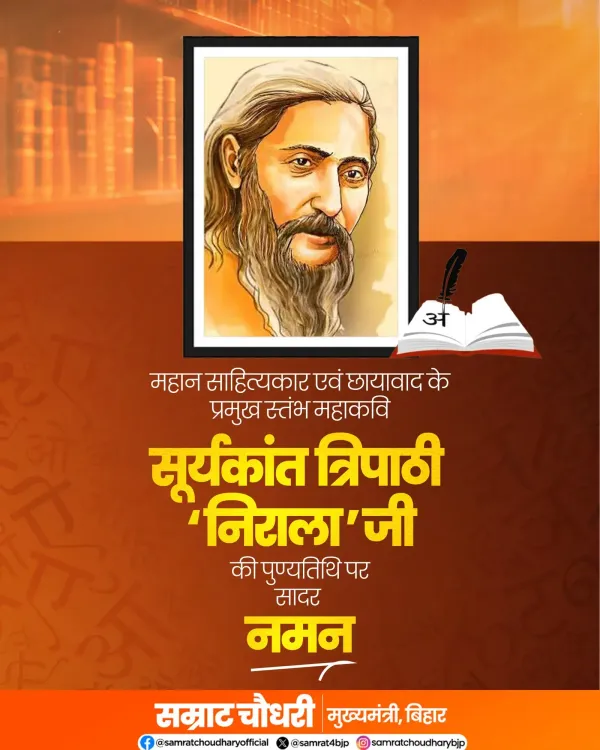
CM Samrat Choudhary pays tribute to Mahakavi Nirala on death anniversary
Synopsis
Bihar Chief Minister Samrat Choudhary offered 'hundredfold salutations' to Mahakavi Suryakant Tripathi 'Nirala' on his death anniversary on October 15, 2026, honouring the Chhayavad pioneer's timeless contribution to Hindi literature.
Key Takeaways
Bihar Chief Minister Samrat Choudhary paid public tribute to Mahakavi Nirala on his death anniversary, October 15, 2026 .
Suryakant Tripathi 'Nirala' (1896–1961) is recognised as one of the four pillars of the Chhayavad movement in modern Hindi literature.
Nirala pioneered free verse (muktak chhand) in Hindi poetry, breaking with classical metrical forms.
His landmark works include 'Saroj Smriti' and 'Ram Ki Shakti Puja' , still taught widely across Indian universities.
CM Choudhary's tribute reflects the longstanding Indian political tradition of commemorating major literary figures on their death anniversaries.
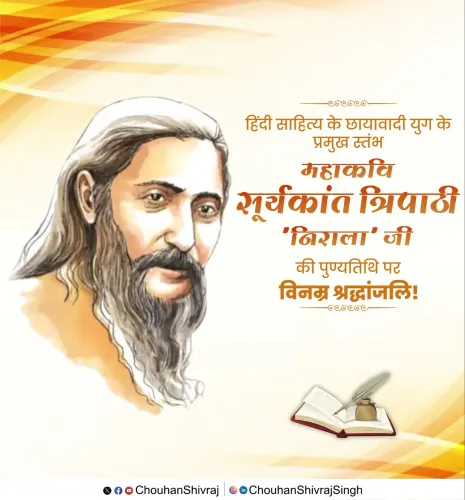
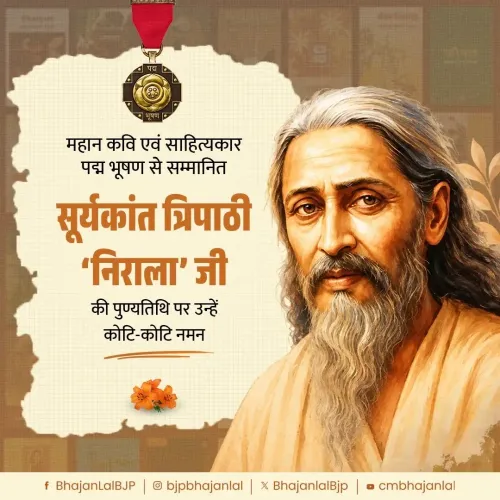
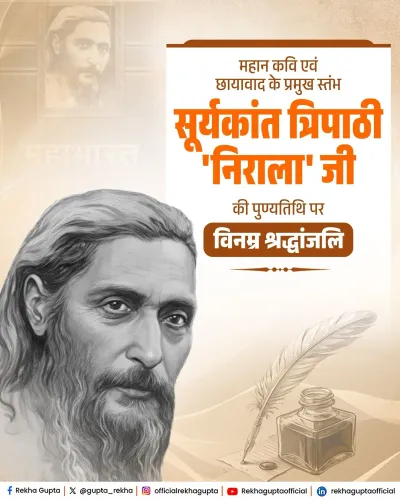
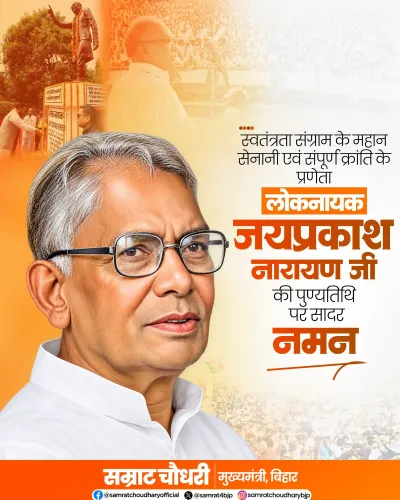
On the death anniversary of one of Hindi literature's most towering figures, Bihar Chief Minister Samrat Choudhary offered his homage to Mahakavi Suryakant Tripathi 'Nirala' on Thursday, October 15, 2026 — saluting a poet whose rebellious verses reshaped a language and an era.
In his post, CM Choudhary wrote: 'Mahan sahityakar evam Chhayavad ke pramukh stambh Mahakavi Suryakant Tripathi Nirala ji ki punyatithi par unhe shat-shat naman.' — ('Heartfelt hundredfold salutations to the great literary figure and principal pillar of Chhayavad, Mahakavi Suryakant Tripathi Nirala, on his death anniversary.') He added that Nirala's literary contribution in enriching Hindi literature through his timeless works 'will always be remembered.'
Who was Suryakant Tripathi 'Nirala'
Suryakant Tripathi 'Nirala' (1896–1961) stands as one of the four principal pillars of the Chhayavad movement — the Romantic-Symbolist wave that transformed modern Hindi poetry in the early twentieth century. A poet, essayist, and novelist of extraordinary range, Nirala broke decisively with classical metre, pioneering free verse in Hindi at a time when the form was virtually unrecognised. His works carried both lyrical beauty and fierce social conscience, confronting caste, poverty, and colonial rule with equal intensity.
His canonical poems — including 'Saroj Smriti' and 'Ram Ki Shakti Puja' — are studied across Indian universities and remain benchmarks of Hindi literary achievement. Nirala spent much of his later life in Allahabad (now Prayagraj), writing and living in straitened circumstances, a fact that burnished his legend as a poet who chose truth over comfort.
Leaders and literature: a long tradition of public remembrance
Indian political leaders across parties have long marked the birth and death anniversaries of major literary and cultural figures with public statements — a practice that situates them within a shared national heritage. For a Chief Minister of Bihar, a state with deep roots in Hindi literary culture, paying tribute to Nirala carries particular resonance: the language Nirala transformed is the mother tongue and cultural bedrock of millions of Bihari citizens.
CM Choudhary's tribute is part of this wider commemorative tradition, acknowledging Nirala not merely as a poet of the past but as a living presence in the Hindi-speaking world's collective memory.
Nirala's verse endures because it demanded something rare — that a language look honestly at itself. That demand has never gone out of season.
Point of View
Marking the death anniversaries of canonical literary figures reinforces that cultural narrative without any policy risk. In Bihar, where Hindi identity is politically and emotionally charged, invoking Nirala is also a statement of shared rootedness. The tribute carries no legislative weight, but in the grammar of Indian political communication, these symbolic moments accumulate into a persistent brand of cultural stewardship.
NationPress
15 Oct 2026
Frequently Asked Questions
Who is Suryakant Tripathi 'Nirala' and why is he famous?
Suryakant Tripathi 'Nirala' (1896–1961) was a celebrated Hindi poet, essayist, and novelist, recognised as one of the four pillars of the Chhayavad movement in modern Hindi literature. He is famous for pioneering free verse in Hindi and for works like 'Saroj Smriti' and 'Ram Ki Shakti Puja.'
When is Nirala's death anniversary?
Suryakant Tripathi 'Nirala' passed away on October 15, 1961 , making October 15 his annual death anniversary.
What is the Chhayavad movement in Hindi literature?
Chhayavad was a Romantic-Symbolist literary movement in early twentieth-century Hindi poetry, characterised by themes of nature, mysticism, individualism, and nationalist sentiment. Its four principal figures were Jaishankar Prasad, Sumitranandan Pant, Mahadevi Varma, and Suryakant Tripathi 'Nirala.'
Why did Bihar CM Samrat Choudhary pay tribute to Nirala?
CM Choudhary paid tribute to mark Nirala's death anniversary on October 15, 2026, acknowledging the poet's lasting contribution to Hindi literature — a common practice among Indian political leaders on the anniversaries of major cultural figures.
What did Samrat Choudhary say about Nirala?
CM Choudhary offered 'shat-shat naman' (hundredfold salutations) to Nirala and said his literary contribution in enriching Hindi literature through timeless works 'will always be remembered.'