CM Bhupendra Patel pays tribute to Dr. Kalam on birth anniversary
Synopsis
Gujarat Chief Minister Bhupendra Patel paid tribute to Dr. A.P.J. Abdul Kalam on his birth anniversary, October 15, calling the Bharat Ratna scientist's contributions to India's space and missile programmes 'unparalleled' and his life an inspiration rooted in simplicity and dedication.
Key Takeaways
Gujarat CM Bhupendra Patel offered a tribute to Dr.
Abdul Kalam on his birth anniversary, October 15, 2026 .
Kalam served as President of India from 2002 to 2007 and was awarded the Bharat Ratna in 1997 .
CM Patel described Kalam's role in advancing India's space and missile programmes as 'unparalleled' at a global level.
October 15 is observed as World Students' Day in honour of Kalam's lifelong engagement with India's youth.
Kalam was a principal figure in the Integrated Guided Missile Development Programme (IGMDP) and contributed to the PSLV programme.
Annual tributes to Kalam on this date form a cross-party national tradition, especially prominent in scientific and educational institutions.
On the birth anniversary of one of India's most beloved scientist-statesmen, Gujarat Chief Minister Bhupendra Patel offered a heartfelt tribute to Dr. A.P.J. Abdul Kalam on Thursday, October 15, 2026, honouring the former President's extraordinary legacy in science, space, and national defence.
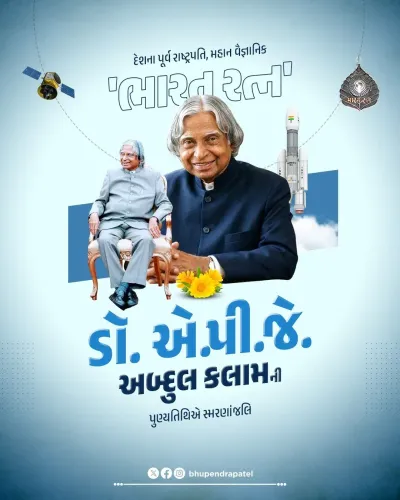
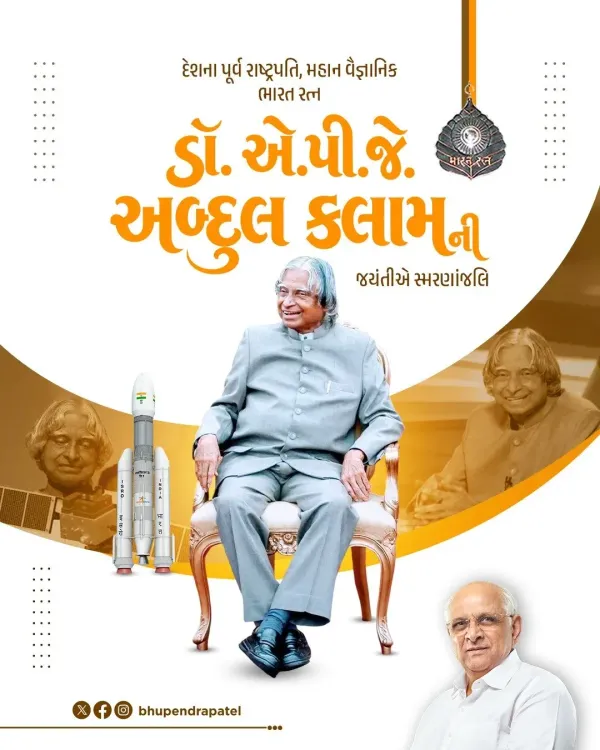
Posting in Gujarati, CM Patel wrote: 'દેશના પૂર્વ રાષ્ટ્રપતિ, મહાન વૈજ્ઞાનિક, ભારત રત્ન ડૉ. એ.પી.જે. અબ્દુલ કલામની જયંતીએ ભાવાંજલિ' — 'Heartfelt tribute on the birth anniversary of the former President of India, great scientist, and Bharat Ratna, Dr. A.P.J. Abdul Kalam.' He went on to note that Kalam's contribution to elevating India's space programme and missile capabilities to a global stage was 'unparalleled', and described his life as a symbol of simplicity, dedication, and high ideals — 'inspiring and worthy of reverence for all of us.'
The scientist who built a nation's ambitions
Dr. Avul Pakir Jainulabdeen Abdul Kalam, born October 15, 1931, in Rameswaram, Tamil Nadu, rose from modest beginnings to become the chief architect of India's indigenous missile and space launch vehicle programmes. He served as President of India from 2002 to 2007 and was awarded the Bharat Ratna — the country's highest civilian honour — in 1997. His role in developing the Integrated Guided Missile Development Programme (IGMDP) and his contributions to the Polar Satellite Launch Vehicle (PSLV) made him a towering figure in India's strategic technology story.
His presidency broke from convention in the most human way possible: he spoke directly to students, visited schools, and made youth ambition his central message. That is why October 15 is also observed as World Students' Day — a recognition of the man who believed every young Indian carried the seed of a scientist.
A recurring national ritual of respect
Each October 15, political leaders across party lines and institutional heads across India pause to honour Kalam — a rare figure who transcended political affiliation. CM Patel's tribute follows this well-established national tradition, with schools, defence institutions, and space agencies typically marking the day through special programmes, lectures, and remembrances.
The resonance is especially strong in scientific and student communities, where Kalam's vision of a technologically self-reliant India — articulated in his landmark work 'India 2020' — continues to frame aspirations around indigenous capability in space exploration and defence manufacturing.
A boy from Rameswaram who grew up to give India its missiles remembered, every year, by an entire nation. That is the only tribute that could ever match the life.
Point of View
Invoking Kalam's name carries particular resonance: his work underpins the 'Atmanirbhar Bharat' narrative on indigenous defence and space capability that the party has built much of its technology-governance identity around. The tribute also arrives as India's space and defence sectors are in an active expansion phase, making Kalam's foundational contributions politically and institutionally timely rather than merely ceremonial. In that sense, every October 15 tribute is both a backward glance and a forward signal.
NationPress
15 Oct 2026
Frequently Asked Questions
Why is October 15 celebrated as World Students' Day in India?
October 15 is observed as World Students' Day to mark the birth anniversary of Dr. A.P.J. Abdul Kalam , who was born on this date in 1931 . Kalam was renowned for his deep engagement with students and his belief in youth-driven national development, which led to the day being dedicated in his honour.
What was Dr. APJ Abdul Kalam's contribution to India's missile programme?
Dr. Kalam was a central figure in India's Integrated Guided Missile Development Programme (IGMDP) , which developed missiles including Agni and Prithvi. He also contributed to the Polar Satellite Launch Vehicle (PSLV) programme, helping establish India's indigenous space launch capability.
When did APJ Abdul Kalam serve as President of India?
Dr. A.P.J. Abdul Kalam served as the 11th President of India from 2002 to 2007 . He was widely known as the 'People's President' for his accessibility and focus on inspiring young Indians.
What is the Bharat Ratna and when did Kalam receive it?
The Bharat Ratna is India's highest civilian honour, awarded for exceptional service to the nation. Dr. A.P.J. Abdul Kalam received it in 1997 in recognition of his contributions to science and national development.
What did Gujarat CM Bhupendra Patel say about Dr. Kalam?
Gujarat CM Bhupendra Patel described Kalam's contribution to India's space and missile programmes as 'unparalleled at a global level' and called his life — marked by simplicity, dedication, and high ideals — 'inspiring and worthy of reverence for all of us.'