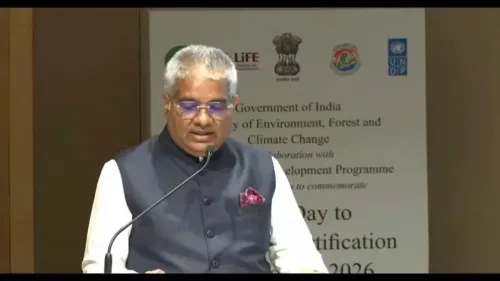
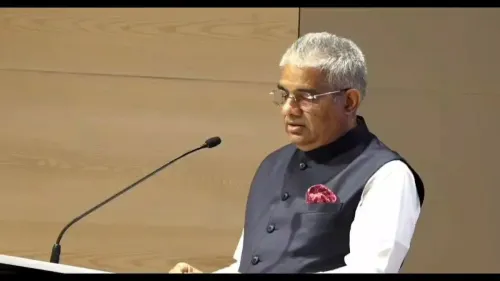
Yadav Shares Vision of Green Dreams for India's Future
Synopsis
Union Environment Minister Bhupender Yadav shared an evocative Hindi verse on X on 9 July 2026, evoking the image of dreams multiplying to thousands — framing India's climate ambitions as a collective national aspiration rooted in cultural idiom.
Key Takeaways
Bhupender Yadav , Union Minister of Environment, Forest and Climate Change, posted an inspirational Hindi verse on X on 9 July 2026 .
The verse — 'from one dream is born another, from dreams are born a thousand more' — frames India's green transition as a shared national aspiration.
India pledged net-zero emissions by 2070 at COP26 in Glasgow in 2021 as part of the Panchamrit commitments.
Mission LiFE , launched by Prime Minister Modi in 2022 , underpins the government's push for individual and community-level environmental action.
India's National Action Plan on Climate Change (2008) established eight national missions covering solar energy, water, and sustainable agriculture.
Revised Nationally Determined Contributions and future COP sessions remain key milestones for India's climate roadmap.
Union Environment Minister Bhupender Yadav took to X on 9 July 2026 to share an evocative Hindi verse, invoking the imagery of dreams multiplying from one to thousands — a message widely read as an appeal for collective environmental ambition among India's youth and citizens.
The post reads: 'Aaj main kehta hoon, ek sapne se janme doosra sapna, sapne janme hazaar...' ('Today I say, from one dream is born another dream, from dreams are born a thousand more...'). The lines carry the cadence of inspirational verse, and in the context of the ministry's sustained climate messaging, they signal an effort to frame India's green transition as a shared national aspiration rather than a top-down mandate.
Context
Yadav has helmed the Ministry of Environment, Forest and Climate Change since 2021, a tenure that has coincided with some of India's most prominent international climate commitments. His social media presence has consistently blended formal policy updates with motivational outreach, particularly aimed at younger audiences. This post continues that pattern, using poetic language to sustain public engagement between major policy announcements.
Policy Backdrop
India's climate ambitions were crystallised at COP26 in Glasgow in 2021, where Prime Minister Narendra Modi announced the Panchamrit pledges — including a net-zero emissions target by 2070. Building on that, Mission LiFE (Lifestyle for Environment) was launched in 2022 to mobilise individual and community action on sustainability, explicitly asking citizens to see environmental responsibility as a personal commitment. India's National Action Plan on Climate Change, introduced as far back as 2008, had already established eight national missions covering solar energy, sustainable agriculture, and water conservation, laying the institutional groundwork for the aspirational messaging seen today.
Stakeholders and Impact
The primary audience for this kind of ministerial outreach is Indian youth, who form both the largest demographic cohort and the generation that will live with the consequences of today's climate decisions. Successive environment ministers have recognised that translating complex multilateral commitments — Nationally Determined Contributions, carbon market rules, biodiversity frameworks — into accessible public language is essential for domestic buy-in. Inspirational posts in Hindi, India's most widely spoken language, serve to bridge that gap between Geneva negotiating rooms and grassroots behavioural change.
Civil society groups and environmental educators have long argued that public enthusiasm for green policies depends as much on cultural and emotional resonance as on regulatory enforcement. A verse shared by a senior cabinet minister carries symbolic weight, signalling that environmental consciousness is a mainstream political value rather than a niche concern.
What's Next
Attention will now turn to India's revised Nationally Determined Contributions, which are expected to reflect updated domestic targets under the Paris Agreement framework. Parliamentary discussions on the Ministry of Environment's budget allocations will also be closely watched as a measure of whether the inspirational rhetoric is matched by institutional investment. Future COP sessions will provide the next major international stage for India to demonstrate progress against its 2070 net-zero pledge.
As India positions itself as a leader in the Global South on climate action, messaging that frames green ambitions as a civilisational dream — rooted in cultural idiom — may increasingly become a defining feature of the government's environmental communication strategy.
Point of View
Such ministerial outreach to youth and vernacular audiences serves a dual purpose: sustaining public enthusiasm and projecting a narrative of grassroots ownership over the green transition. The real test, however, will be whether inspirational messaging is backed by commensurate budget allocations and regulatory ambition in the months ahead.
NationPress
8 Oct 2026
Frequently Asked Questions
What did Bhupender Yadav post on X on 9 July 2026?
Union Environment Minister Bhupender Yadav posted a Hindi verse saying 'from one dream is born another dream, from dreams are born a thousand more,' widely interpreted as a call for collective environmental ambition.
What is India's net-zero target?
India has committed to achieving net-zero carbon emissions by 2070 , a pledge announced by Prime Minister Modi at COP26 in Glasgow in 2021 as part of the five Panchamrit climate commitments.
What is Mission LiFE?
Mission LiFE (Lifestyle for Environment) was launched by Prime Minister Narendra Modi in 2022 to encourage individuals and communities across India to adopt sustainable habits and take personal responsibility for environmental outcomes.
Who is Bhupender Yadav?
Bhupender Yadav is a senior BJP leader who has served as Union Minister of Environment, Forest and Climate Change since 2021 , representing India at major international climate forums including COP summits.
What are India's Panchamrit climate pledges?
The Panchamrit are five climate commitments India made at COP26 in 2021 , including reaching 500 GW of non-fossil energy capacity, meeting 50 per cent of energy needs from renewables, reducing carbon intensity, and achieving net-zero by 2070 .