51World's AperEgo headset targets embodied AI data gap in China
Synopsis
Beijing firm 51World claims its new AperEgo wearable headset and AperOS platform can hit 99% data-collection precision for humanoid robot training — a direct strike at the data bottleneck that analysts say is holding back China's fast-growing embodied AI sector.
Key Takeaways
51World launched the AperEgo headset and AperOS platform on 19 August 2026 in Shenzhen to address the embodied AI training-data shortage.
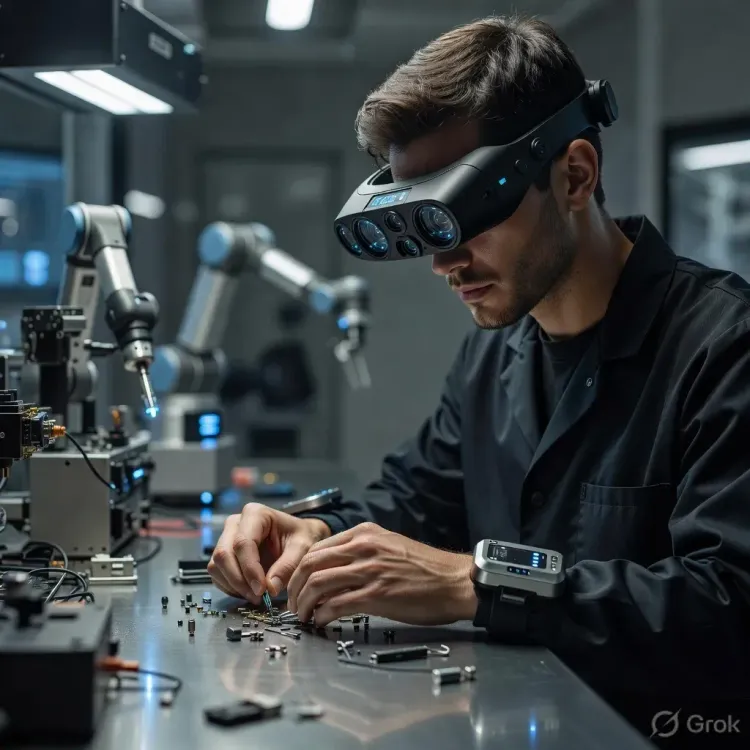
The multi-camera wearable synchronises visual, motion, and audio inputs; companion wrist and finger devices capture hand-mechanics data.
Li Yi , 51World 's founder and CEO , said hardware-software integration would push data-collection precision to 99 per cent .
AperOS screens invalid data before upload, lowering storage and compute costs, according to the company.
China 's humanoid robot market is projected to reach 15 billion yuan (US$2.2 billion) in 2026 and grow at least 60 per cent in 2027 , per TrendForce .
Beijing-based tech firm 51World launched a new hardware-software suite on Tuesday, 19 August 2026, aimed at solving one of the most acute bottlenecks in humanoid robotics: the scarcity of high-precision training data for embodied AI systems. The announcement was made at a launch event in Shenzhen, where Li Yi, 51World's founder and CEO, called the data shortage 'one of the biggest hurdles facing the embodied AI industry.'
What 51World unveiled
51World — best known for its digital twin and simulation technology — introduced AperEgo, a wearable headset equipped with a multi-camera system that captures a panoramic view of the user's environment. The device synchronises visual, motion, and audio inputs with high accuracy through integrated sensors. The hardware suite also includes wrist and finger-mounted devices designed to capture fine-grained data on hand mechanics, which are critical for dexterous robot manipulation. Worn by a human operator while performing real-world tasks, AperEgo feeds data into 51World's AperOS software platform, which filters out invalid data before upload, according to the company. The pre-screening step is intended to lower data storage and computing costs — a meaningful consideration as embodied AI training runs typically consume large volumes of compute.Why it matters
Embodied AI refers to models that enable machines to perceive, reason, and interact with the physical world — the intelligence layer underpinning humanoid robots. High-quality, precisely labelled motion and sensory data is the raw material for training these models, and its absence has been widely cited as a constraint on commercial deployment timelines. Li Yi said the hardware-software integration would push data-collection precision to 99 per cent. 'High precision translates directly to greater accuracy and efficiency,' he said. 'Looking ahead, we are confident we can boost the efficiency of embodied AI across data collection, utilisation, training and generalisation by a large margin.'Market context
China's humanoid robot market is forecast to reach 15 billion yuan (US$2.2 billion) in 2026 and grow by at least 60 per cent in 2027 as mass production scales and applications broaden, according to a report by research firm TrendForce released on Wednesday, 20 August 2026. That trajectory has intensified competition among hardware makers, software platforms, and data-infrastructure providers.The competitive backdrop
The embodied AI data challenge is not unique to China. Globally, robotics firms and AI labs have been racing to build proprietary datasets — through teleoperation, simulation, and human demonstration — to train manipulation and locomotion policies. 51World's pivot from digital twin software toward physical data-capture hardware positions it as an infrastructure play in this supply chain, rather than a robot maker itself.What's next
With the AperOS platform handling data validation and the AperEgo headset generating multi-modal inputs, 51World is betting that robot developers will outsource the data-capture layer rather than build it in-house. How quickly the company can sign up robot manufacturers as customers — and whether its 99 per cent precision claim holds in diverse real-world environments — will determine its position in what is shaping up to be a fiercely contested data-infrastructure market.Point of View
And 51World's hardware pivot signals that the real margin opportunity may lie not in building robots but in supplying the data pipelines that train them — a dynamic reminiscent of how cloud providers captured value in the last AI wave. China's state-backed push to dominate humanoid robotics by 2027 creates a captive domestic market for exactly this kind of tooling, which mainstream coverage tends to overlook in favour of the headline robot makers. The 99 per cent precision claim is commercially potent but unverified in independent testing; if it holds, it could commoditise a step that leading labs currently treat as a proprietary moat. Watch whether global robotics firms — outside China's regulatory perimeter — adopt or replicate this approach, as data-capture standards could become the next quiet battleground in the broader tech competition.
NationPress
4 Oct 2026
Frequently Asked Questions
What is 51World's AperEgo and what does it do?
AperEgo is a wearable headset launched by 51World on 19 August 2026 that uses a multi-camera system to capture panoramic video and synchronises visual, motion, and audio data for training embodied AI systems. It is worn by a human operator performing tasks, generating the high-precision datasets that humanoid robots need to learn real-world interactions.
Why is training data a bottleneck for humanoid robots?
Embodied AI models — the intelligence that lets robots perceive and act in the physical world — require large volumes of precisely labelled sensory and motion data to train effectively. Li Yi , 51World 's CEO , described this data shortage as 'one of the biggest hurdles facing the embodied AI industry' at the Shenzhen launch event.
How big is China's humanoid robot market in 2026?
China 's humanoid robot market is forecast to reach 15 billion yuan (US$2.2 billion) in 2026 , according to research firm TrendForce . The market is projected to grow by at least 60 per cent in 2027 as mass production scales and commercial applications expand.
What is the AperOS platform and how does it reduce costs?
AperOS is 51World 's software platform that processes data captured by AperEgo and screens out invalid data before it is uploaded for further processing. By filtering low-quality data at the edge, the platform lowers downstream data storage and computing costs, according to the company.
Who are 51World's likely customers for this technology?
51World is positioning itself as a data-infrastructure provider for humanoid robot developers rather than a robot maker itself. Its primary customers are expected to be robotics firms and AI labs that need high-quality embodied AI training datasets but prefer to outsource the data-capture layer.