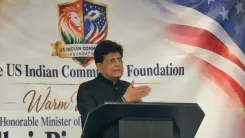
AMD CEO Lisa Su meets China's Vice-Premier He Lifeng amid AI chip export hopes
Synopsis
AMD CEO Lisa Su met Chinese Vice-Premier He Lifeng days after Nvidia's Jensen Huang joined Trump's Beijing delegation — a rare dual-chipmaker diplomatic push that analysts say signals Washington may be softening its AI chip export stance toward China.
Key Takeaways
AMD CEO Lisa Su met Chinese Vice-Premier He Lifeng in Beijing on Monday, 19 May 2026 .
He Lifeng reaffirmed Beijing 's openness to foreign investment, according to Xinhua News Agency .
Su praised the Xi-Trump summit and pledged to expand AMD 's investment in China .
Nvidia CEO Jensen Huang was added last-minute to Trump 's Beijing delegation, alongside 17 other American executives.
Analyst Peng Peng of the Guangdong Society of Reform said the US appears to be 'pulling back on its aggressive tariff war and tech decoupling.'
AMD CEO Lisa Su met Chinese Vice-Premier He Lifeng in Beijing on Monday, 19 May 2026, signalling a potential easing of US restrictions on high-end semiconductor and AI chip exports to select Chinese firms, according to analysts. The meeting has raised cautious optimism that Washington may be reconsidering its aggressive tech-decoupling posture toward China.
What happened at the meeting
During the meeting, He Lifeng reiterated that Beijing welcomed continued foreign investment, according to Xinhua News Agency. Su praised the outcomes of last week's summit between President Xi Jinping and US President Donald Trump, while affirming AMD's commitment to expanding its business and increasing investment in China.
The competitive backdrop
The visit came days after 17 American business executives accompanied Trump on his state visit to Beijing. Su, who was not part of that delegation, appeared to be 'catching up on missed homework', said Peng Peng, executive chairman of the Guangdong Society of Reform, a think tank affiliated with the provincial government. Notably, Nvidia CEO Jensen Huang was added to the delegation at the last minute, underscoring the semiconductor sector's centrality to the diplomatic agenda.
Why it matters
The back-to-back engagements by both AMD and Nvidia leadership with senior Chinese officials suggest a coordinated — or at least parallel — effort by US chipmakers to position themselves ahead of any policy shift on export controls. Analysts note that a selective relaxation of restrictions could unlock significant revenue for American semiconductor firms that have been locked out of one of the world's largest AI markets.
Market reaction
'The US appears to be pulling back on its aggressive tariff war and tech decoupling,' said Peng Peng. While no formal policy changes have been announced, the optics of senior chip executives meeting top Chinese economic officials so soon after a presidential summit carry weight in markets sensitive to export-control signals.
What's next
The trajectory of US chip export policy toward China will depend heavily on follow-through from the Xi-Trump summit and subsequent trade negotiations. Investors and industry observers will be watching for any formal revision to the US Commerce Department's entity list or export licensing framework — moves that could reshape competitive dynamics for AMD, Nvidia, and Intel across the Asia-Pacific region.
Point of View
Reflecting how deeply export controls have damaged US chipmakers' revenue outlook in China. What mainstream coverage underplays is that any selective licensing carve-out would likely favour firms like AMD and Nvidia over domestic challengers such as Huawei, potentially re-entrenching American dominance in China's AI infrastructure at a critical buildout phase. The framing of 'easing' also obscures the leverage dynamic: Washington controls the tap, and every CEO visit to Beijing reinforces that asymmetry. Investors should note that policy reversals in this space have historically moved faster than the market prices in.
NationPress
3 Oct 2026
Frequently Asked Questions
Why did AMD CEO Lisa Su meet China's Vice-Premier He Lifeng?
Lisa Su met He Lifeng to signal AMD 's commitment to the Chinese market and to engage diplomatically following the Xi-Trump summit. The meeting is seen as part of broader efforts by US chipmakers to position themselves ahead of a potential easing of AI chip export restrictions.
Could the US ease AI chip export restrictions to China?
Analysts believe the meetings suggest a possible softening of US export policy, though no formal changes have been announced. The back-to-back visits by AMD and Nvidia executives to Beijing have raised market optimism about selective licensing for AI chips .
Was Nvidia's Jensen Huang also involved in China diplomacy?
Nvidia CEO Jensen Huang was added at the last minute to President Trump 's delegation for his state visit to Beijing , joining 17 other American business executives. This, combined with Su 's separate visit, points to a coordinated push by the US semiconductor industry.
What did He Lifeng say during the AMD meeting?
He Lifeng reiterated that Beijing welcomed continued foreign investment, according to Xinhua News Agency . Su in turn praised the outcomes of the Xi-Trump summit and reaffirmed AMD 's intent to expand its business and increase investment in China .
Which other companies are affected by US AI chip export rules in China?
Beyond AMD , companies including Nvidia , Intel , and Huawei Technologies are central to the US-China chip export debate. Any policy shift would reshape competitive dynamics for these firms across the Asia-Pacific market, with downstream effects on cloud providers such as Alibaba Cloud .