Chinese AI models slash LLM prices 40%, may boost global AI adoption

Synopsis
Chinese open-weight AI models have driven LLM inference prices down 40% in weeks — forcing OpenAI to slash GPT-5.6 Luna pricing by 80%. Analysts say cheaper AI is a long-term demand catalyst, but Wall Street's sell-off signals deep anxiety about hyperscaler valuations.
Key Takeaways
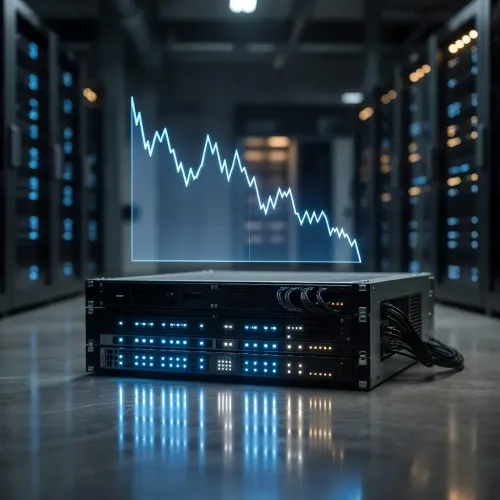
LLM inference prices fell from above US$2 per million tokens in early June 2026 to US$1.2 by 9 August 2026 , per Silicon Data 's LLM Token Expenditure Index.
OpenAI announced an 80 per cent discount on developer pricing for its GPT-5.6 Luna model and a 20 per cent discount on GPT-5.6 Terra .
The price compression was driven primarily by competitive pressure from low-cost Chinese open-weight AI models .
A significant AI stock sell-off occurred last month on concerns that US hyperscalers including Azure , Amazon Web Services , and Google are overvalued.
Silicon Data stated on X that falling prices 'promote much wider and faster AI adoption' for consumer and enterprise users.
Analysts at Barclays , Nomura , and Morgan Stanley are tracking the repricing cycle's impact on enterprise AI spending trajectories.
Breakthroughs in low-cost Chinese open-weight AI models have rattled Wall Street, but analysts argue that the resulting collapse in model inference prices will ultimately supercharge global demand for AI systems — benefiting the broader industry over the long term. Large-language model (LLM) inference prices per million tokens have dropped from above US$2 at the start of June 2026 to just US$1.2 this week, according to research firm Silicon Data's LLM Token Expenditure Index, which tracks both frontier providers and open-weight platforms.
Why It Matters: A Price War With Industry-Wide Consequences
The rapid cost compression is not incidental — it is structural. Under pressure from cheaper Chinese open-weight models, Silicon Valley firms have aggressively cut the prices of their closed proprietary models to defend market share. The price war has triggered a severe AI stock sell-off, with investors growing concerned that US hyperscalers — including companies operating platforms such as Azure and Amazon Web Services — are overvalued relative to a world where inference costs trend toward near-zero.
OpenAI Moves: 80% Discount on GPT-5.6 Luna
OpenAI last week announced an 80 per cent discount on developer pricing for its lightweight GPT-5.6 Luna model, alongside a 20 per cent discount on the mid-tier GPT-5.6 Terra. The cuts reflect the mounting competitive pressure that Chinese open-weight alternatives have placed on frontier model providers. Microsoft, Google, and Amazon are among the hyperscalers most exposed to the repricing dynamic, given their heavy infrastructure investment bets on sustained high inference margins.
The Competitive Backdrop: China's Open-Weight Advantage
Chinese AI developers, including firms such as Moonshot AI, have released capable open-weight models at a fraction of the cost of Western closed alternatives, compressing the value proposition of proprietary platforms. The trend echoes the disruption triggered by DeepSeek earlier in 2026, which similarly shook investor confidence in the capital-intensive AI buildout thesis. Analysts at firms including Barclays, Nomura, and Morgan Stanley have been monitoring the repricing cycle's downstream effects on enterprise AI spending.
What Analysts Are Saying
'Competition is up and prices are down,' Silicon Data wrote on social media platform X on Wednesday, 9 August 2026. 'This is good for consumer and enterprise users of AI (agents) and promotes much wider and faster AI adoption.' The research firm's position aligns with a broader school of thought that lower inference costs function as a demand multiplier — reducing the barrier to deploying AI agents at scale across industries.
What's Next: Adoption Surge or Margin Squeeze?
The central question for investors and enterprises alike is whether the volume gains from accelerated AI adoption will offset the margin erosion hitting frontier model providers and cloud hyperscalers. Companies with diversified AI revenue streams — spanning hardware, software, and services — are better positioned to weather the transition. The pace at which enterprise buyers absorb cheaper inference capacity into production workloads will be the clearest indicator of whether the optimistic adoption thesis holds through the rest of 2026.
Point of View
From cloud compute to smartphone SoCs, where falling unit costs unlocked orders-of-magnitude demand growth. What analysts at Barclays and Morgan Stanley are quietly grappling with is not whether adoption accelerates, but whether the hyperscalers' massive capex commitments — built on assumptions of sustained inference margins — can be justified in a world where open-weight Chinese models keep the price ceiling perpetually low. The OpenAI decision to discount GPT-5.6 Luna by 80 per cent is less a strategic choice than a forced concession, signalling that the moat around closed frontier models is narrower than investors priced in. The companies most exposed are those whose AI revenue thesis depends on premium inference pricing rather than on application-layer lock-in or proprietary data advantages.
NationPress
23 Sept 2026
Frequently Asked Questions
Why did AI stocks sell off amid Chinese AI model breakthroughs?
Investors sold AI stocks over concerns that US hyperscalers are overvalued as cheap Chinese open-weight AI models compressed inference prices by roughly 40 per cent between June and August 2026 . The fear is that falling model costs erode the high-margin inference revenue that justified massive capital expenditure by companies operating platforms like Azure , Amazon Web Services , and Google .
How much did OpenAI cut prices for GPT-5.6 Luna?
OpenAI announced an 80 per cent discount on developer pricing for its lightweight GPT-5.6 Luna model and a 20 per cent discount on the mid-tier GPT-5.6 Terra last week. The cuts were a direct response to competitive pressure from lower-cost Chinese AI alternatives.
What is the current LLM inference price per million tokens?
LLM inference prices stood at US$1.2 per million tokens as of the week of 9 August 2026 , down from above US$2 at the start of June 2026 , according to Silicon Data 's LLM Token Expenditure Index . The index tracks both frontier closed-model providers and open-weight platforms.
Will cheaper AI models hurt or help the AI industry long-term?
Analysts broadly argue that cheaper AI models will benefit the industry long-term by accelerating adoption. Silicon Data stated that falling prices 'promote much wider and faster AI adoption' for both consumer and enterprise users of AI agents, functioning as a demand multiplier rather than a pure revenue headwind.
Which companies are most affected by the AI price war?
US hyperscalers with significant closed-model inference businesses — including those operating Azure , Amazon Web Services , and Google cloud platforms — face the most direct margin pressure. Frontier model providers like OpenAI and open-weight competitors such as Moonshot AI are also central players in the ongoing repricing cycle being monitored by analysts at Barclays , Nomura , and Morgan Stanley .